


A growing number of crypto founders, traders, creators and even seasoned crypto professionals are being targeted by a new kind of attack, one that doesn’t look like a hack at all.
It starts with something familiar: a message, a call request, a meeting link.
But behind it is a coordinated attempt to gain access to what matters most: your browser wallets, your seed phrases, and in many cases, your email accounts.
Unlike traditional phishing, this isn’t just about clicking a bad link.
It’s about manipulating context, trust, and urgency and increasingly using AI to make everything feel real.
This is exactly how I almost got caught.
So here’s what transpired
It started like any other routine conversation.
I was catching up with someone I had already spoken to before, a known name in the crypto industry. There was nothing unusual about the interaction. We had an active chat history, prior context, and the kind of familiarity that removes suspicion.
When he suggested we hop on a call, I didn’t think twice.
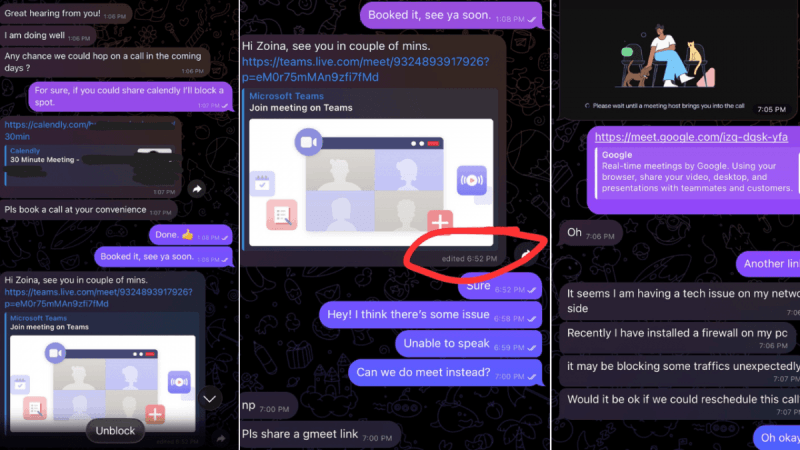
He shared a Calendly link. I booked the slot.
Everything looked normal.
The moment things started to shift
A few minutes before the scheduled call, I received a message:
“I’m already on this link, join here.”
The link looked like a Microsoft Teams meeting at a glance.
But it wasn’t.
That small moment of being told someone is already waiting created urgency. And urgency is exactly what attackers rely on.
Without overthinking, I clicked.
The illusion of legitimacy
I joined the meeting as a guest to avoid logging in.
What I saw next removed almost all remaining doubt.
The person I was supposed to meet appeared to be on the call, along with what looked like other team members.
Whether this was AI-generated, pre-recorded, or cleverly simulated, it was convincing enough to override skepticism.
At that point, the environment felt real.
And that’s where the attack becomes dangerous.
The trap: engineered confusion
There was one problem.
I couldn’t hear anything.
I checked my system. Audio was fine. The Internet was stable.
When I tried to unmute, a prompt appeared: “Download required. Update needed to enable audio.”
This is where the scam tightens.
The file presented itself as a Microsoft Teams SDK/update, something that feels routine, even expected.
This is a key part of the attack: The file is always framed as an “update” so you don’t question it.
I tried to ignore it at first.
But the pressure builds subtly:
– The “client” is already on the call
– Others appear to be waiting
– You feel like you’re the one delaying things
So I rejoined.
And this time, I clicked.
The moment everything changed
The file was downloaded.
A terminal window opened.
Code started running.
That’s the exact second it hit me.
This wasn’t a meeting.
This was an execution.
I immediately closed the terminal, disconnected the internet, stopped all activity.
Seconds. That’s all it took to realize what was happening.
The final confirmation
I went back to the chat.
The link to the malicious one had already been edited.
Replaced with a legitimate Microsoft Teams link.
That’s when it became clear:
This wasn’t random. This was deliberate, timed, and designed to leave minimal trace.
What this attack is really trying to do
This isn’t just about getting you to download a file.
The objective is much bigger:
Once that script runs, attackers can attempt to:
- Extract browser-stored wallet data (MetaMask, Phantom, etc.)
- Access saved credentials and session tokens
- Scan for seed phrases stored in files, screenshots, or notes
- Gain access to email accounts, which becomes the master key to everything
- Install persistent backdoors for later access
In crypto, access = assets.
They don’t need to “hack” your wallet.
They just need to become you.
Why is this more dangerous now?
What stood out to me is how far this has evolved.
Even experienced users can fall for this because:
- The interface looks real
- The people appear real
- The context is real
- The pressure is real
And now, with AI:
Seeing someone on screen no longer guarantees it’s actually them.
What I did after (and what you should do immediately)
If you ever suspect something like this, act fast.
Immediate steps
- Disconnect from the internet
- Close all active processes
- Restart your system
Mac users check this immediately
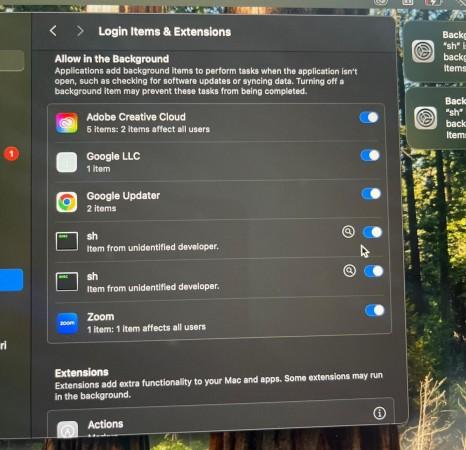
Login Items
- System Settings → General → Login Items
Launch Agents / Daemons
- Check folders:
- /Library/LaunchAgents/
- /Library/LaunchDaemons/
- /Library/LaunchAgents/
Look for:
- Unknown .sh files
- Suspicious scripts
- Recently added entries
Browser checks (CRITICAL)
Go to:
- Chrome → Settings → Extensions
Look for:
- Unknown extensions
- Anything recently added
Disable immediately
Remove anything suspicious
Windows users check this
Startup Programs: Task Manager → Startup tab
Installed Programs: Control Panel → Programs
Background Processes: Task Manager → Processes
Look for unknown scripts, apps, command-line processes.
Critical precautions
- Do NOT access crypto wallets from the same device immediately
- Do NOT enter passwords anywhere until system is verified safe
- Move funds if you suspect compromise
- If unsure → format and reinstall OS
The biggest mistakes (and how to avoid them)
1. Trusting the source blindly
Even if it’s a known contact:
- Accounts get compromised
- Identities get spoofed
2. Not verifying links
That link looked like Teams. It wasn’t.
Always check domains carefully
Never trust look-alike URLs.
3. Letting urgency override judgment
“They’re already waiting.”
That’s not pressure. That’s the attack.
4. Believing what you see on screen
A real face ≠ a real person anymore.
5. Storing crypto on active work devices
- Browser wallets are high-risk
- Use separate devices for storage vs communication
6. Entering credentials into unknown environments
Never enter credentials inside any meeting link or external page.
If someone shares a link:
- Do not enter your email or password
- Do not approve wallet prompts
- Do not input seed phrases
Even if it looks like a legitimate login screen, assume it can be fake.
7. Accepting alternate links mid-conversation
This is a major red flag:
If someone sends a different link right before a call, stop.
Final thought
I didn’t lose funds, but I was seconds away from something far more damaging, and that is the real takeaway. Attacks like these are not purely technical in nature; they are designed to exploit human behavior under pressure, using urgency, familiarity, and trust to bypass rational judgment in critical moments.
While scams involving fake meeting links and malicious downloads have existed for years, what is changing rapidly is the level of sophistication behind them. The integration of AI from impersonated identities to highly convincing meeting environments has made these attacks significantly harder to detect, even for experienced users and crypto professionals.
The tools are evolving, the execution is becoming more precise, and the margin for error is shrinking. What once required suspicion can now appear completely routine, embedded within otherwise legitimate conversations.
If this could happen in a familiar interaction, with context and trust already established, it serves as a clear reminder that no one operating in the crypto space is immune.
(International Business Times, India, has verified the claims and screenshots to be authentic. The sourced screenshots haven’t been manipulated in any way.)

Comments are closed.