
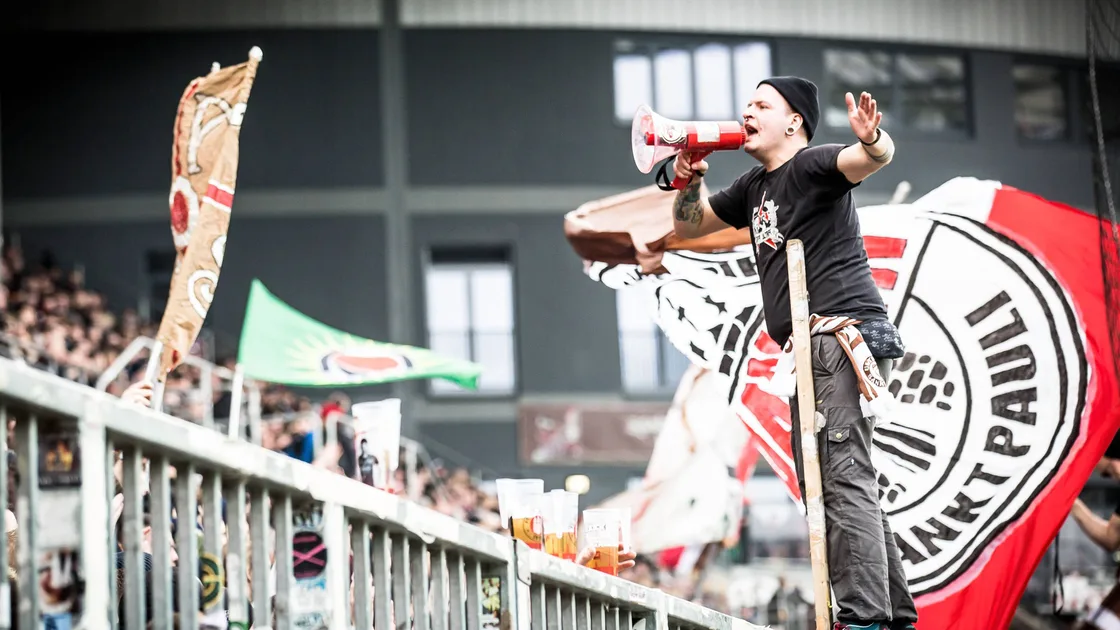

From St. Pauli’s currywurst train to Union Berlin’s annual Christmas carol sing-a-long, German football has a number of Kultvereine — ‘cult clubs’ — who do things just a bit differently to everyone else.
There is no clear-cut definition of a ‘cult club’, just as there isn’t a hard-and-fast definition of a ‘big club.’ But fundamental factors that come into play are what a club does off the pitch as much as on it, while their fans – and the relationship the club has with them – also play a significant role.
We take a closer look at some of German football’s leading cult classics.
St. Pauli
THE cult club of German football – arguably world football – saw the light of day in 1907 in Hamburg, and has spent most of its history overshadowed by neighbours HSV.
But when 1980s Hamburg saw the development of a left-wing alternative culture in the city, St. Pauli – based in Kiez near the city’s Reeperbahn red-light district – became the team associated with it.
The pirate flag that has become the club’s semi-official badge was first flown at games at the time after being brought to the stadium by a man known as ‘Doc Mabuse’, who was living in a punk commune with 40 other squatters.
That perfectly encapsulates the rebellious spirit that still reigns at St. Pauli, where vocal pro-environment and LGBTQ stances as well as initiatives combatting racism – among other issues – have long been weaved into the fabric of the club.
Watch: St. Pauli city and stadium tour
They also have a self-deprecating sense of humour. In 2002, when Pauli defeated a Bayern Munich side that had just two months earlier won the FIFA Club World Cup, having picked up the UEFA Champions League the previous season, it was clearly a momentous occasion.
“We could hardly believe it,” said defender Holger Stanislawski, who would go on to coach the club some years later. “There are so few moments in the life of an athlete that stick with you. That’s a game that sticks for a St. Paulianer.”
You could say that. All these years later, you can still buy a T-shirt from the club shop with the ironic slogan ‘Weltpokalsiegerbesieger’ emblazoned on it, a Scrabble treble-word score of a German compound noun that means something like ‘Defeaters of the Club World Cup winners’. It sounds better in German…
Oh yeah, and they have a small train that delivers currywurst – sausage in curry sauce, German football’s traditional matchday meal – to fans. Not even joking.
Union Berlin
Union are a relative baby in German football terms, founded in 1966, though the club’s origins are in its predecessor, FC Olympia Oberschöneweide, founded 60 years earlier.
Their Iron Union (Iron Union) nickname comes from the blue strips they previously wore that were reminiscent of the overalls donned by local workers in the Köpenick district of Berlin, something that played well with the East German Communist authorities in power at the time of the club’s founding.
However, though part of the DDR’s football system, the club’s fierce rivalry with BFC Dynamo – the club of the regime’s feared secret police, the Stasi – made them an unofficial symbol of the opposition as Union became the most popular club among East Berlin’s working classes.
Reports suggest fans frequently and cheekily chanted, ‘The wall must go!’ when opposing teams lined up to defend an Union free-kick, with obvious allusions to the Berlin Wall that divided the German capital until 1989.
Watch: Union Berlin city and stadium tour
The club’s Stadion An der Alten Försterei is a legend in itself. The intriguing name – the Stadium at the Old Forester’s House – has something of a Hansel & Gretel ring to it, and though it has been radicaly revamped in line with the club’s progress, it has retained its charm thanks to the fans.
Some 30,000 people, including players, turn up for the annual Christmas carol singing, the Union Christmas singingin which traditional songs are mixed with football chants, while during the 2014 FIFA World Cup, Union created the WM living room – the World Cup Living Room – when they invited fans to bring their own sofas to the stadium to watch games from the tournament in Brazil.
Over 800 sofas were placed on the pitch in front of a big screen as Germany were crowned world champions for a fourth time.
Kaiserslautern
One of Germany’s oldest clubs, founded in 1900, Lautern are also a legendary name of the German game and one of the best supported teams in the country.
A founding member of the Bundesliga in 1963/64, they carved out a place in German football history after winning their second Bundesliga title, as a newly promoted team no less, in 1997/98. Head coach Otto Rehhagel sensationally guided Greece to European Championship glory in 2004, but his achievement with the Red Devils six years earlier was arguably even more miraculous.
Despite many ups and downs, the club’s fame stretches far beyond German borders, holding a special place in particular among many American military familes after Kaiserslautern – or “K-town”, as it became known due to difficulties pronouncing the full name – developed into the US’s largest military community overseas during the 1950s, bearing witness to one of Lautern’s greatest footballing sons – the iconic Fritz Walter.
Watch: Kaiserslautern’s fairytale 1997/98 title win
Walter played his entire career with the Red Devils, and was captain of the Germany side that pulled off the ‘Miracle of Berne’ to win the 1954 FIFA World Cup against a Hungary team, starring Ferenc Puskas, that had been overwhelming favourites to lift the trophy.
Kaiserslautern’s home ground was named after Walter in 1985, and a memorial to him and the four other Lautern players who featured in that 1954 final stands outside the stadium, while in 2005, the DFB established the annual Fritz Walter Medals for the top three U19, U18, U17 and women’s players in the country.
Tasmania Berlin
Some clubs achieve cult status thanks to their results. Normally, though, the results in question are of a positive nature. Tasmania Berlin are the stunning exception to the rule.
The club is a classic: they’ve been around for more than a century, but in all that time, they’ve played just once in the top flight, in 1965/66. What a memorable season they made it, only for all the wrong reasons.
Handed a Bundesliga spot just days before the season’s start due to financial irregularities at other clubs, and the desire of the football authorities to have a West Berlin club in the Bundesliga at the height of the Cold War, Tasmania had to drag their squad – packed with players used to the German capital’s local leagues – off the beach. Maybe they should have stayed there.
Where to start? Fewest goals scored (15), most conceded (108), fewest wins (2), most defeats (28), biggest home defeat (9-0 vs. Duisburg) and, of course, fewest points (10) are all records Tasmania can still boast, just not proudly.
Incredibly, the season had started with a win: 2-0 against Karlsruhe in front of 81,000 at Berlin’s Olympiastadion, their own home ground not even having floodlights. By January, they were playing Borussia Mönchengladbach in front of a still record-low crowd of 827.
That opening day triumph was their only victory until they defeated Borussia Neunkirchen on the penultimate day of the season, 32 games and 27 defeats later.
The club’s unusual name stems from the founders’ mutual ambition to emigrate to the island off mainland Australia. If they lived long enough to see the 1965/66 season, they will have been delighted they got that far away.
Altona 93
There must be something about the water in Hamburg that makes special football clubs.
Not as well known as their neighbours, Altona – or Altonaer Fussball- und Cricketclub to give it its full name – can boast of being the city’s oldest, founded in 1893. Though ‘Cricket’ was soon dropped from the name, the gymnasts and young businessmen who set up the club played a central role in establishing football as an organised sport in Germany.
AFC, as it’s known, was one of 86 clubs that gathered in Leipzig on 28 January 1900 to form the German Football Assocation (DFB), which – four years later – was led by one of their players and founding members, Franz Behr, the DFB’s second president.
Their glory days came with five pre-Bundesliga German titles between 1898 and 1903, but although their first team has since dropped down the divisions, they still hold a prominent place in German football thanks to their 87 teams across men’s, women’s and youth football – among the most in the country.
BFC Germania 88
What do you mean you have never heard of Berliner Fussball-Club Germania? They’re only Germany’s oldest existing football club founded in 1888 – why would you have heard of them?
OK, they have never played in the Bundesliga, but they were the (albeit unofficial) first champions of Germany in 1891, while one of their players, Fritz Baumgarten, played goalkeeper in Germany’s first official international game: a 5-3 defeat to Switzerland in Basel on 5 April 1908.
Founded by four brothers, led by 17-year-old Paul Jestram, BFC Germania did not even have their own pitch and instead used the nearby Tempelhofer Feld, on which Berlin’s Tempelhof airport was later built.

Comments are closed.