

Recently, while sitting behind her husband on a motorbike and checking a map to guide him to a meeting, she confidently told him to “turn right” at a three-way intersection though the screen indicated a left turn.
The mistake forced the couple to drive an extra five kilometers and arrive 20 minutes late. On the way home she endured his complaints the entire trip, Huong said.
Since childhood, Huong has often been the target of teasing for classmates. During physical education class, when the class leader would shout “turn left,” she alone would turn right. Through 18 years of school, the nickname “Huong the directionless” stuck with her.
She once tried wearing a ring on her right hand as a reminder, but whenever she forgot to wear it she would again become confused.
“Now I don’t give directions verbally, I just tap lightly on the driver’s shoulder to signal,” she says.
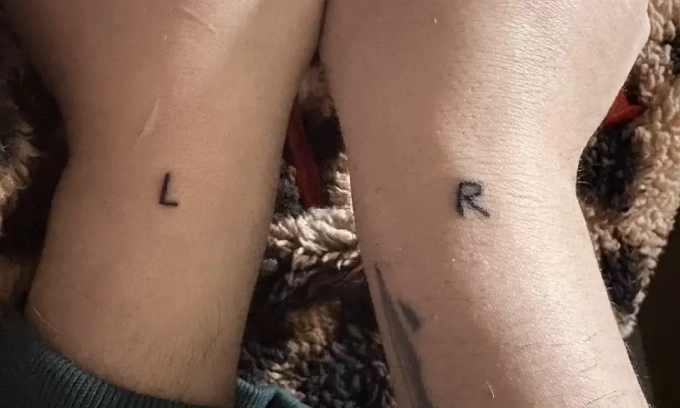
A X user show their tattoos on their left and right wrists to differentiate directions in a photo shared in February 2026. Photo from X/bearbubb |
Neuroscience refers to her condition as Left-Right Confusion (LRC). People with LRC can read maps and indicate directions through gestures, but struggle to quickly verbalize “left” and “right” or to process spoken directional instructions.
Quoc Tuan, 29, of Hung Yen Province has faced similar struggles, and friends call him a “broken compass.” Once while in school he asked his parents to buy him a watch to wear on his left wrist to help reduce the confusion.
But his most embarrassing memory is from a university military training program. When the instructor shouted “Turn right!”, Tuan turned left and accidentally struck the soldier behind him with his rifle. He repeated the mistake four or five times, causing the entire platoon to be punished with laps around the yard.
At his wedding in late 2024, when the MC invited him to place the ring on his bride’s right hand, Tuan grabbed her left hand instead. After being reminded, he panicked and nearly put the ring on his own left hand, prompting laughter from guests.
When he took a driving test in June 2025, the instructor told him to turn left at an intersection, but Tuan turned right instead.
“Nearly 30 years into my life I still feel like a malfunctioning machine that can’t distinguish between these two basic directions,” he laments.
Dr. Doan Van Phuc, deputy director of Duc Giang General Hospital in Hanoi and former head of its neurology department, says while there have been no major studies on LRC in Vietnam, globally it is estimated that 15-18% of the world’s population has the condition.
The problem occurs when the parietal lobe, a region near the top of the brain responsible for processing bodily sensations and spatial awareness, suffers damage.
“This is the core reason why some people lose the ability to distinguish left from right,” Phuc says.
Neurology experts say it could be due to either a congenital abnormality or trauma from an accident. People with the condition typically live with it for life.
But many people occasionally mix up directions even without brain damage, often due to psychological stress or mental overload.
“Stress-related cognitive confusion is temporary and usually disappears once a person’s mental state stabilizes,” Phuc says.
Professor Ineke van der Ham of Leiden University in the Netherlands once explained that people rarely confuse up and down, but distinguishing left from right is harder because the two sides are spatially symmetrical. Her 2020 research found that about 15% of people rate their own ability to tell left from right as poor.
A 2016 study by Professor Gerard Gormley and others, published in the Canadian Medical Association Journal and based on a survey of 800 adults, found that 17% of women and 9% of men struggle with the issue. According to the researchers, determining direction requires coordinated interaction between memory, language processing and visual-spatial reasoning.
Many people with LRC develop personal strategies to cope, a survey by Read finds. Some identify their hands by moles or scars. Others use a simple but ingenious trick: holding up the thumb and index finger on both hands, with the hand forming the letter “L” indicating the left side.
Some consistently wear a ring or watch on one hand to help them remember.
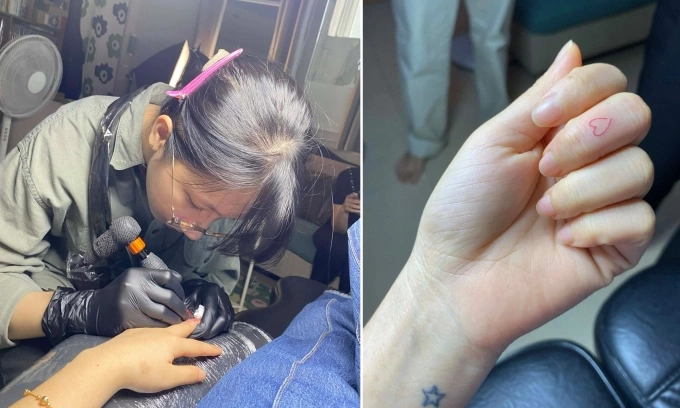 |
Truc An, from Ho Chi Minh City, has a tattooist marking her left wrist and middle finger to help distinguish directions. Photo courtesy of An |
But for 28-year-old Truc An in Ho Chi Minh City, these are not always practical and has chosen a permanent solution: tattoos on her left hand of a heart on the middle finger and a star on the wrist.
“When I’m typing, I see the heart on my finger and know that’s my left hand,” she explains. “When I’m driving and turn my palm upward, the star on my wrist helps me orient myself.”
Since getting the tattoos, life has become “much easier,” she says.
Saying this is a real difficulty, Gormley hopes the public will have greater understanding of people with LRC, allowing them enough time to double-check their decisions.
Comments are closed.