

The 2025 World Air Quality Report, released last week, found that the vast majority of Asian cities exceeded the WHO’s recommended annual average PM2.5 level of 5 micrograms per cubic meter.
Only three cities met the standard, and all are located in Central Asia.
Leading the list is Zhezqazghan in Kazakhstan, with an annual average PM2.5 concentration of 2.8 μg/cu.m. It is followed by Kokshetau, also in Kazakhstan, at 3 μg/cu.m, and Kuyulusebil in Turkey, at 4.2 μg/cu.m.
The findings are notable given Japan’s reputation for environmental quality.
While no Japanese city met the WHO guideline, the country accounted for the majority of Asia cities in the relatively low pollution range of 5.1-10 μg/cu.m.
Of the 552 Asian cities in this category globally, 487 are in Japan.
The report analyzes PM2.5 data from 9,446 cities across 143 countries, regions, and territories, offering a comprehensive snapshot of global air quality in 2025.
Asia leads global pollution rankings
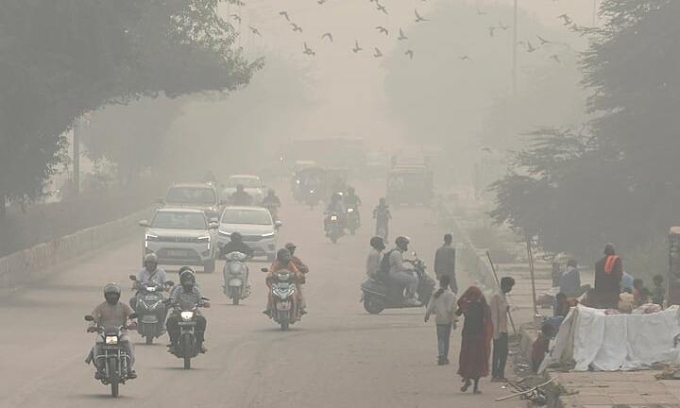
People and vehicles are seen on a road amidst the morning smog in New Delhi, India, Nov. 8, 2023. |
While nine of the top 10 cleaneast cities are in Asia, the continent also has many of the world’s most polluted cities.
The most polluted city in 2025 was Loni in India, with an average PM2.5 concentration of 112.5 μg/cu.m. It was followed by two other cities in India: Hotan (109.6) and Byrnihat (101.1).
According to the report, rapid urbanization, heavy traffic, coal consumption, and industrial activity remain key drivers of air pollution across the region.
Globally, only 13 countries and territories met the WHO’s safe air quality standards in 2025. The highest pollution levels were concentrated in South Asia and parts of Africa, while most of the world failed to meet the recommended limits.
The IQAir dataset draws on more than 40,000 regulatory monitoring stations and low-cost sensors operated by government agencies, universities, non-profit organizations, private companies, and citizen scientists worldwide.
At the city level, just 14% met safe air standards, down from 17% a year earlier.
Comments are closed.