
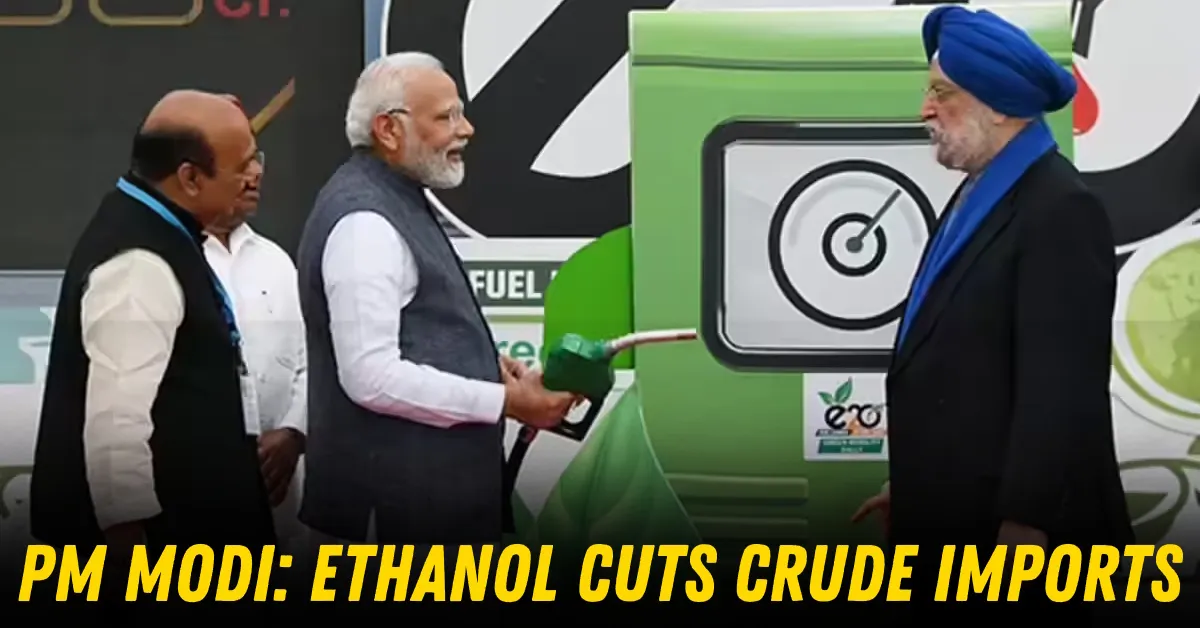

Prime Minister Narendra Modi, speaking at the inauguration of Noida International Airport in Jewar, made the most direct public statement yet linking the West Asia energy crisis to the domestic ethanol blending programme.
The context was not coincidental. Jewar sits at the edge of western Uttar Pradesh’s sugarcane belt, the single largest feedstock source for the country’s ethanol supply, and the PM’s remarks were a pointed acknowledgment that decisions made in agricultural fields are now directly shaping fuel security at a national level.
The core numbers he cited are significant. If the blending programme had not been in place, the country would have needed to import an additional 4.5 crore barrels of crude oil every year, equivalent to 700 crore litres of additional foreign exchange outflows.
Across the programme’s duration, the cumulative foreign exchange savings have reached approximately Rs 1.5 lakh crore. In the current environment, where crude is above $112 per barrel and global supply is under pressure from the Strait of Hormuz crisis, those avoided imports translate directly into reduced strain on the rupee and the current account.
In Parliament recently, the PM had highlighted that ethanol blending was at a negligible 1 to 1.5 percent just a decade ago. By 2025, the country achieved its E20 target ahead of schedule, reaching 20 percent ethanol content in petrol across the network. That acceleration required a rapid scale-up of domestic distillery capacity. The country’s ethanol sector now has a cumulative production capacity of around 2,000 crore litres annually, of which over 1,000 crore litres is actively used for petrol blending.
The All India Distillers’ Association has since offered to supply blends exceeding 20 percent, anticipating that the government will push toward E25 as the next target. Separately, discussions on moving to E25 at retail pumps are already underway with automobile manufacturers, though carmakers have flagged concerns around engine compatibility and emission testing compliance under the current BS6 Phase 2 framework.
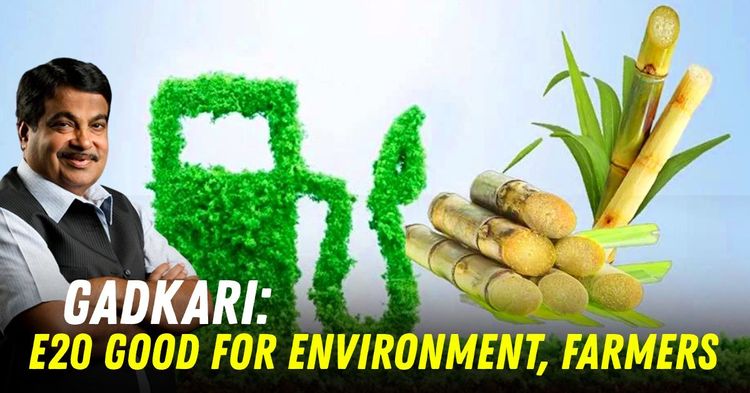
The PM specifically credited farmers for the programme’s success. Sugarcane growers in states like Uttar Pradesh, Maharashtra, and Karnataka supply the raw material that feeds the distilleries.
The blending programme has created a consistent, government backed procurement channel for this produce that did not exist at scale a decade ago. Farmers are now essentially supplying fuel to a country navigating a global energy crisis, which gives the programme a rural income dimension that goes well beyond fuel pricing.
Railways have contributed too. Electrification of rail networks has saved approximately 180 crore litres of diesel annually; another piece of the wider energy diversification push that has reduced dependence on imported crude across multiple sectors simultaneously.
For vehicle owners, the E20 rollout has had mixed reception. Several users have reported marginal drops in fuel economy, and concerns about compatibility with older vehicles remain. The government maintains that the programme is managed within safety parameters. What the current global crisis has done is given the programme’s economic rationale a visibility it did not have when crude was stable and imports were routine.
Comments are closed.