
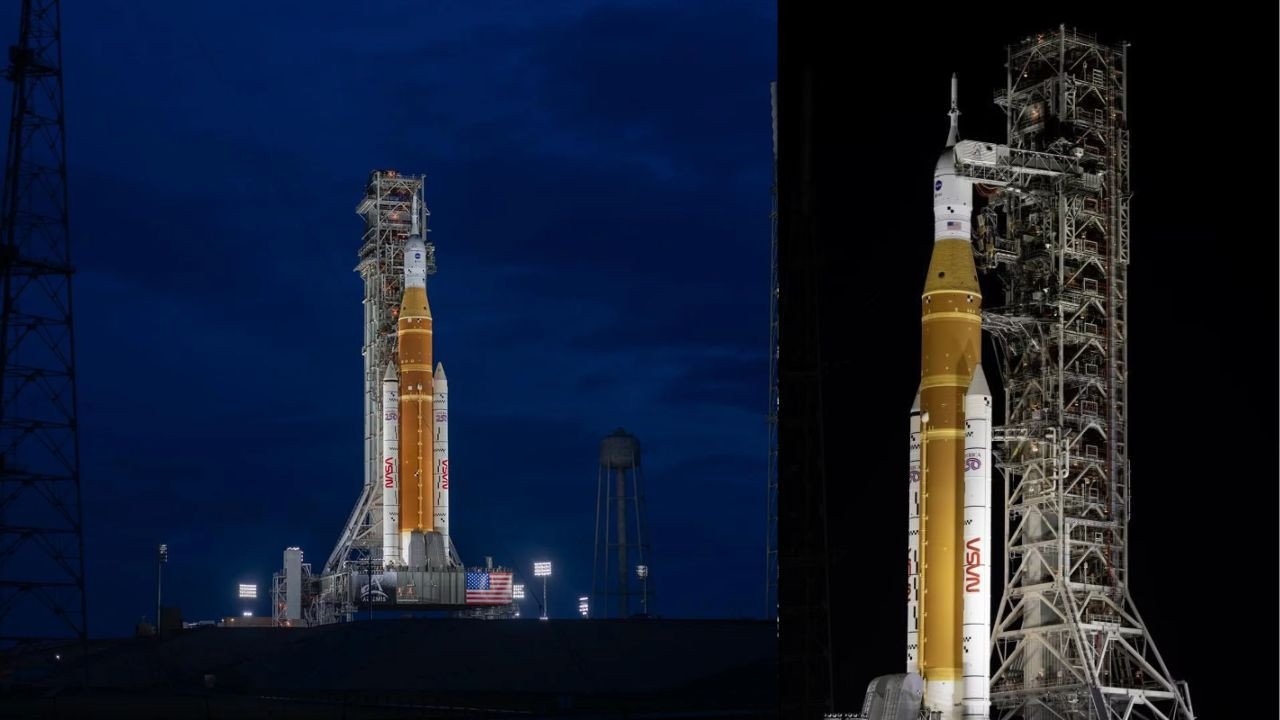
Artemis-II Mission: NASA’s historic return to the Moon after 50 years, four astronauts leave

New Delhi:After a long gap of more than five decades, humans have once again stepped towards the Moon. Four astronauts took off on Thursday morning, marking the return of human missions to deep space.
NASA’s Orion spacecraft successfully launched from the Kennedy Space Center in Florida aboard a Space Launch System (SLS) rocket. The Artemis-II mission is NASA’s first manned lunar mission in 50 years, ushering in a new era of space exploration.
Grand Launch: Mission Begins
The SLS, which is counted among the most powerful rockets ever, took off at 4:04 am Indian time. The four astronauts aboard the Orion capsule safely headed towards space.
About eight minutes after launch, the Orion capsule separated from the rocket and reached its intended orbit.
Planning and preparations for the first day
After launch, the astronauts will remain in Earth’s orbit on the first day of the mission. During this time they will examine the major systems of the spacecraft such as propulsion, navigation and life-support systems.
Engineers and the mission control team will ensure that all systems are working smoothly, so that the journey towards the moon can be made safely. During this time, an important perigee-raising burn will also be done, so that the direction and speed of the spacecraft can be controlled.
Astronauts’ daily routine
Inside the spacecraft, the astronauts remove their launch suits and change into normal clothes and arrange the necessary facilities. This includes water supply, toilets, carbon dioxide control and safety equipment.
They make the cabin conducive for living and working, as well as prepare sleeping arrangements. Due to limited space, the crew will rest in two different shifts.
process of reaching the moon
Artemis-II is likely to reach the Moon about four days after launch. This spacecraft will adopt a special path, which will be like the shape of 8 in space.
After the Trans-Lunar Injection (TLI) burn on the second day, Orion will exit Earth’s orbit and move towards the Moon. During this time the crew will continuously monitor the spacecraft’s systems and collect necessary data.
withdrawal plan
Upon reaching the Moon, Orion will not enter its orbit, but will instead perform a flyby using its gravity and then return to Earth.
During this time, the spacecraft will also make small corrections to keep its path accurate.
Diverse team creates history
The Artemis-II mission is not only a technological achievement but also a symbol of social change. For the first time, this mission includes a woman, a black man and a Canadian astronaut.
Christina Koch will become the first woman to travel to the Moon. Victor Glover is the first black astronaut involved in this mission. Canada’s Jeremy Hansen is the first astronaut from outside NASA to be part of this mission.
The command of the mission is in the hands of Reed Wiseman, who is leading this historic team with his experience.
Why is Artemis-II mission special?
This mission is the first manned lunar mission since 1972 and is considered very important for NASA’s future plans. Its success will determine the direction of future Artemis missions and the journey to Mars.
This mission will take astronauts out of low Earth orbit into deep space, where they will have to face challenges such as radiation, long separation and communication delays.
It is important for NASA that all systems of the Orion spacecraft work properly in these conditions, so that safe lunar landings are possible in the future.

Comments are closed.