
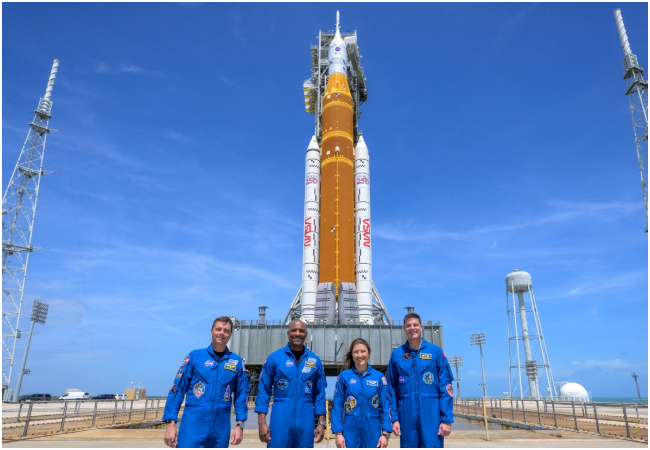
NASA astronauts will now be able to take moon selfies from iPhone, Artemis II mission launched from Kennedy Space Center in Florida today

New Delhi. NASA’s Artemis II mission was launched from Kennedy Space Center in Florida at 3:58 am today. This mission is the first mission to take humans to the Moon since Apollo 17 in 1972. The objective of this mission is not just to fly, but to open the way for permanent human presence on the Moon in the future and human travel to distant planets like Mars.
Read:- Sunita Williams: Indian-origin astronaut Sunita Williams holds these records, retired
Four astronauts are involved in this mission. Three Americans and one Canadian will orbit the Moon in the Orion capsule and then return safely. The mission duration is 10 days, in which the astronauts will spend almost an entire day in the lunar orbit.
Personal smartphone in space for the first time
A major change that makes this mission more special is that NASA has allowed its astronauts to carry personal smartphones for the first time. This will enable them to capture unique photos and videos for their family and the world. According to NASA Administrator Jared Isaacman, its purpose is to enable astronauts to share their experiences and inspiring moments by providing modern equipment.
Astronauts of the mission and their story:
Read:- NASA astronaut Sunita Williams retired, was part of 3 missions and spent 608 days in space.
Reed Wiseman (Commander) – NASA astronaut, US Navy aviator and test pilot. This is his second space flight.
Victor Glover (Pilot) – This mission would give him the distinction of becoming the first black pilot to the Moon.
Christina Koch (Expert) – NASA engineer and scientist, who holds the record for space flight for 328 days. She has been a part of the first female space walk.
Jeremy Hansen (Expert, Canada) – Fighter pilot for the Royal Canadian Air Force and this is his first space flight.
Artemis II mission objective
Creating a permanent human presence on the Moon.
Making future human missions to Mars possible.
Monitoring space weather outside Earth and the Sun’s activities, such as solar flares and coronal mass ejections.
Mission Timeline
Day 1: Taking the vehicle out of orbit.
Next 3–4 days: Journey to the moon.
One day: orbiting the moon.
Last 4 days: Return to Earth.
This mission of NASA is not just a technical achievement, but a symbol of human curiosity and courage. The photos and videos coming during this mission will not only be important from scientific point of view, but will also inspire millions of people in the world.
Report: Kaushiki Gupta
Comments are closed.