
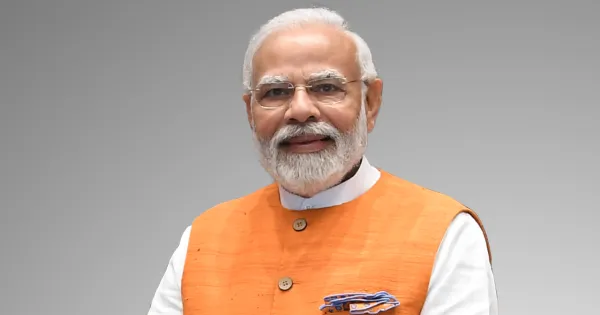

New Delhi. Prime Minister Narendra Modi on Thursday stressed the need to continuously update the governance system with the rapidly changing times to ease the lives of citizens. He said that the basic mantra of the country’s administration today is ‘Nagrik Devo Bhava’ and the public service is being reorganized to make it more efficient and sensitive to the needs of the citizens.
“Governance is now being given a new identity by making it truly citizen-centric,” PM Modi said in a video message at the launch of the ‘Sadhana Week’ programme. The Prime Minister said governance should be the benchmark to improve the ease and quality of life of citizens and urged public servants to learn something new every day.
He said, “Our governance system should ensure that the quality of life of citizens improves day by day. This is our true standard.” Emphasizing the need for a fundamental change in the administrative culture, Prime Minister Modi said that in the old system, there was too much emphasis on being an ‘officer’, whereas today the country’s focus is completely on the sense of duty. Addressing the public servants, he said, “If before every decision you think about what your duty demands, then the impact of your decisions will increase manifold.”
The Prime Minister said that India is moving forward rapidly amidst rapidly changing global systems and it will have to continuously update its governance system. Reminding civil servants that for the common citizen, the local government office is the face of the entire governance, Modi said the working style and behavior of the officials directly affects the public’s faith in democracy and constitutional institutions.
He said, “Whatever we do, at whatever level we do it, we must protect that trust; This is the foundation of our democracy.” Referring to India’s federal system, Modi said that the country’s success is the collective success of all its states. He also stressed the need to eliminate outdated categories like “leading states”, “backward states” and “sick states” and called for bridging the gap between states through coordinated efforts.
PM Modi said, “We have to break silos and move forward with better coordination, shared understanding and a holistic government approach; only then will every mission be successful.” PM Modi linked the need for rapid economic growth, modern infrastructure, use of technology and a large skilled workforce to the broader goal of ‘Developed India’ and said that public institutions and civil servants have an important role in achieving these objectives.
He said, “Today’s India is full of aspirations. Every citizen has his own dreams and goals, and it is the responsibility of all of us to provide maximum support to fulfill them.” The Prime Minister inspired civil servants to see their current work in the broader context of the future and challenged them to think about how their individual decisions can impact the lives of millions of people.
He said, “What impact will the work we (public servants) are doing on the country’s development journey?” How many citizens’ lives can our one decision change? How can our personal change become institutional change? Let these questions guide our every effort. I can say from experience that it takes a lot of energy to achieve this.”
Emphasizing the importance of technology, Modi said that in the last 11 years, there has been widespread integration of technology in the functioning of the government, which has impacted governance, service delivery and the economy. He said that these changes will accelerate with the advent of artificial intelligence (AI).
Modi said, “A better administrator and a better public servant will be one who has a deep understanding of technology and data; This will form the basis of the decision making process.” SADHANA (Strengthening Adaptive Development and Human Capabilities for National Advancement) week is being organized by the Capacity Development Commission (CBC) from April 2 to 8. The week is one of the largest collaborative capacity building efforts in the civil services ecosystem of India.
Reflecting on the background of the establishment of the Commission, Prime Minister Modi said that since independence, many institutions were working in different fields, but a clear need was felt for a dedicated institution to enhance the capacity of every government employee. “This thinking gave birth to the Capacity Development Commission, which focuses on empowering every ‘Karmayogi’ in the system,” he said.
The Commission outlines, sets standards and encourages collaboration to make governance more transparent, accountable, citizen-centric and future-ready. It is the custodian of the Mission Karmayogi framework to advance civil service reforms through capacity development and competency-based education.

Comments are closed.