
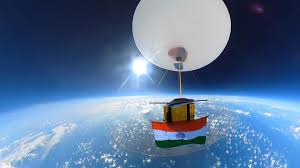
India’s lead in the space race, NASA now flies, but ISRO has already planted the flag on the South Pole.

News India Live, Digital Desk: The competition to know the unsolved mysteries of the universe has now become even more interesting. For the first time since 1972, the ‘SLS’ rocket of the American space agency NASA has left for the Moon today on April 2, 2026, carrying four astronauts. But on this historic day, the eyes of the whole world are fixed on NASA as well as India. In fact, in the orbit of the mysterious ‘South Pole’ (South Pole) towards which NASA has now taken its steps, ‘Chandrayaan-3’ of the Indian Space Research Organization (ISRO) has already hoisted the tricolor and proved India’s technological prowess. ISRO’s historic feat at the South Pole is recorded in the golden pages of history on 23 August 2023, when ISRO’s Chandrayaan-3 reached the most inaccessible and coldest area of the Moon. He surprised the whole world by successfully landing his rover on the South Pole. This was not just the success of a space mission, but it was a story of India’s indomitable willpower and digital revolution amidst limited resources, which forced even the developed countries to recognize India’s iron. The wonderful journey had started with a bicycle and a bullock cart. In today’s era, even though we talk about 5G internet and supercomputers, India’s space program had taken shape decades before the advent of the internet. You will be surprised to know that ISRO did not have any advanced lab in the 1960s. The rocket components were assembled in a small room of a church and our scientists even used bicycles and bullock carts to transport them to the launch pad. Despite the absence of internet, scientists were carrying out successful tests on the basis of heavy manual calculations and their own intelligence. Even before the advent of internet, India had created history. Internet for the common people in the country was started on 15 August 1995 through Videsh Sanchar Nigam Limited (VSNL). But even before entering this digital era, India had already established its dominance in space. In 1975, India launched its first satellite ‘Aryabhata’ and in 1980 became the sixth most powerful country in the world by sending a satellite into space with its own rocket ‘SLV-3’. Even without internet, ISRO connected villages through ground stations and satellite networks and worked to revolutionize the fields of agriculture and education. What is NASA’s much awaited ‘Artemis 2’ mission? Talking about NASA’s ‘Artemis 2’ mission, today on April 2, 2026, in the morning, NASA’s rocket took off with a loud roar from the Kennedy Space Center in Florida. This mission is the second important phase of the Artemis program, which aims to land the first woman and man on the lunar surface by the late 2020s. After the success of Artemis 2, NASA is planning human landing on the Moon in the next phase. But ISRO’s unmatched journey in this entire space race will always remain an example and inspire the world.

Comments are closed.