
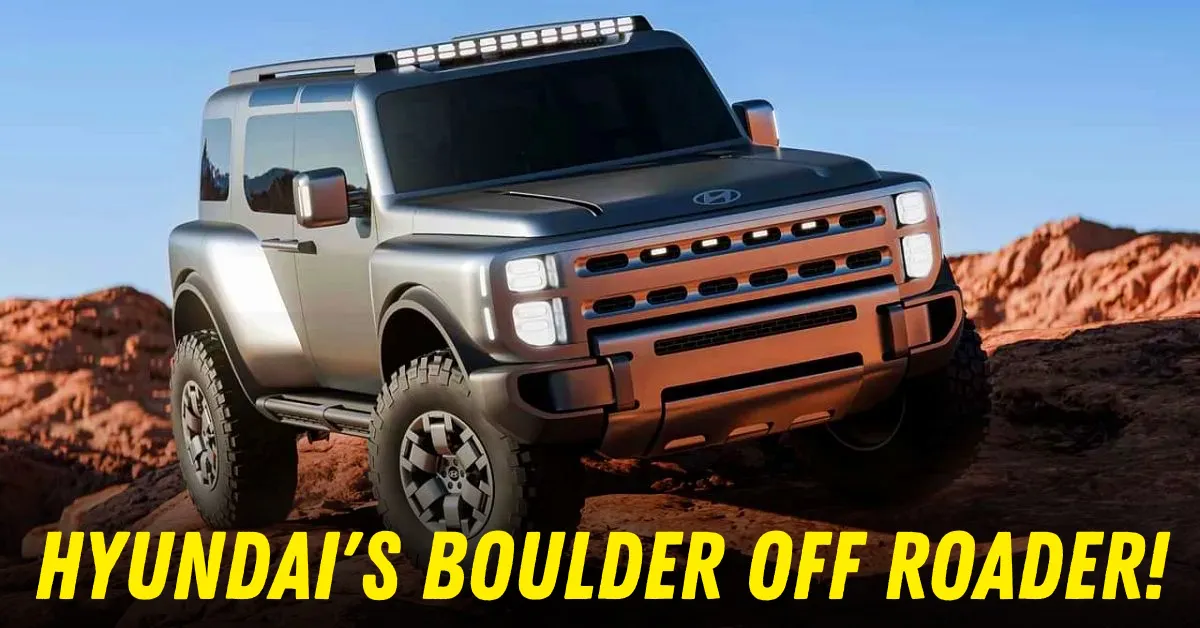

The South Korean automaker Hyundai has taken the covers off the Boulder Concept. The unveiling of this unique off-roader SUV took place at the New York International Auto Show. What makes the Boulder Concept even more interesting is that it is based on Hyundai’s first-ever body-on-frame (ladder-frame) architecture. In terms of the design, the Boulder looks extremely capable and will rival the Jeep Wrangler Rubicon, Ford Bronco, and the Land Rover Defender luxury lifestyle off-roader SUVs.
Before you become super excited, it has to be mentioned that the Boulder Concept will be primarily for the market in the United States of America. Also, it has been highlighted that it will not be launched as direct production. Rather, it previews a future pickup truck which will be making its debut by 2030. However, there is still a possibility that the company could launch an SUV based on the Boulder Concept in the future.
The recently showcased Boulder Concept is based on a fully boxed body-on-frame chassis, which is the first such platform from Hyundai. According to the company, its main advantages will be higher torsional rigidity, better towing capacity, and improved off-road durability. This platform will also underpin a midsize pickup truck by 2030 and potential future SUV derivatives.

It has been built using Hyundai-produced American steel and will support internal combustion engines, hybrid setups, and fully electric powertrains. Hyundai has designed the Boulder Concept with serious trail and off-road use in mind. The concept boasts aggressive approach, departure, and breakover angles.
Also, it will offer a very high water-wading capability and robust underbody protection. The Boulder has also been given 37-inch mud-terrain tyres, a massive ground clearance, and also includes a real-time software-driven off-road guidance system. Overall, it will be a true and thoroughbred off-roader, which will help beginner off-roaders in taking on rough challenges.

The Boulder Concept has won the hearts of all true adventure enthusiasts. In terms of design, it is based on Hyundai’s ‘Art of Steel’ design language, which emphasises strength, durability, and functional aesthetics. It boasts an overall rugged design with a boxy, upright silhouette and wide, muscular proportions.
At the front, the Boulder Concept boasts a tall, upright fascia, a ridged muscular bonnet, and two rows of pill-shaped DRLs. These DRLs form ‘H’ in Morse code, and the SUV also gets vertically stacked LED headlights. Other design details include an off-road bumper with tow hooks and very rugged claddings.
As for the side, the Boulder Concept offers wide front and rear fenders, sharp window lines, suicide doors, functional side steps, and large 18-inch alloy wheels wrapped with 37-inch all-terrain tyres. Other notable highlights include a very high ground clearance, a roof rack with steel webbing, integrated LED lighting, and dual safari-style roof windows.
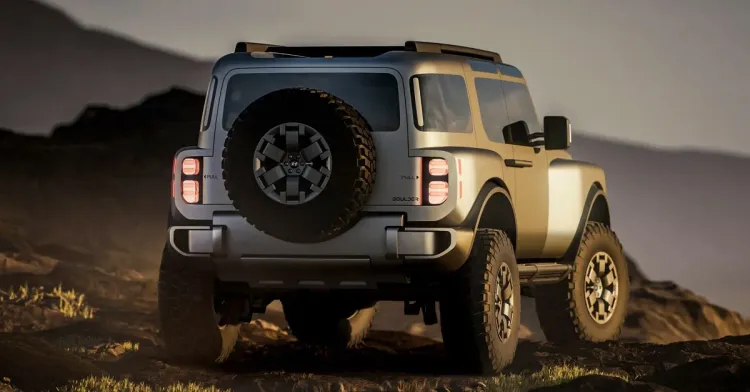
The rear-end design of this rugged off-roader features a double-hinged tailgate which can be opened from both sides, a tailgate-mounted full-size spare wheel, and a power drop-down rear windshield. All of these elements will help in carrying long items and improving airflow during trails. The Boulder Concept showcased was finished in a Liquid Titanium shade.

Coming to the interior of the Hyundai Boulder Concept, the concept has been showcased with a rugged yet practical cabin with a beige and black dual-tone layout. This SUV’s cabin focuses more on durability over luxury. Its highlights include a three-spoke flat-bottom steering wheel, rotary knobs for off-road modes, multiple physical buttons, and tactile controls.

The concept was also equipped with a full-width head-up display (HUD), which projects info across the windshield base, and four individual screens on the dashboard to show off-road data, navigation, media, and vehicle controls, avoiding a single large touchscreen approach. It also gets a real-time off-road guidance system, which will act as a digital co-driver, trail spotter, and enhance navigation.

Hyundai has not revealed any information about the powertrain options for the Boulder Concept and the vehicles that will be based on this ladder-frame architecture.
However, it has announced that the platform will be able to accommodate petrol and diesel options along with hybrid systems, and there will also be fully electric variants. The focus will mainly be on torque-heavy performance, towing capability, and off-road endurance.
Comments are closed.