
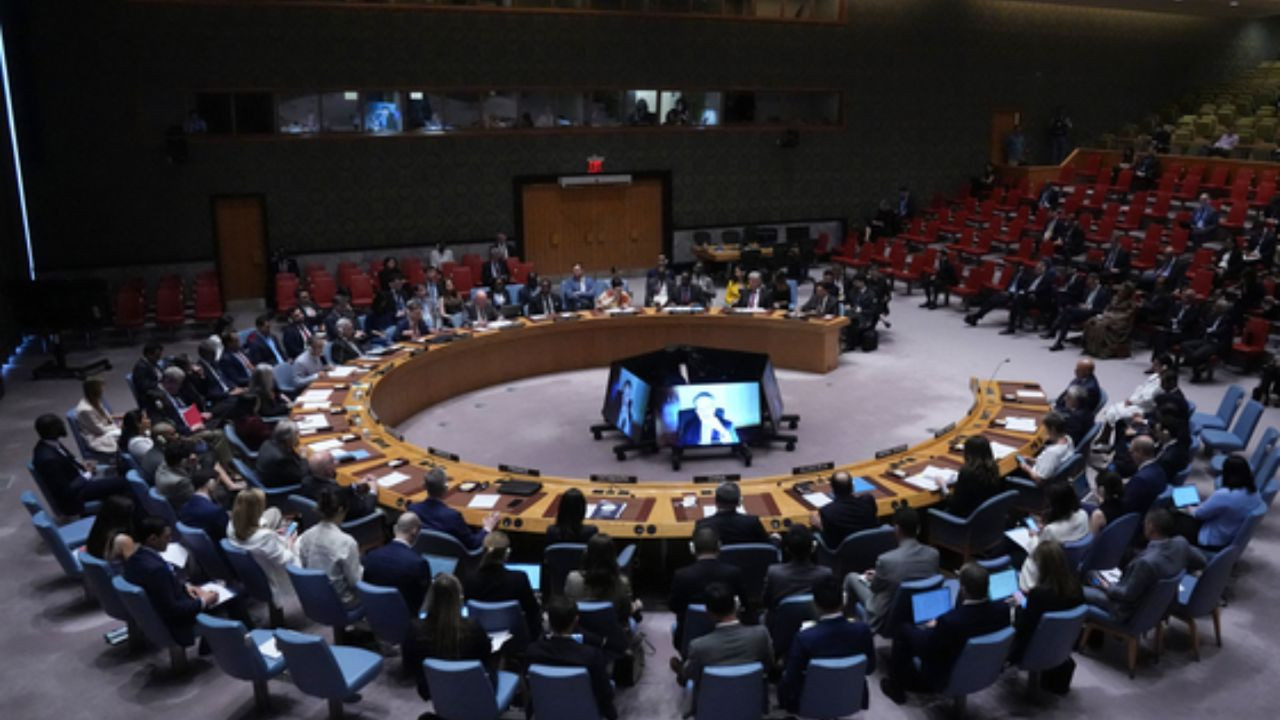
Proposal for military action on Strait of Hormuz stuck, Russia-China-France vetoed in UNSC

New Delhi: Amidst the ongoing conflict in the Middle East, an important resolution in the United Nations Security Council (UNSC) has suffered a major setback. In the UN Security Council, Russia, China and France vetoed the resolution which sought permission for military action to open the Strait of Hormuz.
This proposal had the support of Bahrain and other Gulf countries, but due to opposition from the countries having veto power, it has been put on hold for the time being. This development has sparked a new debate regarding global diplomacy and energy security.
Bahrain’s proposal did not get approval
According to officials, this proposal was prepared by Bahrain in collaboration with its Gulf allies. It called for allowing member countries and multinational naval forces to use “all necessary means” to protect sea lanes.
However, Russia, China and France made it clear that they are not in favor of any proposal allowing the use of military force.
Disagreements in UNSC, eye on voting
There is a possibility of voting on this proposal on Friday, but it seems difficult to reach a consensus at the diplomatic level.
It is being told that along with the permanent members of the Security Council, there are differences of opinion on this issue also among the 10 temporary member countries.
Macron calls military option ‘unrealistic’
French President Emmanuel Macron rejected the idea of military action, calling it “unrealistic.” They believe that this could further increase the threat of Iranian Revolutionary Guards and ballistic missiles.
What was special in the proposal?
After several weeks of discussion, limited amendments were made to the proposal. It said that member states can use “all necessary means” through national or multinational naval cooperation, provided that information is first given to the Security Council.
Its objective was to ensure the security of international sea routes and to prevent disruption of navigation through the Strait of Hormuz.
Strategic importance of the Strait of Hormuz
The Strait of Hormuz is very important for global energy supply. Iran closed this route on 28 February 2026 after the war with America and Israel.
About 20% of the world’s oil and gas passes through it, and its closure has caused global market instability, increased oil prices and increased shipping costs.
Deep impact on energy market
The effect of this blockade is clearly visible on the global energy market. Countries like Qatar had to stop their production, due to which they suffered huge economic losses.
Additionally, Iran has also carried out retaliatory attacks targeting American bases and other infrastructure in the Gulf countries, resulting in the loss of many lives.
Bahrain blames Iran
Bahrain’s Foreign Minister Abdullatif bin Rashid Al Zayani made a sharp attack on Iran in the Security Council. He said that Iran’s action "fraud"And "pre planned"Which is a violation of international law.
He alleged that Iran targeted civilian structures such as airports, water plants, ports and hotels.
Changing equation and new role of arbitration
Experts believe that this conflict has again spoiled the improving relations between Iran and its neighboring countries.
Now the role of regional mediation seems to be going to countries like Pakistan, Türkiye and Egypt instead of Oman and Qatar.
Conditions on ceasefire also
Abdulaziz Sagar, president of the Gulf Research Center, said that any ceasefire agreement would need to include the issue of Iran’s military capabilities and control over Hormuz.
He said, "We will not forget what he did to us."

Comments are closed.