

According to The Korea Timesthe restrictions were introduced in 2017 following South Korea’s deployment of the U.S. Terminal High Altitude Area Defense (THAAD) missile system. In the years since, the popularity of Korean cultural exports, including K-pop and television dramas, has slowed in China.
However, while the cultural wave has cooled, demand for Korean instant noodles has surged, with export value to China rising by 266% between 2017 and 2025. In contrast, broader Korean food exports to China have fluctuated, declining from 2022 to 2024 before rebounding last year.
South Korea has consistently been mainland China’s top supplier of instant noodles since 2016. On Chinese e-commerce platform Taobao’s latest bestseller list, Samyang Foods’ Buldak Original and its carbonara variant ranked eighth and ninth, respectively, while Nongshim’s Shin Ramyun placed 17th among the top 20 instant noodle products.
“Compared with local brands, Korean instant noodles offer differentiated Korean-style flavors centered on spiciness, as well as a chewier noodle texture,” said an official of Samyang Foods, which is building its first overseas factory in Zhejiang Province in eastern China.
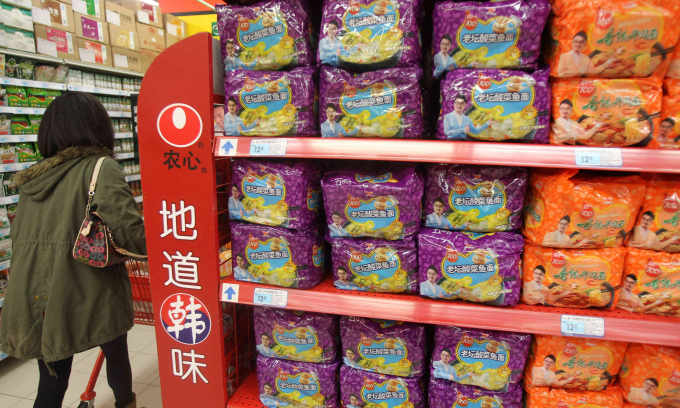
A customer walks past instant noodle of South Korean instant noodle maker Nongshim at a supermarket in Nantong city, east China’s Jiangsu Province, Nov. 14, 2012. Photo by AFP |
The trend also reflects broader shifts in Chinese consumer behavior. Once viewed primarily as a quick, utilitarian meal, instant noodles are increasingly seen as a source of comfort and enjoyment, according to this industry insider.
“With rising living standards and a wider range of food options, consumers are now maintaining this functional demand while also seeking emotional satisfaction, such as stress relief through intense flavor experiences,” the official told The Korea Times. “In other words, Chinese consumers are now willing to pay not only for satiety, but also for emotional value.”
Social media trends reinforce this shift, with users sharing recipes that elevate instant noodles by cooking them in pots and adding toppings such as eggs, vegetables, and meat. These posts have helped transform a basic convenience food into a more personalized and comforting dish.
Lu Chao, a professor at the Liaoning Academy of Social Sciences, attributed the surge in instant noodle consumption to the rise of China’s “night-snack culture,” Global Times reported.
As late-night eating becomes more common, consumers are showing a growing preference for bold and varied flavors, particularly the spicy profiles associated with Korean brands.
Sally Xu, an office worker in Shenzhen in southeastern China, described her routine including cooking South Korea’s Buldak noodles with vegetables, a fried egg, and kimchi after finishing work at 10 p.m.
“The spicy flavor is intense,” said Xu. “Sometimes it even brings tears to my eyes, but it helps me forget about work stress, at least for a while. None of the chili sauces available where I live have a similar taste.”
The Chosun Daily reported that curiosity driven by the popularity of Korean content may also be contributing to demand. At the same time, amid global inflation, instant noodles have become an increasingly attractive option as a cost-effective meal.
China remains the world’s largest instant noodle market. Data from the World Instant Noodles Association shows consumption reached 43.8 billion servings in 2024, accounting for 35.6% of global demand.
As consumer preferences evolve, demand is shifting toward higher-quality products. The premium instant noodle segment, typically priced above 5 yuan (US$0.73) per serving, where many Korean brands are positioned, is expanding rapidly.
Founder Securities projects this segment will nearly double from 49 billion yuan in 2020 to 94.8 billion yuan, while the lower-end market is expected to grow more slowly, reaching 71.2 billion yuan by 2026.
Comments are closed.