

127
On Wednesday, in the Muslim-majority enclave of Mothabari in Malda district near the Bangladesh border, a mob’s fury over names missing from electoral rolls erupted into a brazen assault on judicial officers appointed under Supreme Court mandate to cleanse voters’ lists.
The immediate spark was the Election Commission of India’s (ECI’s) Special Intensive Revision (SIR) of electoral rolls, a mammoth exercise that flagged 1.36 crore voters state-wide under the “Logical Discrepancy” category. These names—neither deleted nor retained—were slapped with an “Under Adjudication” tag, effectively suspending their voting rights pending verification.
Seven judicial officers—three of them women—and a five-year-old child were held hostage for more than nine hours. They were gheraoed around 3.30 p.m. and could only be evacuated after midnight, when a large contingent of police and Central forces moved in. During the evacuation, stone-pelting continued and several vehicles were damaged as protesters tried to obstruct the convoy.
A panic-stricken female judicial officer’s entreaties to the High Court Registrar, asking the court to “take care of her children if anything happened to her”, quickly went viral even as visuals, showing frenzied mob throwing stones and trying to block the cars with bamboo poles in the dead of night, ran endlessly on TV channels.
The unprecedented attack underscored the perils of Bengal’s overheated political landscape ahead of the 2026 Assembly polls to be held later this month.
The Supreme Court, which has been closely monitoring the SIR process in West Bengal, took a stern view of the developments. Taking suo motu cognisance and convening an urgent hearing the next morning, Chief Justice of India Surya Kant described the events as a “brazen attempt” to browbeat judicial officers and a “calculated and motivated” move aimed at derailing the adjudication of objections. The court said the incident was not routine but appeared designed to create a “psychological attack” on officers working under its directions.
The bench also remarked that West Bengal was now “the most polarised state”, sharply rebuking the state’s Advocate-General when he suggested that the Election Commission should not act as an adversary under the Model Code of Conduct. The Chief Justice noted that he had personally monitored the situation till 2 a.m., and that the Chief Justice of the Calcutta High Court had to call the Director-General of Police and the Home Secretary to ensure that help reached the stranded officials.
“This is also an abdication of duty by the West Bengal government,” the court observed, directing senior state officials to explain why adequate measures were not taken despite being informed in time. It ordered the Election Commission and the state government to ensure the safety of all judicial officers engaged in the SIR exercise and to strictly limit the number of people allowed to attend hearings or file objections.
The court further directed that the incident be probed by an independent Central agency—either the Central Bureau of Investigation (CBI) or the National Investigation Agency (NIA)—and asked for a preliminary report to be submitted directly to it. Following these directions, the NIA has been tasked with investigating whether there was a larger conspiracy behind the attack and whether any organised groups were involved.
The April 1 violence ignited a partisan firestorm, with leaders from the Trinamool Congress, Bharatiya Janata Party, Indian Secular Front, and CPI(M) scrambling to spin the chaos for electoral gain.
BJP leader Suvendu Adhikari, the party’s heavyweight in Bengal, fired the first salvo on X, branding the attack a “heinous, life-threatening” conspiracy orchestrated by Chief Minister Mamata Banerjee and her Trinamool Congress. “This is not the first instance where judges have faced harassment by TMC,” Adhikari thundered, cataloguing past alleged outrages: courtroom blockades, slogan-shouting in chambers, derogatory barbs from TMC spokespersons, and posters pasted at judges’ homes.
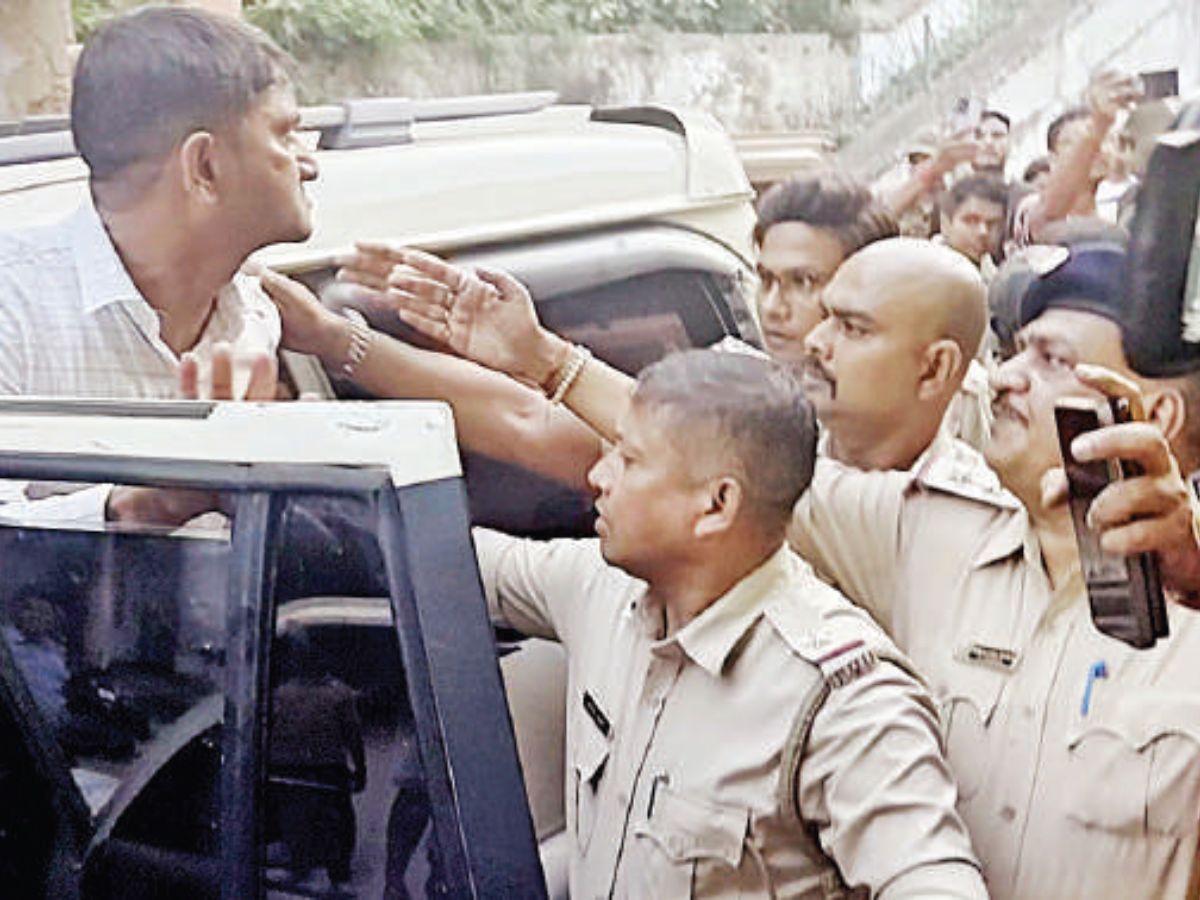
Adhikari specifically focused on Mofakkerul Islam, a 40-year-old rabble-rousing lawyer and the alleged mastermind of the Mothabari incident, who has been arrested by the state CID along with his associate Akramul Bagani while reportedly trying to fly out of Bagdogra to Bengaluru. Bagani, who runs a news channel on Youtube, is known for posting pro-Trinamool content and eulogies to Abhishek Banerjee on his social media accounts.
On her part, Mamata Banerjee pointed finger at the Asaduddin Owaisi-led AIMIM and the Indian Secular Front (ISF) that is linked to the Fufurfa Sharif shrine in Hooghly district. The CM alleged that those “trying to escape through Bagdogra came from Mumbai … the BJP brought that MIM-ISF group from Mumbai with help from the Congress … they split the votes in Bihar to help the BJP win.”
Dismissing Banerjee’s claim that the accused was a BJP plant from Maharashtra, Suvendu Adhikari asserted: “The truth: he is TMC-linked, seen on stage with Mamata herself,” reiterating: “The incident was entirely planned by Trinamool.” He posted pictures of Islam with Mamata Banerjee and party MP Kalyan Banerjee to support his claim.
Perhaps bearing him out was a Facebook Live video done by Mofakkerul Islam when he was in police custody. “Unless he has connections and enjoys special privileges in Didi’s Bengal, can any arrested accused do a Facebook Live video sitting inside a police station after being arrested and while being in police custody?” asked political observer Biswanath Chakraborty.
Photos and videos of the day’s happenings show Trinamool’s Mothabari MLA and Minister in Mamata Banerjee’s Cabinet, Sabina Yeasmin sitting among the protesters and even cooking food for them.
This is not Mothabari’s first brush with violence and bloodshed.
In March 2025, the area witnessed similar eruptions of violence during communal clashes triggered by rumours of cow smuggling across the porous border. Mobs torched vehicles, clashed with security forces, and left several injured, drawing sharp criticism from the Calcutta High Court for the local administration’s alleged laxity.
That episode, linked to tensions between local Muslim communities and Hindu and BJP groups, foreshadowed the current unrest, revealing Mothabari as a tinderbox where border sensitivities, demographic divides, and electoral anxieties collide with potentially disastrous consequences. The recurrence exposes deeper governance failures in Malda, a district long accused of harbouring illegal immigration and vote-bank politics.

Comments are closed.