


India does not need more graduates; it needs better-prepared graduates who are aligned to employment market
Published Date – 6 April 2026, 12:15 AM
By T Muralidharan
The Azim Premji University, in its State of Working India report 2026, published a bombshell: two out of three unemployed youth are graduates, and around 40% of young graduates (age 15 to 25) remain jobless. Only 7% get permanent salaried jobs within a year and face severe friction and delay in the first job entry. Most importantly, even as graduate unemployment is increasing, the government is pushing for more and more graduate enrolment. This is not a cyclical slowdown. It is a structural crisis.
India is producing more graduates than ever before. Yet, graduate unemployment is at historic highs. To understand this, we need to answer questions on three Es — Employment, Employability and Expectations. Why has graduate employment declined? Why has graduate employability declined? Why have expectations increased despite falling employability? These are not separate issues but linked failures.
3-sector Job Economy
Graduate employment does not mean any job a graduate can do. It refers to jobs where graduates have a clear productivity advantage over non-graduates. In my work “101 Jobs for Graduates”, I found that only three sectors have historically created large-scale graduate employment: IT & ITeS, Banking, Financial Services and Insurance (BFSI), and Life Sciences & Pharma.
These sectors are now slowing or transforming. The IT sector, employing over 5.1 million people, has shifted from mass hiring to selective hiring. Automation, cloud computing, and AI are reducing entry-level roles. The traditional model of hiring fresh graduates in bulk and training them is over. Even the growth of the Global Capability Centres (GCCs), employing around 2.2 million professionals, does not solve the problem. These jobs are high-skill and selective.
In BFSI, digitalisation has reduced traditional roles. Branch expansion has slowed, and fintech has replaced many operational processes. Jobs still exist, but they are increasingly sales-driven, high-pressure, and unstable.
The pharma sector, which employs over 2.7 million people, remains specialised and cannot accommodate most general graduates. Major roles include manufacturing chemists (requiring 18 months of experience), quality control/assurance, R&D, clinical research, regulatory affairs, and medical representation. Automation in pharma manufacturing is driving down frontline jobs.
Now superimpose with the new AI & automation shock. India’s graduate employment model was built on knowledge-based, process-driven work: coding, processing, low-end analysis, and customer operations. These are precisely the functions now being disrupted by AI. Key insight: AI is not eliminating jobs randomly. It is eliminating the very category of jobs India created for its graduates.
Contrast this with the supply reality. India has expanded higher education enrolment rapidly, with over 40 million students enrolled. Approximately 5 million graduates pass out every year, and not even 1 million graduate jobs are being created.
Employability
Moreover, we are producing graduates with irrelevant degrees. AISHE data shows that around 34% of undergraduate students are in Arts alone, and over 10 million are enrolled currently in the BA course. These degrees are not necessarily weak, but they are not aligned with job roles. India’s education system focuses on knowledge, exams, and memory. But the workplace demands execution and performance. Employers do not hire knowledge. They hire the ability to perform tasks.
The employability issue is severely compounded by the lack of expertise of faculty to move from knowledge transfer to task mastery training. The rapidly changing job realities are measured by the wrong outcome like exam pass percentage.
Task Mastery
One of the least discussed indicators of low employability is early job failure. A large proportion of graduates — leave or fail within the first 6–9 months — are unable to meet performance expectations. This is not an attitude problem. It is a capability problem.
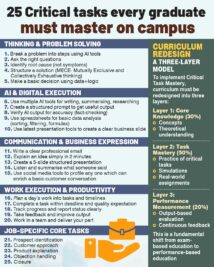
This is where Critical Task Mastery (CTM) becomes important. Without the ability to perform tasks, degrees have limited economic value. CTM is a simple but powerful idea: Break a job into critical tasks, and ensure the individual can perform them consistently and measurably. For example, a frontline sales role may require prospect identification, Customer engagement, product explanation, objection handling, and closure— all in a sales role. A graduate who cannot perform these tasks, after role induction, is not employable, regardless of the degree.
High performers are not defined by degree or intelligence. They are defined by mastery of a small set of critical tasks in the role. In contrast, low performers lack clarity and do not prioritise critical tasks and absorb the role induction training. The difference is not knowledge. It is task mastery.
The third issue is expectations. Education has become an investment. Graduates expect returns in the form of higher salaries and better jobs. However, entry-level wages have remained stagnant net of inflation. Employers resist wage increases due to low productivity. The result is a widening gap between expectation and capability.
The real problem is not students or employers. It is the higher education system. Over the last decade, the price of higher education has increased, but the quality has declined. India’s graduate unemployment problem is the outcome of the failure of the graduate system design.
The Solution Framework
The answer lies in a structural shift—from degrees to delivery, from knowledge to task mastery, and from education to employment pathways.
Shift the goal
For decades, India’s higher education policy has been driven by one metric: Gross Enrolment Ratio (GER). The objective was clear — increase access. It was understandable. Large sections of the population were first-generation in higher education, and hence, access to education for this group was paramount. That objective has been achieved. India now has over 4 crore students in higher education, one of the largest higher education systems in the world; women’s enrolment has surpassed all expectations.
But access without outcomes has created the current crisis. We must now shift the policy focus from enrolment to employability outcomes. Today, all outcomes are linked to what happens to the students when they are on the campus.
Critical Task Mastery
The central flaw in India’s education system is this: It teaches knowledge. The workplace demands performance. This gap can only be bridged through CTM. Critical Tasks are the minimum set of repeatable actions a graduate must perform to be productive from Day 1 in a job. These are not theoretical capabilities. They are execution capabilities.
Compulsory Apprenticeship
The biggest gap in India’s education system is the transition from campus to workplace. This must be institutionalised. The apprenticeship model in the final year of graduation must be dedicated to full-time industry immersion: no tuition fees during this year; no mandatory salary requirement; focus on task exposure, learning on the job and real-life workplace behaviour.
This model solves three problems simultaneously:
• Skill gap: Students learn what real work requires and recognise their skill gaps
• Expectation gap: Students understand job realities and that the employer’s salary is not as important as the learning opportunities the employer provides
• Employability gap: Students become job-ready before graduation
Specialisations
One of the core issues is the misalignment of degrees, especially BA, BSc, BCom, with job roles such as business, banking; retails operations, sales and customer management, content and communication, public systems and governance.
Employer–education interface
Today, the link between employers and colleges is weak except in a few courses like engineering. Employers for plain graduates engage only at the hiring stage, and graduate colleges operate without market feedback. This must change. Employers must help define critical tasks; performance benchmarks, regular feedback loops; internship evaluation, apprentice performance tracking and co-designed curriculum modules.
What gets measured gets improved. We need to move beyond pass percentages, placement percentagesto 6-month retention rates, performance scores in the first job and employer satisfaction, etc.
The Real Reform
India does not need more graduates. It needs better-prepared graduates who are aligned to employment market. The crisis we see today is not accidental; it is the result of expanding education without aligning it to jobs, focusing on knowledge without ensuring capability, and increasing cost without improving outcomes.
The solution is equally clear: shift from quantity to quality, from knowledge to task mastery and from education to employment pathways. If we do this, we will not just solve unemployment. We will unlock productivity at the national level and make Indian talent globally employable. And that will be the real transformation. The future belongs not to those who know more, but to those who can do more — and do it consistently.

(The author is Founder Chairman, TMI Group and Quanta People)

Comments are closed.