
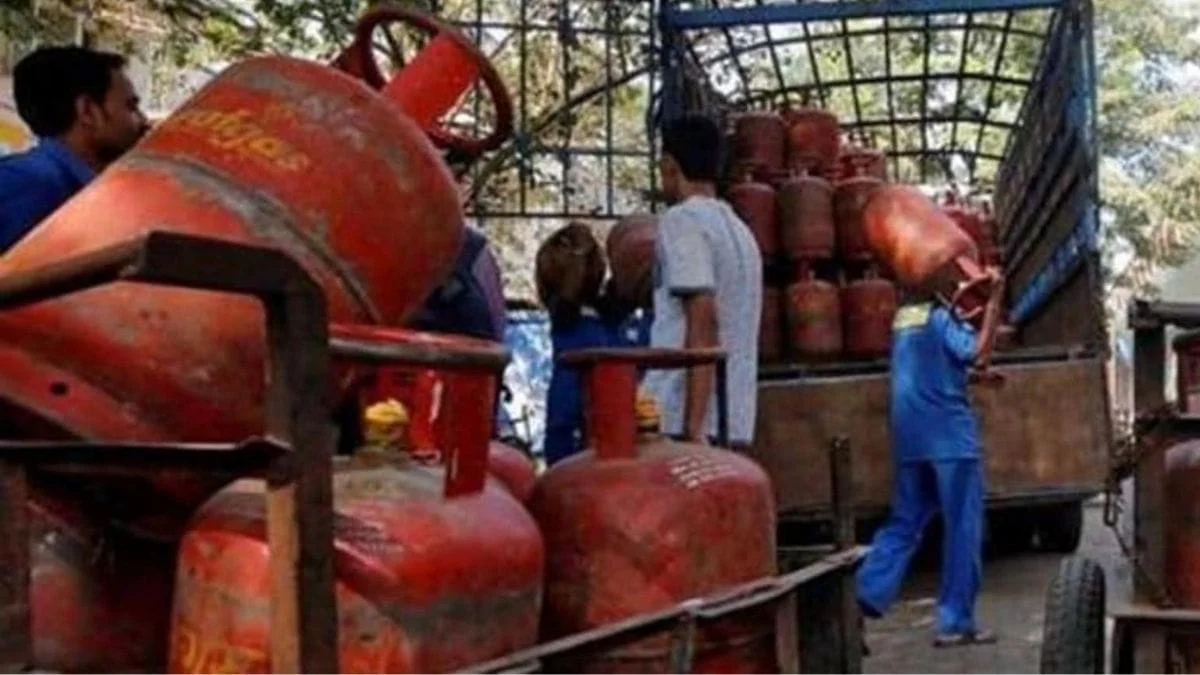

Every time an Indian household uses a 14.2 kg LPG cylinder for cooking in April 2026, the government is quietly losing Rs 380 on it. Not the consumer. Not the oil company in any final sense. The government, through its oil marketing companies and direct fiscal support. Multiply that Rs 380 by every cylinder sold across India’s 330 million plus LPG consumer households between now and the end of May, and you arrive at the figure the Ministry of Petroleum and Natural Gas has put on record: cumulative OMC losses on domestic LPG will reach approximately Rs 40,484 crore by end of May 2026.
That is the price India is paying to keep your cooking gas bill unchanged during the Iran war.
How the Under-Recovery Works
Under-recovery is the difference between what it costs to supply a product and what the consumer pays for it. At current international LPG prices, driven by the 44 percent spike in the Saudi Contract Price from $542 per metric tonne in March to $780 per metric tonne in April following the Strait of Hormuz closure, the true market cost of supplying a 14.2 kg domestic cylinder in India is approximately Rs 1,293. The consumer pays Rs 913. The Rs 380 difference is the under-recovery, absorbed by Indian Oil, BPCL, and HPCL on every single cylinder sold.
This is not a rounding error or a temporary accounting adjustment. It is a deliberate and sustained policy decision to insulate Indian households from an international commodity price shock that they had no role in creating and no ability to manage on their own.
Last Year’s Precedent Shows How the Bill Gets Paid
The Ministry’s statement provides the financial precedent that shows how India handles these situations. In the previous financial year, OMCs incurred total losses of Rs 60,000 crore on domestic LPG. That burden was split equally between two sources. Rs 30,000 crore was absorbed by the Oil PSUs themselves, effectively drawn from their operating profits and balance sheet reserves. Rs 30,000 crore was absorbed by the Government of India through direct budgetary support to the OMCs.
The same framework will apply to the current cycle. The Rs 40,484 crore projected loss by end of May will eventually be split between OMC balance sheets and government fiscal support in proportions to be determined. What the consumer will not be asked to do is contribute to filling that gap through higher cylinder prices. The political and social commitment to protecting the domestic cooking gas price, which PM Modi has made explicit, means the bill lands on public sector balance sheets rather than on kitchen budgets.
The Rs 40,484 Crore in Perspective
To understand what Rs 40,484 crore means in practical terms, consider some comparisons. It is approximately two thirds of last year’s full-year LPG loss of Rs 60,000 crore, projected to accumulate in just two months of April and May. It reflects both the severity of the current Strait of Hormuz supply disruption, which is blocking 20 to 30 percent of global LPG supplies, and the volume of domestic LPG consumption in India, which is enormous given the country’s 330 million plus consumer base.
It is also worth noting what the alternative would look like. If the Rs 380 per cylinder under-recovery were passed to consumers in full, the 14.2 kg domestic cylinder would need to be priced at approximately Rs 1,293. That represents a 41.6 percent increase from the current Rs 913. For PMUY beneficiaries currently paying Rs 613, the equivalent market-rate price would be even more disproportionate to their household income levels. The government has judged that the social cost of that increase, particularly for the hundreds of millions of lower-income households that depend on subsidised LPG for cooking, exceeds the fiscal cost of absorbing it.
The regional context supports that judgment. India’s domestic cylinder at Rs 913 is cheaper than Pakistan’s equivalent at Rs 1,046, Sri Lanka’s at Rs 1,242, and Nepal’s at Rs 1,208, all countries that themselves subsidise cooking gas. India is holding its domestic price below regional peers while absorbing a larger international price shock than any comparable recent period.
The Strait of Hormuz Connection
The Rs 40,484 crore loss projection is built on the assumption that the Strait of Hormuz remains closed and international LPG prices remain elevated through May. If Wednesday’s ceasefire signals from Washington and Tehran translate into an actual resolution of the Iran conflict and the Strait reopens, allowing the 20 to 30 percent of global LPG supplies currently bottled up in the Gulf to resume normal flow, international LPG prices would fall and the under-recovery per cylinder would narrow.
Every day the conflict continues, the cumulative loss figure grows. Every day it moves toward resolution, the projected Rs 40,484 crore becomes slightly more manageable. The connection between geopolitics and your cooking gas bill has never been more direct or more numerically precise than it is in April 2026.
All financial figures and price data are sourced from the official Ministry of Petroleum and Natural Gas statement dated April 1, 2026. This article is for informational purposes only and does not constitute financial or investment advice.

Comments are closed.