
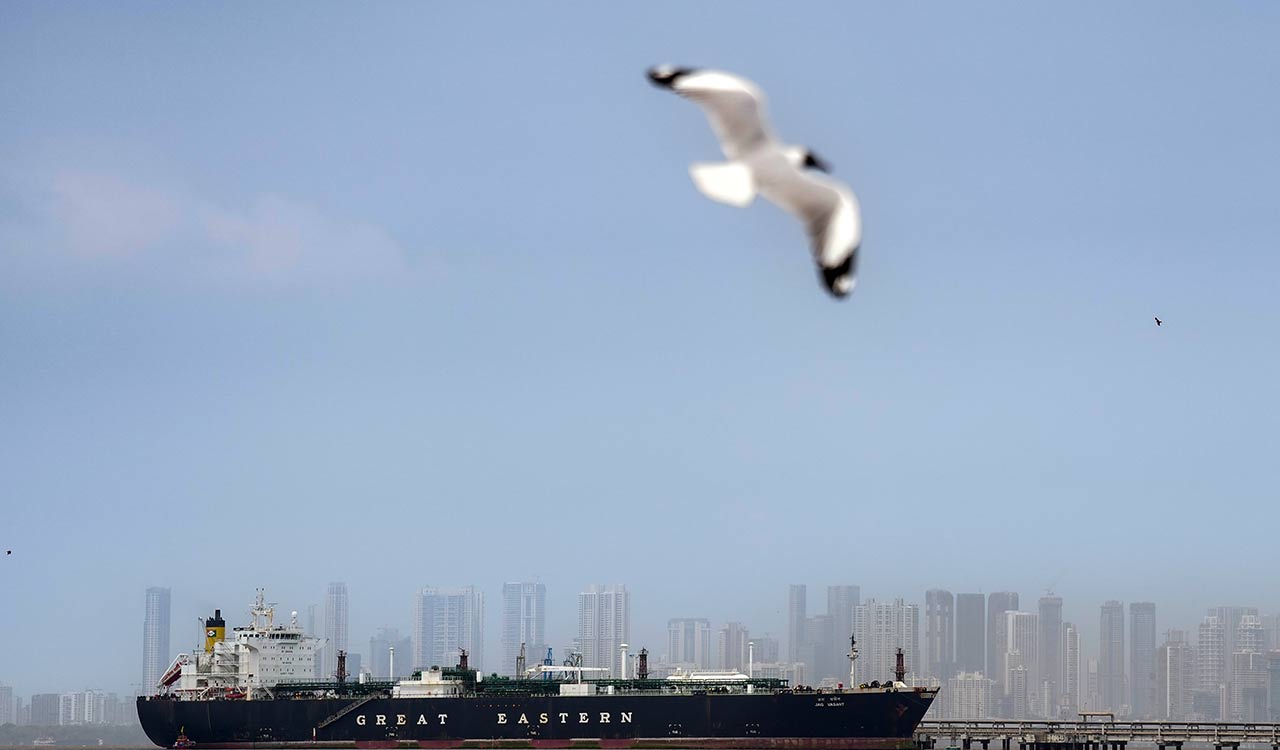

US President Donald Trump intensified threats against Iran, warning of strikes on key infrastructure amid escalating conflict. Airstrikes and missile attacks caused casualties across Iran and Israel, while rising tensions disrupted oil markets
Published Date – 6 April 2026, 11:07 AM
Dubai: US President Donald Trump on Sunday stepped up his threat to hit Iran’s critical infrastructure hard if the country’s government doesn’t reopen the Strait of Hormuz by his deadline.
Trump punctuated his threat with profanity in a social media post Sunday, saying that Tuesday will be “Power Plant Day, and Bridge Day, all wrapped up in one, in Iran.” He also offered details of the rescue of a “seriously wounded and really brave” US service member he identified as a “respected colonel” who was missing since Iran shot down a US F-15E Strike Eagle on Friday.
The US president said the rescue was a rarely attempted type of operation because of the potential dangers. A second crew member was rescued earlier in “broad daylight” after seven hours over Iran.
The war began with joint US-Israel strikes on February 28 and has killed thousands, shaken global markets, cut off key shipping routes and spiked fuel prices. Both sides have threatened and hit civilian targets, bringing warnings of possible war crimes.
Strikes in Iran kill 9 people
From Sunday into Monday across Iran, local media and activists reported strikes on Ahvaz, Bandar Lengeh, Karaj and Shiraz.
The strikes in Bandar Lengeh and Kong killed at least six people and wounded 17 others, the state-run IRAN newspaper said.
Another airstrike in southeastern Tehran hit a home, killing at least three people, Iranian state TV reported.
Iranian strikes hit Haifa
Israel’s Magen David Adom and Fire and Rescue services said early Monday that there are two reported sites of Iranian missile hits in the northern city of Haifa.
Video footage provided by Magen David Adom of the affected sites show active fire and bombed cars in what appears to be a residential area.
It is still unclear whether those were direct hits or damage from falling shrapnel from interceptions.
The missile strikes comes a day after another attack from Iran also hit a Haifa residential area, killing two people and injuring others.
Two people were still trapped in the rubble caused by the Sunday attack and their fate is unknown.
Meanwhile, Israel’s military warned the public Monday morning of another missile barrage coming from Iran, the third-such alert of the day.
Airstrike on Iranian city of Eslamshar kills 13
An airstrike early Monday struck a residential building in a city southwest of Iran’s capital, Tehran, killing at least 13 people, Iranian media reported.
The semiofficial Fars news agency and Nour News reported the strike near Eslamshar.
It wasn’t clear why the building had been struck.
Neither Israel nor the United States claimed the strikes early Monday, but they came after Trump issued a profanity-laced threat to Iran that it must reopen the Strait of Hormuz.
Airstrikes hit Tehran university linked to weapons work
Airstrikes early Monday morning on Iran’s capital targeted the Sharif University of Technology.
Iranian media reported the strikes and damage to buildings there, as well as a natural gas distribution site next to the campus.
It wasn’t immediately clear what had been targeted on the grounds of the university, which is empty of students as the war has forced all schools in the country into online classes.
However, multiple countries over the years have sanctioned the university for its work with the military, particularly on Iran’s ballistic missile program, which is controlled by the country’s paramilitary Revolutionary Guard.
Meanwhile, the Guard and other security forces have been using secondary sites as rally points as their bases have come under repeated attack during the war.
Airstrike in the Irani city of Qom kills 5
The state-run IRAN daily newspaper said in an online message that an airstrike in a residential area of Qom killed at least five people. Qom is a holy Shiite seminary city just south of Tehran.
It wasn’t unclear what the target of the strike was.
Iran has not provided overall casualty figures from the war in days. It also hasn’t discussed its materiel losses.
Airstrikes hit Iran’s capital
Before dawn Monday, a series of airstrikes hit Iran’s capital, Tehran. Explosions rang out into the night, though it wasn’t immediately clear what had been struck. The sound of low-flying fighter jets could be heard off and on for hours.
In Israel, authorities sounded one missile alert. In Dubai in the United Arab Emirates, two such alerts went off with air defences firing, but it wasn’t immediately clear what had been targeted by Iran. Kuwait also said its air defences worked multiple times overnight to intercept incoming.
Crude oil prices jump in early trading after Trump threats
Crude oil prices jumped sharply in early trading Sunday after US President Donald Trump issued fresh, heightened threats against Iran and its infrastructure.
The price of Brent crude, the international standard, rose more than 2 per cent to $USD 111.25. US crude oil prices were up nearly 3 per cent to USD 114.54 a barrel.
The last time front-month prices for US crude oil prices were above USD 115 a barrel was the summer of 2022, in the aftermath of Russia’s invasion of Ukraine and during a period of high inflation across the globe.
Trump on social media vowed to hit Iran’s power plants and bridges and said the country would be “living in Hell” if the Strait of Hormuz, crucial for global trade, isn’t opened by Tuesday.
Official with Lebanese Christian party killed in Israeli strike
Pierre Mouawad, an official with the Lebanese Forces party, was killed along with his wife in an Israeli strike Sunday on an apartment building in the village of Ain Saadeh in the mountains east of Beirut, the state-run National News Agency reported.
Another woman was killed and three women were wounded, Lebanon’s health ministry said.
The Israeli military has made no statement about the strike, and its intended target remains unclear.
The Lebanese Forces party is opposed to Hezbollah and has blamed the Shiite militant group for dragging Lebanon into a new war with Israel.
Israeli strikes in Christian-majority areas have led to sectarian tensions, with local residents fearing that Hezbollah members may be hiding among displaced Shiite civilians taking refuge there.

Comments are closed.