
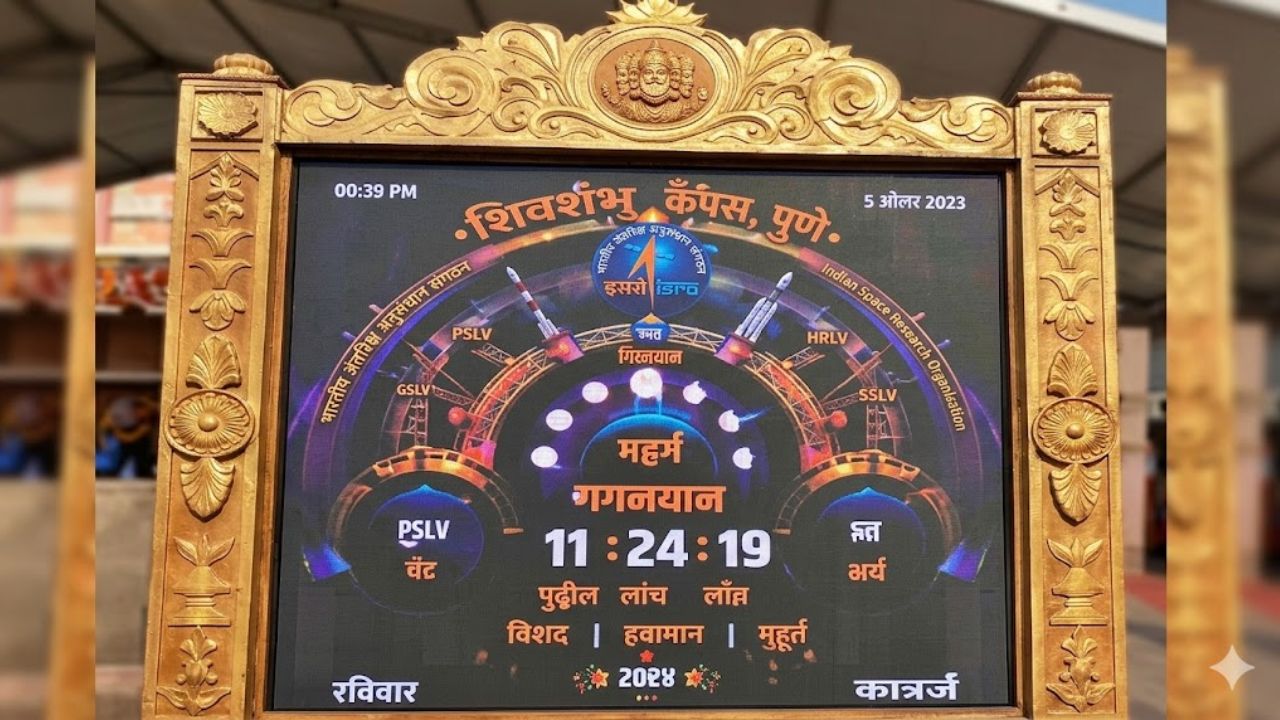
Not hours, time in muhurat! Entry of ‘Vedic clock’ in Kashi! A unique blend of tradition and technology

- Unique Vedic clock entry in Kashi.
- This clock divides the day into 30 muhurtas and shows time along with Tithi, Nakshatra.
- Provides more accurate timekeeping by showing local time starting at sunrise.
of Uttar Pradesh The ‘Vikramaditya Vedic Clock’ has now become a center of attraction at the Kashi Vishwanath Temple in Varanasi. This Vedic clock, weighing 700 kg, is a remarkable example of the confluence of tradition and technology. Gifted by Madhya Pradesh Chief Minister Mohan Yadav, this unique clock represents the ancient time measurement system of India. This clock divides the day into 30 muhurtis and shows local time, tithi, nakshatra and much more. With the installation of this clock, devotees visiting the temple will not only experience the spiritual atmosphere, but also gain knowledge about the ancient and scientific system of time measurement of India. The Vikramaditya Vedic Clock is considered to be the world’s first timepiece designed to display time based on the traditional Vedic calendar, rather than the standard one-hour Gregorian calendar.
Weather Update : There is a big change in the weather; There will be rain with thunder till April 10.
Time to know
The Vedic clock divides the day into 30 muhurtis (velas). Each muhurta of which is approximately 48 minutes. The clock started at 0:00 at sunrise and sunset generally around the 15th Muhurta. This watch shows the local mean time, which is calculated according to the position of the sun. As the local time is displayed, it is more accurate for a particular location. This clock is a Tithi in Panchang. It also shows important elements like Chandra Diks) and Nakshatras (constellations).
A big blow to the opposition parties! Impeachment motion against Chief Election Commissioner Gyanesh Kumar rejected
More accurate predictions
This Vedic clock displays IST and GMT simultaneously for information, this initiative aims to revive the ancient Indian practice of ‘Kalganita (calculation of time)’ derived from Vedic texts and integrate it with modern digital technology. This installation is an attempt to reconnect people with traditional knowledge systems. A study conducted in collaboration with the Departments of Meteorology and Astrology has shown that predictions based on Vedic time calculations are in some cases 20 to 23 percent more accurate than modern methods.
Disclaimer: This is an automated news feed of Navrastra newspaper. It is not edited by navarashtra.com staff.

Comments are closed.