
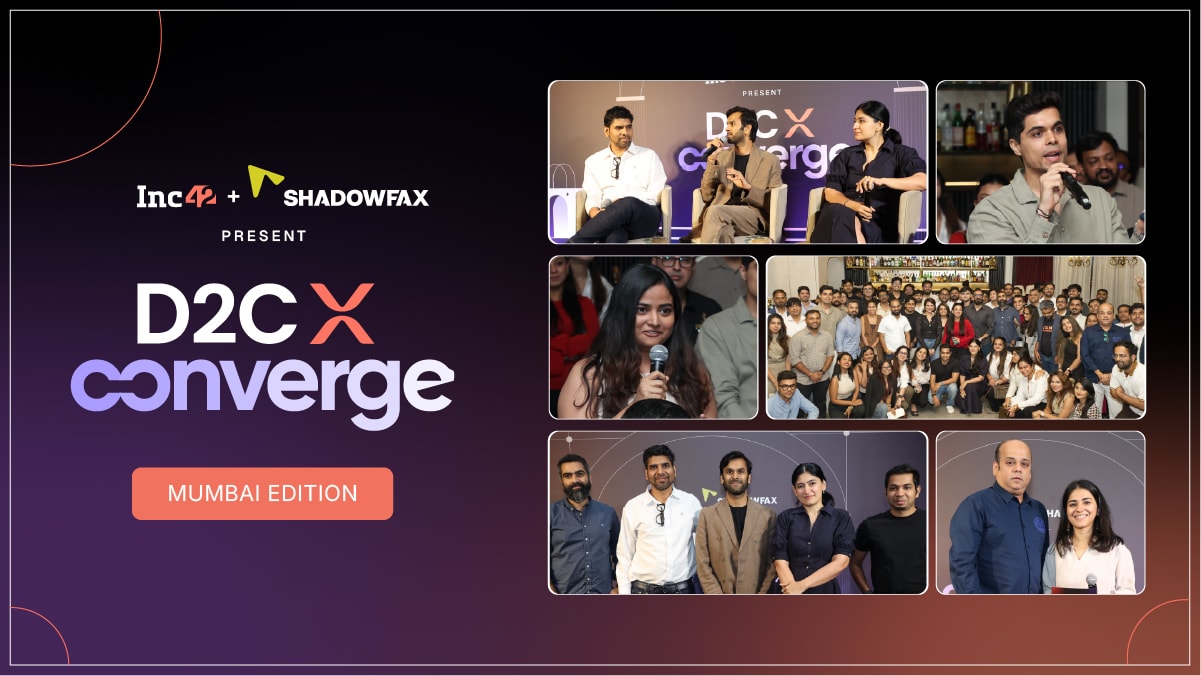

Inc42 and Shadowfax rolled out the third chapter of D2CX Converge in Mumbai, bringing together more than 65 founders to discuss the ₹10 Cr to ₹100 Cr journey for D2C brands
The founders highlighted that the D2C growth hinges on retention, unit economics and sharp execution, with growth behaving as a ‘step function’ driven by experimentation rather than linear scaling
In a fireside chat, Inc.5 CEO Rajesh Kadam shared his journey of building a consumer brand in India’s fragmented footwear market, drawing on over two decades of experience
As India’s D2C ecosystem rides the digital wave, with the broader ecommerce market projected to hit $400 Bn by 2030it is reshaping how consumer brands are built, scaled and differentiated in a market where competition is intensifying by the day. What began as a channel shift has now evolved into a full-stack play across product innovation, supply chains and brand storytelling.
With internet consumption rising exponentially, the direct-to-consumer (D2C) segment is projected to contribute significantly to the country’s broader ecommerce market, as it gears up to capture a $400 Bn market opportunity by the end of the decade. The country now has a growing base of digitally native consumers, with 886 Mn internet users, 332 Mn online shoppers and over 18 Mn power shoppers (who place more than 50 orders a year).
At the same time, the playbook for success is becoming more complex. Rising customer acquisition costs, the need for an omnichannel presence, and the pressure to drive profitable growth are pushing D2C founders to rethink their strategies. For many, the next phase will be defined by capital efficiency, brand recall and operational depth.
Against this backdrop, Inc42 and ShadowFax partnered to host the third chapter of D2CX Convergea five-city founder meetup series, in Mumbai, continuing its effort to enable high-quality, operator-led conversations within India’s fast-evolving D2C ecosystem. The series is designed to bring together early stage founders in a curated, high-trust setting where real insights drive meaningful learning.
Mumbai offers a unique vantage point into the country’s consumption story. Over the past decade, consumer startups headquartered in Mumbai garnered more than $24 Bn in funding. The local ecosystem comprises over 1,100 funded startups, 18 of which are unicorns, 34 soonicorns, and 14 minicorns. With ecommerce leading as the top-funded sector and eight companies listed on public markets, Mumbai sits at the intersection of capital, distribution, and demand.
Building on the momentum from Hyderabad and Bengaluru, the Mumbai chapter brought together over 65 D2C founders across categories such as fashion, FMCG, health and lifestyle. The focus of the third chapter remained clear: to create space where some of India’s most promising operators could exchange ideas, pressure-test their strategies and learn from others navigating similar growth challenges.
The evening featured a fireside chat and a panel discussion, and a convergence of diverse perspectives on scaling, branding and profitability in today’s competitive environment.
The D2C gathering at the event included the likes of:
- Rajesh Kadam, CEO, Inc.5 Shoes
- Shishir Gupta, Director and Cofounder, Kalki Fashion
- Saloni Anand, Cofounder, Traya Health
- Udit Toshniwal, Founder and Director, The Pant Project
- Aditya Ruia, Cofounder, Beco
- Shivam Dang, Head – Marketing & New Initiatives, Shadowfax
The Making Of A Footwear Brand
The fireside chat, themed ‘How Inc.5 Is Winning In India’s New-Age Footwear Market’, featured Rajesh Kadam, CEO of Inc.5 Shoes. He shared his journey from running factories to building a consumer brand in one of India’s most fragmented categories. Drawing on over two decades of experience, Kadam spoke about identifying gaps in an unorganised market and scaling the business through a mix of intuition, operational discipline and deep market understanding.
“When I was manufacturing 50,000 to 60,000 pairs a month, I realised the market was doing crores of pairs. The right word, it is not even unorganised, it’s worse than that. So there is a huge, huge landscape of footwear in India.”
A large part of the conversation centred on product-market fit and category realities. Kadam highlighted how the sheer scale and fragmentation of India’s footwear market created an opportunity for organised players to build strong brands. He emphasised tracking what sells across stores, cities and channels, and building products based on real demand signals and instinct-led design.
“Marketplace has been extremely helpful for us to churn the rotation. If you have stores, get it plugged into a marketplace first. I mean that could change your rotation, your stock liquidation is easy, and it makes profitability last better than any of the verticals,” Kadam noted.
He also unpacked the brand’s omnichannel strategy and expansion playbook. With all its 100 stores integrated with marketplaces, he explained how inventory across locations is leveraged to drive both offline and online demand. At the same time, he pointed to Tier II and Tier III markets as the key growth drivers, highlighting their strong spending power and improved accessibility.
He stressed that footwear remains an inventory-heavy business, where managing sourcing relationships, controlling discounting cycles and maintaining healthy inventory turns are critical to sustaining margins at scale.
The Next Wave Of Consumer Brands
The panel discussion on ‘D2C Brands’ ₹100 Cr Playbook’ unpacked what it really takes to scale from ₹10 Cr to ₹100 Cr in today’s highly competitive market – where growth is less about chasing channels and more about cracking retention, unit economics and sharp execution.
From rethinking channel mix and resisting premature expansion to building repeat cohorts and managing inventory risk, the conversation – moderated by Shivam Dang, head of marketing and new initiatives at Shadowfax – made one thing clear: the ₹100 Cr journey is not linear, it is a series of sharp inflection points driven by experimentation, insights and discipline.
Ruia of Beco highlighted how founders often misread growth trajectories. “I’ve made a few Excel plans in the past, but that’s honestly not how business functions. We’ve tracked some percentage growth across different metrics every month, but in reality, growth is more of a step function, you stay flat for a while and then suddenly double. While experimenting with more levers and hacks, you’ll have a few hits and a few misses. As long as you have those hits, you’ll keep seeing growth, but it’s not predictable,” he said.
For Anand of Traya Health, the journey to ₹100 Cr was fundamentally a game of retention and unit economics. “We defined growth backwards from LTV. If our CAC stays below a certain threshold derived from lifetime value, we scale, the moment that math breaks, we stop. In fact, we look at acquisition P&L and retention P&L separately, and we’re okay losing money on the first order as long as the 12-month cohort turns profitable,” she explained.
Toshniwal of The Pant Project underscored how operational metrics determine the scale, especially in categories like apparel. “We started with a made-to-order model to keep inventory at zero, and even today, metrics like inventory days and return rates are critical. We operate at 6% returns versus an industry average of 25-30%, which directly impacts CAC recovery and profitability,” he noted.
Ruia also highlighted that cracking acquisition was the biggest unlock in a low-frequency category. “In categories like home care, repeat isn’t the problem – brand engagement and acquisition is. The minute you start experimenting with content, you get a sense whether people are interested in buying.”
Gupta of Kalki Fashion highlighted the importance of focus and depth over expansion in building a ₹100 Cr brand. “We started with the assumption of selling everything, but realised early that one category – ethnic wear – was large enough to build a massive business. Going deep, instead of going wide, helped us scale faster, especially when we discovered international demand was far bigger than domestic,” he shared.
For founders, the Mumbai edition of D2CX Converge offered a grounded, experience-led view of what it really takes to build a D2C brand in India.
Going forward, the next two chapters of D2CX Converge will unfold in Jaipur and Ahmedabad, bringing together D2C and retail brands rebuilding meaningful traction in their categories.

Comments are closed.