
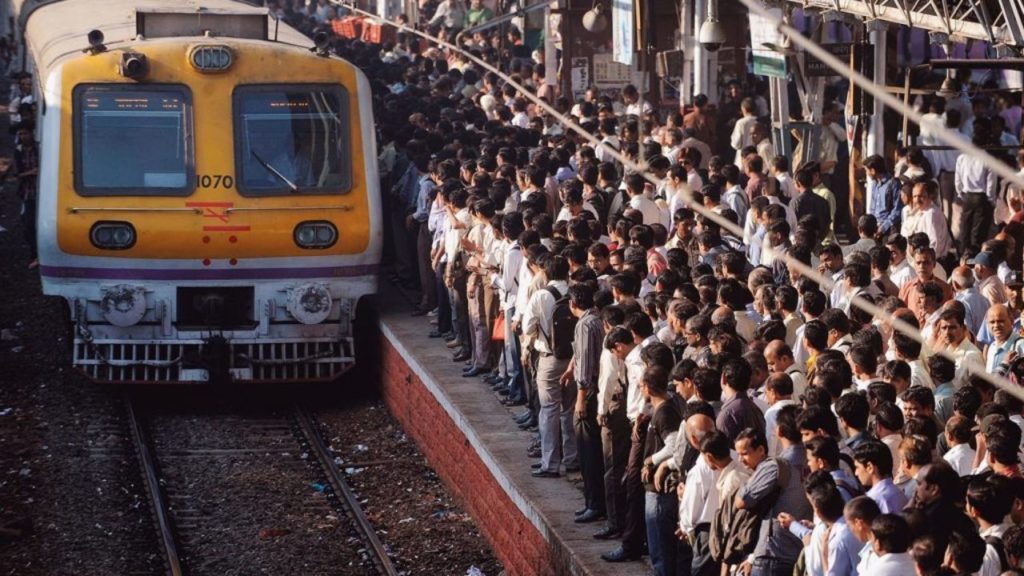

The Bombay High Court stated that standing near the train door or close to the platform edge should not automatically be treated as negligence in Mumbai’s local trains.
At the same time, the court stressed the need for better civic behavior among commuters, suggesting that people should adopt discipline similar to that seen in Japan.
Mumbai High Court Says Standing Near Train Doors Isn’t Negligence, Urges Better Civic Sense
The judge highlighted that passengers must be made aware of the dangers of standing near the edge and should follow safety rules for their own protection.
He explained, “As a responsible passenger there is a need to inculcate civic sense amongst ourselves like civic sense amongst Japanese people… appropriate remedial measures are to be taken to avoid any such incidents.”
Furthermore, the court noted that warnings are usually announced when fast trains pass stations without stopping, but similar alerts are missing when trains arrive at stations where they halt.
Because of this gap, the judge recommended introducing better safety measures to reduce accidents.
In addition, he pointed out that all platforms have a yellow strip meant to warn passengers not to cross into a dangerous zone.
As per the judge, “The yellow strip is there, but nowhere its purpose is stated… no announcement or indication… that this yellow strip is meant… not to enter the danger zone.”
Therefore, he suggested that authorities should use announcements and deploy police to ensure passengers stay behind the line.
He also mentioned that the strip is often faded and not repainted regularly, reducing its visibility.
As an improvement, he proposed using red instead, stating, “authorities should consider ‘RED’ colour… indicating… danger zone.”
Conflicting Reports in 2012 Train Death Case Raise Questions in Bombay High Court
These remarks were made while hearing a case involving Balkrishna Bhandari, who died in a train accident in 2012.
Additionally, several official reports about the incident gave conflicting accounts of how the accident happened.
Some reports claimed he was standing at the platform edge, while others said he was near the train door or fell from the train.
The judge questioned how such conflicting conclusions were reached without any eyewitnesses.
He even doubted the Station Manager’s report, noting that its author had not seen the incident.
He stated, “I am confronted with contradictory reports… I fail to understand why the subsequent reports did not adopt the same reasoning.”
As a result, due to lack of clear evidence, the court concluded that the death was an “untoward incident,” meaning a fall from a moving train.
Additionally, the judge explained that overcrowding makes it normal for passengers to stand near doors, saying, “standing near the door cannot be treated as negligence.”
Finally, the court directed the family to apply for compensation, and ordered railway authorities to pay up to ₹8 lakh within 12 weeks.

Comments are closed.