
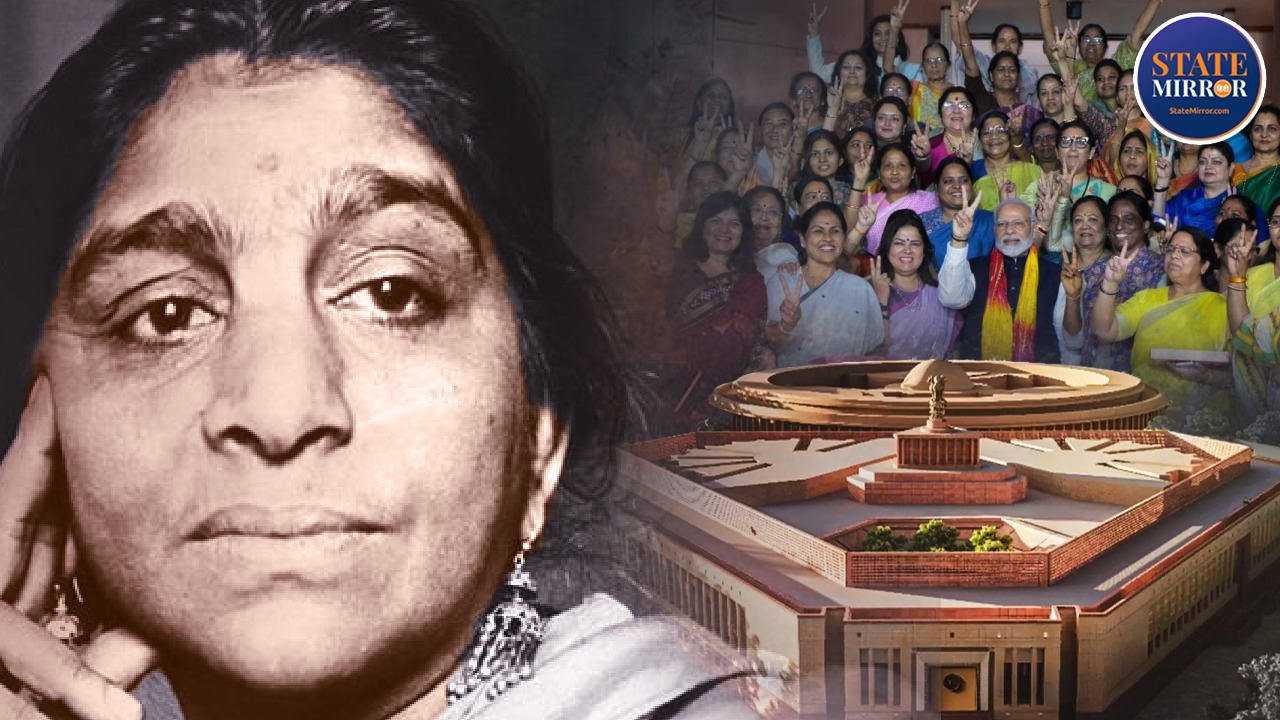
Women’s Reservation Controversy: Nari Shakti Vandan Act & Sarojini Naidu Story. Women Rights India

Once again the political temperature is at its peak regarding women’s reservation. The special thing is that all the parties are in favor of the Nari Vandan Act, but a political debate has erupted regarding its implementation. Along with this, there is also discussion about which of the women have raised their voice so far. Sarojini Naidu’s name also comes up in this discussion. Sarojini Naidu is one of the two frontline women of the country who raised their voice for women’s rights.
In fact, Sarojini Naidu and Begum Shahnawaz (Begum Jahanara Shahnawaz) were two important pillars of the Indian women’s movement, who, despite different political backgrounds, raised their voice together on many platforms for women’s rights. The “connection” between the two was not through any family or direct relationship, but rather a relationship of ideological and political cooperation, which focused on issues such as Indian women’s suffrage, education and political participation.
What was the connection between Sarojini Naidu and Begum Shahnawaz?
Sarojini Naidu and Begum Jahanara Shahnawaz were both active in women’s rights movements in the 1920s–1930s. Their most important common platform was the “All India Women’s Conference (AIWC)” and various political dialogues of the British era, where Indian women’s suffrage and political representation were discussed.
When was participation in the women’s suffrage movement?
Both the leaders strongly put forward the demand of giving the right to vote to Indian women before the British administration of that time around 1917–1919. Sarojini Naidu was part of the delegation that advocated for women’s rights before the British government. Round Table Conference (1930–32) In the Round Table Conference held in London, both the leaders also talked about the political rights of Indian women. Their objective here was to ensure that women get equal status in the future constitution.
Although Sarojini Naidu was associated with Congress and Begum Shahnawaz with Muslim League, both of them worked beyond party boundaries on the issue of women’s rights. It was the biggest feature of that era that women leaders gave priority to “gender equality” despite ideological differences.
Sarojini Naidu’s struggle which ones Appears in stages?
1. 1917 – Women’s Suffrage Delegation: Sarojini Naidu met the British government with a women’s delegation in 1917 and demanded the right to vote for Indian women. This is considered to be the beginning of the organized women’s suffrage movement in India.
2. 1918-1919 – Support of reform proposals: During the Montagu–Chelmsford Reforms, she strongly advocated the inclusion of women’s political rights.
3. 1925 – As Congress President: In 1925 she became the President of the Indian National Congress. From this platform he emphasized on women’s education, political participation and social freedom. This was very historic at that time because it was the first time that an Indian woman became the President of the Congress.
4. 1930 – Civil Disobedience Movement: She was actively associated with Mahatma Gandhi during the Salt Satyagraha. She inspired the participation of a large number of women in this movement and gave the message of women coming into public life.
5. 1931 – Round Table Conference: In this conference held in London, she clearly said that any constitution would be incomplete without equal participation of women.
6. 1942 – Quit India Movement: Although she went to jail, even at this time she described women as the backbone of the freedom movement.
Begum Jahanara Shah Nawaz also did important work for women’s suffrage and education in the 1930s. She was a prominent voice for the political participation of Muslim women. She proved that women’s rights are not a matter of any one community or ideology, but an issue of the entire society.
The relationship between Sarojini Naidu and Begum Shahnawaz is a symbol of the unity of the Indian women’s movement, in which political and religious differences were left behind and women’s rights came forward. While Sarojini Naidu raised the voice of women empowerment at the national level, Begum Shahnawaz especially strengthened the political rights of Muslim women. The contribution of both can be considered as the historical foundation of today’s “Nari Shakti Vandan Act” and the thinking of women’s reservation, which proves that the fight for women’s rights in India has been a long and shared struggle.
What is Nari Vandan Act?
Nari Shakti Vandan Adhiniyam 2023 is a historic law passed by the Government of India, under which a provision of 33% reservation has been made for women in the Lok Sabha and state assemblies. Its objective is to increase the participation of women in politics and ensure their strong presence in the decision making process. This law is considered a big step towards gender equality by increasing women’s representation in Parliament and states. This is an important achievement of the long-running women’s empowerment movement, which aims to make democracy more inclusive and balanced.

Comments are closed.