
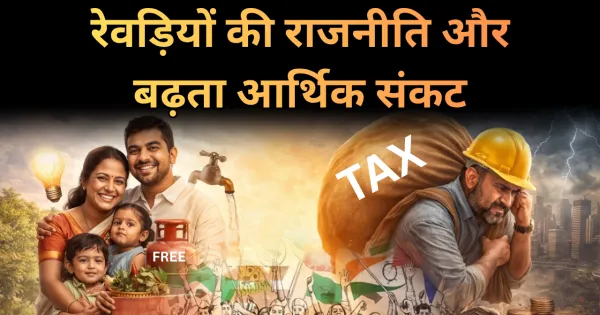
Crowd politics and growing economic crisis, who will pay the price of development in democracy?

Rajesh Jain, senior journalist-
In India’s democratic politics, the focus of policies has increasingly shifted towards freebies, but what is the cost of this model? Is this really a path to empowerment of the poor or a long-term risk of weakening the economy?
There has been a major change in the democratic politics of India in the last decade. The focus of policies has increasingly shifted towards freebies. These schemes, once seen as social security tools, have now become the center of election strategy. Cash transfers, free ration, monthly assistance for women, electricity and water subsidies – all these together have created a model in which the mathematics of winning elections is directly linked to ‘direct benefits’, but what is the price of this model? Is this really a path to empowerment of the poor or a long-term risk of weakening the economy? This is the basic question of this entire discussion.
The biggest rise in the politics of freebies was seen after 2020, when the proportion of cash assistance and free services in election announcements increased rapidly in various states. West Bengal’s ‘Lakshmir Bhandar’ scheme, Madhya Pradesh’s ‘Laadli Behna’, schemes to send money directly into women’s accounts in Tamil Nadu, Karnataka, Telangana, Maharashtra and other states – all these set a new trend. Now the situation is such that election manifestos have started revolving more around ‘direct money and facilities’ than ‘promises of development’. A kind of competition has developed between political parties as to who will give more, who will give more quickly and which section will benefit directly. This competition has diverted democratic politics from ‘policy debate’ towards ‘economic offers’.
The most important aspect of freebies politics is to keep women voters at the center. In almost every state, separate schemes are being made for women, in which cash assistance ranging from Rs 1000 to Rs 2500 is being given every month. There is clear mathematics behind this strategy. In many states the number of women voters is equal to or more than that of men. In states like Tamil Nadu and Kerala, the voting percentage of women is more than 50 percent. In such a situation, this class can decisively influence the election results.
The social impact of these schemes has also been visible. In many poor families, women have for the first time received regular cash in their hands, which has increased their influence in household decisions, but this also raises the question whether this is real empowerment or just a new form of economic dependence?
The biggest criticism of freebies concerns its economic impact. Statistics show that in many states the expenditure of these schemes has reached 30 to 40 percent of the total revenue. This simply means that governments are left with less money for development works.
In Madhya Pradesh, about Rs 50 thousand crores are being spent annually on Ladli Brahmin and other subsidy schemes. About Rs 1 lakh crore is needed every year to fulfill the election promises in Telangana. The situation is more serious in Punjab, where there is a huge gap between income and expenditure and the budget balance has deteriorated. The effect of this is that governments are continuously taking loans. The debt-to-GSDP ratio is increasing, increasing the risk of future financial crisis. In small states, the situation has become so serious that even giving salaries and pensions is becoming a problem.
When a large part of the budget is spent on freebies, development projects are the first to be affected. Roads, bridges, irrigation, education, health – all these sectors gradually get affected due to lack of funds. In states like Rajasthan, the budget of road and water projects had to be reduced. Some traditional schemes had to be stopped in Maharashtra. This means that relief being given for immediate political gain is undermining long-term growth. This situation creates a ‘trade-off’ – should governments provide relief today or invest for the future? If this balance is disturbed, it could have a serious impact on employment, industrial development and economic growth in the coming years.

Comments are closed.