

All taxes on gasoline, oil, and aviation fuel, including environmental protection tax, value-added tax (VAT), and special consumption tax, will be reduced to zero under a resolution passed by the NA on Sunday.
The environmental protection tax on gasoline (excluding ethanol), diesel, aviation fuel, kerosene, and mazut will be cut to VND0, while the special consumption tax on gasoline will also be reduced to 0%. Gasoline, diesel, and aviation fuel will be exempt from VAT declaration and payment, although input VAT will remain deductible.
The policy will take effect from April 16 through June 30.
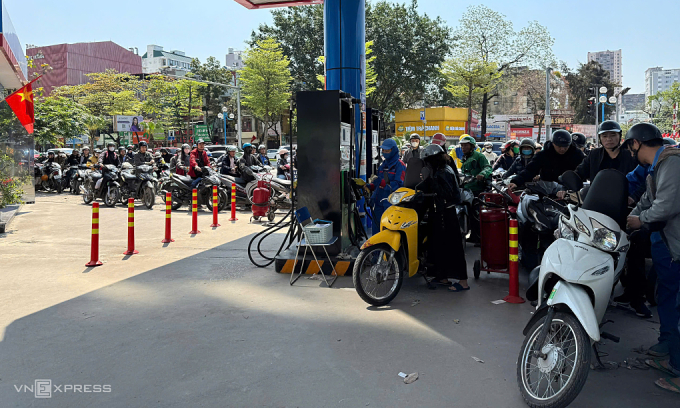
Motorists queue to refuel at a gas station on Hoang Quoc Viet Street in Hanoi, March 10, 2025. Photo by Read/Giang Huy |
Businesses and importers of gasoline, oil products — including diesel, kerosene, and mazut — and aviation fuel will not be required to declare or pay VAT at either the import or sales stages.
In emergency situations, the government is authorized to adjust the policy’s duration, either shortening or extending it, and report to the NA at its nearest session.
According to the Ministry of Industry and Trade, taxes account for a significant share of fuel base prices, with VAT contributing around 7.4%, environmental protection tax 2.7-6%, and special consumption tax about 6.7%. Eliminating these taxes is therefore seen as a measure to support socio-economic development targets and contain inflation.
Environmental protection tax, VAT, and special consumption tax on gasoline (excluding ethanol), diesel, and aviation fuel have already been reduced to zero under Decision 482 issued by the Prime Minister, effective through April 15 under emergency provisions of the Law on Government Organization.
However, kerosene and mazut have remained subject to environmental protection taxes of VND600 (US$0.023) and VND1,000 per liter or kilogram, respectively, along with a 10% VAT.
According to a government report, reducing environmental protection tax on all fuel types to zero is expected to lower state budget revenues by an average of VND7.3 trillion ($277.19 million) per month.
However, the government described the move as a “special fiscal measure applied in exceptional circumstances” to mitigate the impact of global energy price volatility and help maintain macroeconomic stability and social security.
The ongoing conflict in the Middle East has significantly affected global energy markets, including Vietnam, driving fuel prices to surge. Since late February, domestic fuel prices have undergone 15 adjustments. RON 95-III gasoline, the most popular in Vietnam, is priced at VND23,540 per liter, while diesel stands at VND32,960 per liter, after previously peaking at nearly VND34,000 and VND45,000 per liter, respectively.
The government has also introduced additional measures to manage fuel prices and support businesses and consumers, including the use of the price stabilization fund and allocating an additional VND8 trillion from the state budget as an advance to the fund.
Comments are closed.