
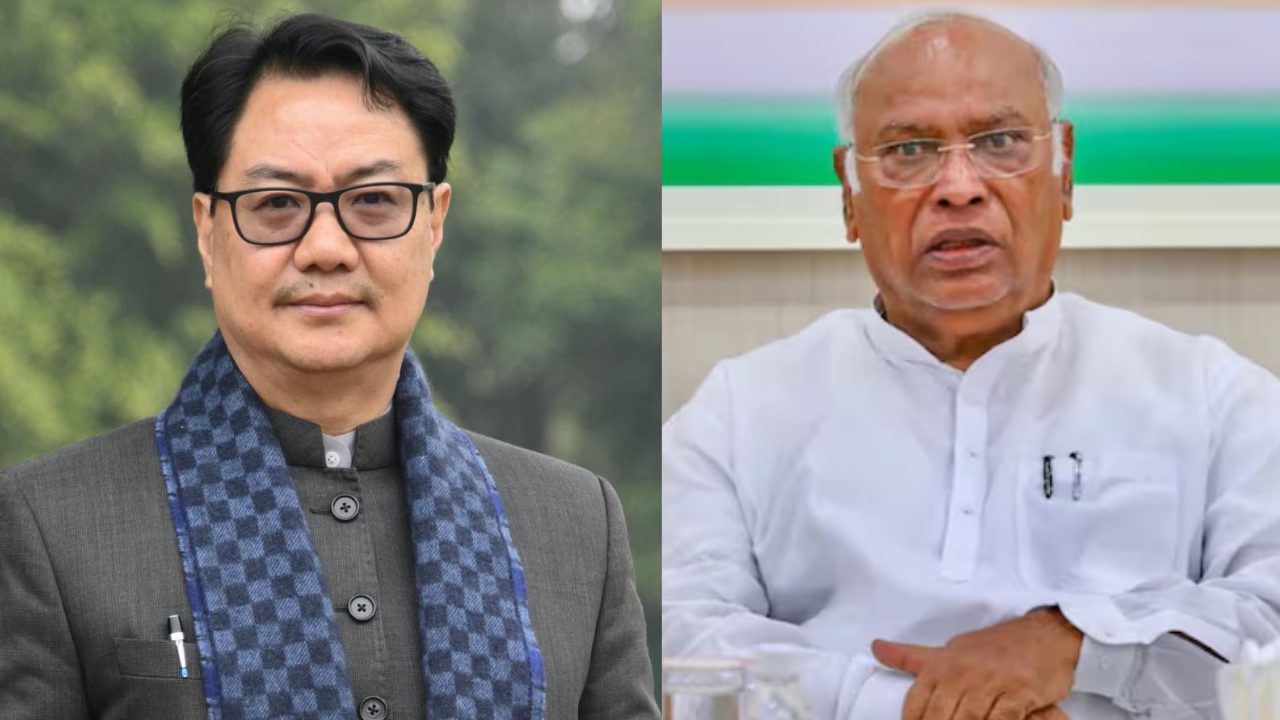
Union Minister Kiren Rijiju wrote a letter to Mallikarjun Kharge, sought cooperation in building consensus on the Women’s Reservation Bill and getting it passed quickly, read full news.

Union Minister Kiren Rijiju has written a letter to Leader of Opposition in Rajya Sabha Mallikarjun Kharge. In this, the government has sought their help in passing the Women’s Reservation Bill and implementing it quickly. The government has clearly stated that if there is any delay in this process, it will directly impact the implementation of the women’s reservation law before the 2029 general elections.
Rijiju in his letter emphasized that the Nari Shakti Vandan Act, passed unanimously by the Parliament in the year 2023, reflects a long-standing national desire and collective commitment of all political parties to empower the women of the country. He clarified that this Act was the result of a true concerted effort of all political parties and national will, symbolizing our collective promise for our women power across the country.
A special session of Parliament is scheduled from April 16 to April 18, 2026. During this important session, the Women’s Reservation Act and the necessary changes related to it are expected to be discussed in detail. Its primary objective is to build consensus among political parties, so that this historic law can be effectively implemented as soon as possible.
Rijiju stressed on early implementation of the bill
Rijiju, in his letter, laid special emphasis on the need for early implementation of the bill. He said the delay could seriously impact its chances of being implemented before the next general elections. Rijiju wrote, “Even then, most parties and stakeholders believed that it should be implemented as soon as possible. Today, we are in 2026 and if we do not act now, women’s reservation may not be implemented until the 2029 elections.”
“Therefore, in our view, this is the most appropriate and logical time to move forward with the necessary changes,” he added. Union Minister Rijiju rejected the allegation that the government had not consulted the opposition. He made it clear that contacts between the government and the opposition are continuing. “On the issue of consultation, I respectfully disagree that the government has not engaged with the opposition,” he wrote.
Rijiju informed in his letter that since March 19, 2026, several meetings have been held with Samajwadi Party, DMK and other parties. Along with this, meetings have also been held with the allies of NDA on this subject. The minister assured that the government is fully prepared for further talks with the opposition to ensure consensus. He wrote, “We are fully ready for further talks with you and your colleagues, because our aim is only to implement the Nari Shakti Vandan Act as soon as possible.”
He also said that the issue of women’s reservation has been a topic of discussion in Indian politics for decades. He made an emotional appeal for everyone’s support for the smooth passage of this historic law. Rijiju wrote in his letter, “In view of the above and the overwhelming consensus already building, I heartily request your valuable support in smoothly passing this historic legislation, which will empower crores of women across the country.”
Need for change in Nari Shakti Vandan Act
Nari Shakti Vandan Act is commonly known as Women’s Reservation Act. The budget session of Parliament has been extended, and a three-day special meeting of the House has been called on April 16. After the implementation of this law, the number of Lok Sabha seats will increase to 816, out of which 273 seats will be reserved for women. This provision will strengthen women representation.
The provision of giving 33 percent reservation to women in the Lok Sabha and state assemblies was brought by changing the Constitution in the year 2023. However, according to the original law, this quota of women would have come into effect only after the completion of the delimitation work based on the 2027 census. This meant that if no changes were made, this reservation would not be implemented before 2034.
To implement this from the 2029 Lok Sabha elections, there is a need to change the Nari Shakti Vandan Act. For this reason, the government is calling a special session to pass necessary changes in the law. The purpose of this amendment is to implement women’s reservation with immediate effect, so that women can ensure their share from the next general elections itself.
PM Modi had also appealed
Earlier, Prime Minister Narendra Modi had also said that it is necessary that the 2029 Lok Sabha and Assembly elections be held with women’s reservation. He had asked all political parties to come together in one voice to pass changes in the Women’s Reservation Act, so that this historic step can be taken on time.
Ahead of the three-day special meeting of Parliament, in a letter to the floor leaders of Lok Sabha and Rajya Sabha, PM Modi had also said that any society truly progresses only when women get full opportunity to progress, take important decisions and most importantly, lead. His statement shows the government’s commitment towards women empowerment.
The Prime Minister, in his letter dated April 11, clearly said, “It is necessary that the 2029 Lok Sabha elections and Assembly elections be conducted with women’s reservation.” PM Modi expressed confidence that the implementation of the Women’s Reservation Act in 2029 will bring a new energy to India’s democratic institutions and strengthen people’s trust. He also said that this will ensure more participation and representation in governance, which will further strengthen democracy.
Promises to India’s women cannot become politics of postponement.
Today, when it is time to deliver the #NariShaktiVandan Adhiniyam, hesitation & questions are being raised. I respectfully differ.I have written to Shri @kharge ji, placing the facts on record & reiterating the… pic.twitter.com/6qvNUgdJ8a
— Kiren Rijiju (@KirenRijiju) April 12, 2026

Comments are closed.