
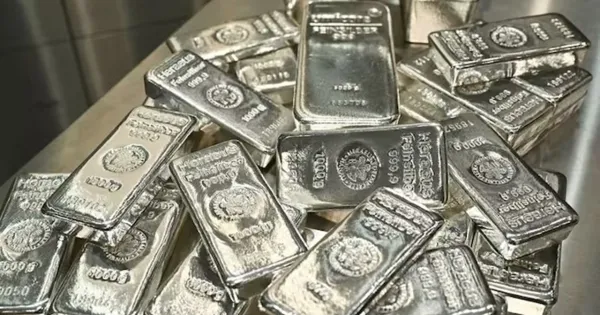

Silver, once known as the ‘gold’ of the poor, has attracted the attention of industry investors and policy makers by registering a huge jump of nearly 180 per cent in just the last 12 months.
If any metal has surprised the most in the last one year, it is silver. Silver, once known as the ‘gold’ of the poor, has attracted the attention of industry investors and policy makers by registering a huge jump of nearly 180 per cent in just the last 12 months. The increasing use of green energy, electric vehicles and solar panels has positioned silver as a strategic metal of the future.
The main reason for its rise is the gap between demand and supply and geo-politics is also playing a big role. On the other hand, due to the many restrictions imposed on its export this year by China, the second largest producer of silver in the world, it is believed that the shine of silver will remain intact in the coming months also. However, this increase in silver is not just recent, in the last 45 years its prices have increased by about 88 times.
In fact, earlier most of the use of silver was limited only to jewelery and utensils etc., but now as the country is moving towards green and clean energy, the consumption of silver in related industries like batteries of electric cars and solar power panels is increasing rapidly. This has become the strongest factor driving the demand for silver and consequently its prices. According to a study, up to 59 percent of silver has started being used in green and clean energy and its other equipment.
Silver mining activities have seen a decline over the last ten years. According to the latest report of ‘World Silver Survey’, global production of silver was 89 crore ounces in 2015, which will fall to 82 crore ounces in 2024. That means its production has declined by 8.6 percent, while demand has increased by 17 percent during the same period. This difference (gap) in demand and supply is also increasing the prices. Mexico is the largest producer of silver with production of 200 million ounces (about 6300 tons).
Market experts or investors have also understood that there is not enough supply of silver, hence investors have also started investing in it. Apart from this, the eyes of the Central Banks are also now fixed on silver and it seems to them that they can also keep silver in their reserves. This is expected to increase additional demand for silver in the market. According to a report, investment made in silver in the year 2025 has given returns of 150 to 180 percent.
There are also geopolitical reasons behind the increase in silver prices. The Trump camp believes that the future war will be fought not on oil but on technology and metals. Due to this, America has recently put silver and copper in the category of ‘rare metals’. In view of this, China has also started taking strict action on the export of silver. This has also affected the prices of silver. According to a report, due to China’s export restrictions, the global silver supply may decrease by 60 percent.
In fact, there are two major technical problems in meeting the demand for silver. First, about 70-80 percent of silver is produced as a by-product from other metals like lead, zinc copper or gold mines. When a metal is a by-product, its production cannot be increased simply to meet its own demand. There are very few mines in the world that extract only silver.
Second, a large part of silver is used in solar panels, semiconductors and medical equipment or devices. Unlike gold, most of it is permanently consumed in these products. Also, recycling it is financially costly. For this reason, it exits the market permanently. That means new silver is required every time it is used in the product.
Silver paste is also used on photovoltaic solar panels. It is noteworthy that silver has the ability to conduct electrons generated from sunlight with very little loss. A solar panel requires 15 to 20 grams of silver. According to experts, solar capacity worldwide is expected to increase by 170 percent by 2030.
In fact, an average of 25 grams of silver is used in an EV. This silver is used in batteries, wiring power, electronics control units and charging stations. With the trend of EV, the demand for silver is also increasing. In America itself, there is a plan to install 28 million EV charging ports by 2030, in which there will be a huge consumption of silver. (These are the personal views of the author.)

Rishabh Mishra, Assistant Professor, Kanpur IIT.

Comments are closed.