
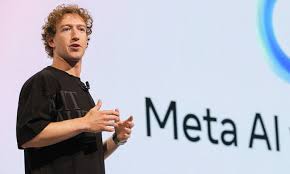

It has been reported that Zuckerberg is developing an AI copy of himself for Meta. The intention behind it is quite basic to allow employees to engage with the digital avatar of himself in his absence.
Rather than presenting this technology as a substitute for himself, he has positioned it as a means to engage in conversation with employees, offer advice, and share feedback.
As per media reports, this avatar will be created using photorealistic 3D models that are capable of responding to queries in real-time.
In addition, the avatar is equipped with speech capabilities and can respond with the same style and tone of Zuckerberg. This artificial intelligence system has been developed using Zuckerberg’s voice, video lectures, and behavioral tendencies.
The objective was to make the interaction seem like a real conversation with him. The employees would be able to pose their queries to the computer and receive responses instantly without needing any meeting or having to go through several managerial levels.
Meta’s Dual Strategy for AI Identites of Mark Zuckerberg
This project also fits into a wider push at Meta. The company has spent years working on avatars and virtual presence. It has already built tools for digital identities in social and work settings. The Zuckerberg avatar may act as a test case for a larger plan. If it works well, similar systems could be offered to creators, leaders, and public figures.
The system would rely on a mix of speech models, vision models, and behavioral data. It would not just repeat answers. It would generate responses based on how Zuckerberg tends to think and speak. That is the key idea. The value is not just access, but access that feels personal and consistent.
Zuckerberg is said to be involved in the process. Reports claim he spends several hours each week working on AI projects. He reviews technical work and helps shape how the system behaves. This is not a hands-off effort. He appears to treat it as a core part of Meta’s AI direction.
There may also be a second system in development. A report by The Wall Street Journal earlier this year said Zuckerberg was building an AI assistant for himself. That tool would help him get quick answers and reduce reliance on internal layers. It would act more like a personal decision aid.
This means there are likely two related efforts. One is inward-facing, helping Zuckerberg run the company. The other is outward-facing, letting others interact with a version of him. They serve different roles, but they draw from the same idea: AI can compress time and access.
Scaling Leadership and Culture Through AI Avatar of Meta
Meta’s reasons are clear. The company wants to lead in AI. It has shifted focus toward building models, tools, and platforms that can scale across its apps. An avatar like this shows what its tech can do. It also reinforces an internal culture where AI is part of daily work.
There is also a signaling effect. If employees can “talk” to the CEO through AI, it sends a message about openness and speed. It suggests fewer barriers between leadership and teams. Whether that holds true in practice is still an open question.
There are limits and risks. An AI avatar can only reflect past data. It may not capture nuance in new or complex situations. It may also present answers with confidence even when the real answer is uncertain. That could lead to confusion if employees treat it as a final authority.
Trust is another issue. People may ask: are they speaking to the real decision-maker, or a model trained on past behavior? If the avatar gives guidance, does it carry the same weight as a direct statement from Zuckerberg? These questions matter in a company setting.
There is also the risk of overuse. If employees rely on the avatar too much, it could replace real discussion rather than support it. That may reduce debate and limit diverse views. Tools like this work best when they assist, not replace, human judgment.
Meta’s AI Leadership Experiment
For now, this remains a reported project. Meta has not shared full details on how it will roll out or how widely it will be used. The concept is clear, but the real test will be adoption. Do employees trust it? Do they find it useful? Does it save time without adding confusion?
If it succeeds, it could set a pattern. Other leaders may build AI versions of themselves. Creators may do the same for fans. This would change how people interact with public figures and decision-makers. It would also blur the line between a person and their digital twin.
The idea is not science fiction anymore. It is a practical step in how AI enters daily work. The outcome will depend on how well it balances speed, accuracy, and trust.

Comments are closed.