
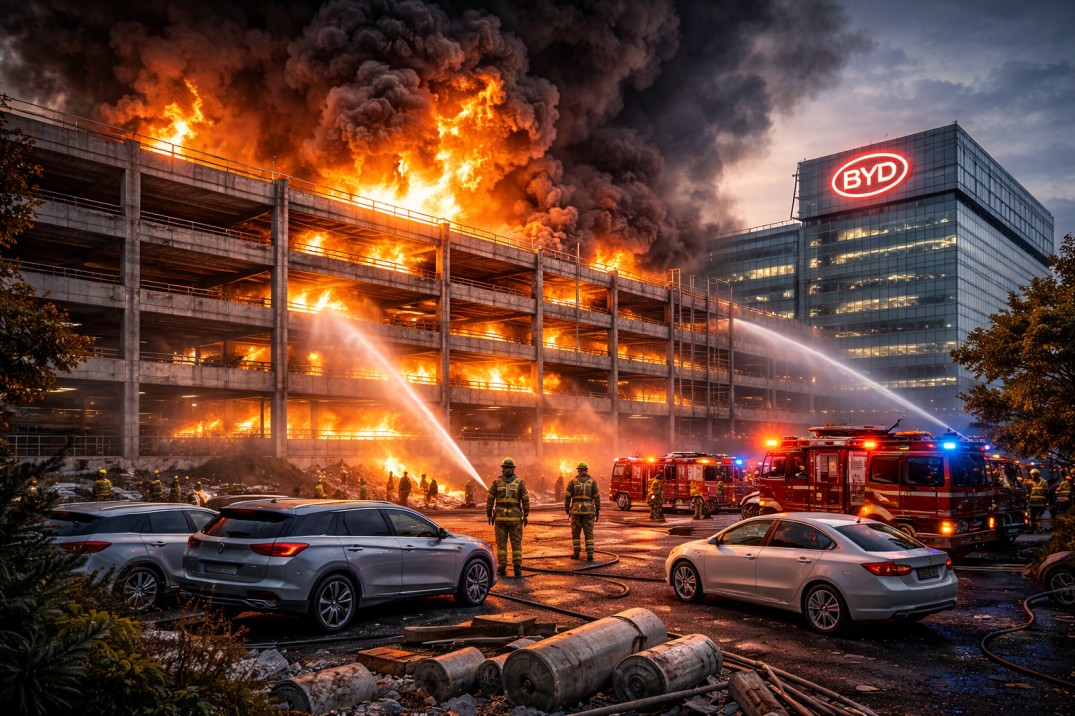

The fire did not begin with a bang, at least not one that carried far beyond the industrial park. It began quietly, in the early hours before dawn, when most of Shenzhen was still asleep. By the time it was visible to the wider city, it had already taken hold. Flames climbed through a multi-storey parking structure inside BYD’s vast campus, sending thick smoke into the sky and drawing attention far beyond the factory gates.
The incident, which broke out around 2:48 a.m. on April 14, quickly became a focal point of concern—not only because of its scale, but because of where it occurred. BYD is not a minor player. It is one of the world’s largest electric vehicle manufacturers, and any fire within its facilities carries immediate weight, particularly in an industry where battery safety is closely watched.
Early reports and widely shared footage showed intense flames engulfing sections of the parking structure, sometimes described locally as a “stereo garage.” The fire spread across multiple levels, with black smoke visible from surrounding districts. For several hours, the scene looked dramatic enough to invite speculation about what, exactly, was burning.
A fire contained, but questions raised
Local fire crews responded quickly, and by morning the blaze had been brought under control. Authorities confirmed that no injuries or fatalities had been reported, a detail that shaped much of the official response. The absence of casualties allowed the focus to move quickly toward cause and impact.
According to statements from BYD and local officials, the affected structure was not part of the company’s main production line. Instead, it was used to store test vehicles, decommissioned units, and some unused equipment. That distinction mattered. It separated the incident from active manufacturing and, just as importantly, from customer vehicles.
BYD moved early to stress that its production activities continued without interruption. Assembly lines remained operational, and the fire was described as isolated to the parking facility. For a company of its scale, maintaining continuity is not just a logistical issue but a reputational one. Any hint that production had been disrupted would have carried wider consequences.
Nearby areas were affected in more immediate ways. The heavy smoke led to temporary closures, including a local school, and traffic in the vicinity was restricted. These measures reflected the practical challenges of managing a large fire in a dense urban-industrial area, even when the incident itself was contained within a single structure.
What drew particular attention, however, was the nature of the vehicles involved. Electric vehicles, and the batteries that power them, have been the subject of ongoing scrutiny when it comes to fire risk. Any blaze involving a facility linked to EV storage or testing inevitably raises the question of whether batteries played a role.
Authorities were quick to address that point. Preliminary findings pointed away from battery-related causes. Officials stated that there was no indication of self-ignition involving lithium-ion batteries, nor any defect linked to production vehicles. Instead, the cause was traced to construction activity near the garage.
The explanation centres on insulation materials used during nearby work. According to initial reports, flammable insulating wool or similar material was mishandled and ignited, leading to the fire. This version of events places the origin of the blaze outside the vehicles themselves and within a more conventional category of industrial accidents.
That distinction is not trivial. In an industry where perception matters, separating the fire from battery systems helps limit broader concerns. It frames the incident as a site-specific lapse rather than a product-related issue.
Industry scrutiny and the limits of reassurance
Even with that explanation, the fire did not pass unnoticed. Social media posts and unofficial accounts circulated rapidly, some suggesting alternative causes or more severe consequences. Claims of battery failures or trapped workers appeared online, though none were confirmed by official sources. In situations like this, the gap between verified information and speculation can widen quickly.
Mainstream reporting, including coverage from international outlets, has remained consistent with the official account. The focus has been on construction-related causes, the absence of casualties, and the limited impact on production. Still, the volume of attention reflects a broader sensitivity around electric vehicle safety.
The EV industry has spent years addressing concerns about battery fires. While such incidents are statistically rare, they tend to draw outsized attention when they occur. The reason is simple. Lithium-ion batteries behave differently from conventional fuel systems, and fires involving them can be more difficult to extinguish.
In this case, officials have taken care to state that the vehicles involved were not active production models and that the fire did not originate from battery systems. That message is aimed not only at local observers but at a wider audience that includes investors, regulators, and consumers.
The market response was relatively muted. Shares linked to BYD saw a slight dip in early trading, but there was no sharp reaction. This suggests that investors viewed the incident as contained and unlikely to affect the company’s broader performance. The quick release of information may have helped limit uncertainty.
Still, the event highlights how closely industrial incidents are now tied to brand perception. For a company like BYD, which operates at large scale and under intense scrutiny, even a fire in a non-production area can become a headline. The challenge lies in managing not just the incident itself, but the narrative that follows.
The cause identified—improper handling of construction materials—points to a familiar category of risk in large industrial sites. Facilities of this size often undergo continuous modification, maintenance, and expansion. Each of those activities introduces variables that sit outside the routine flow of production.
What the incident shows is that risk does not only come from the technology a company builds, but also from the environment in which it builds it. A lapse in handling materials can have consequences that spread quickly, particularly in enclosed structures like multi-storey garages.
For local authorities, the next step involves confirming the preliminary findings and determining whether any regulatory breaches occurred. Investigations of this kind often focus on compliance with safety protocols, oversight of construction work, and the handling of flammable materials.
For BYD, the immediate task has been to contain the damage and reassure stakeholders. The company’s statements have been consistent in emphasising that the fire was isolated and that production remains unaffected. That message aligns with the available facts, but it also reflects the need to maintain confidence in a competitive market.

Comments are closed.