
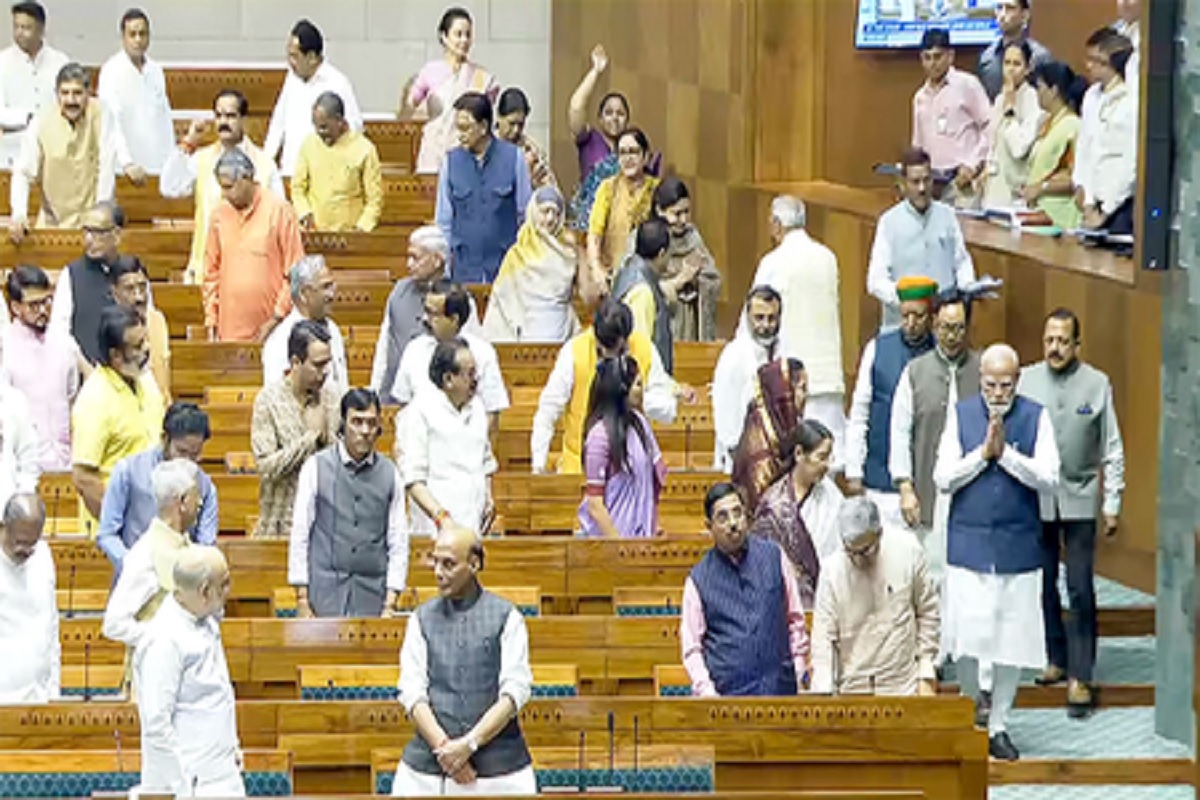

An important legislative contest is being witnessed in the Lok Sabha during the three-day special session of the Parliament. Of the 333 MPs present in the House, 207 voted in favor of introducing the bill, while 126 MPs opposed it. With this, a high stakes political confrontation has started in the House.
According to Article 368 of the Constitution, passing any constitutional amendment bill requires a majority of the total membership of the House as well as a majority of at least two-thirds of the members present and voting. After the bill is passed by both the houses, it is sent for the approval of the President.
At present the effective membership of the Lok Sabha is 540, as three seats are vacant. In such a situation, if all the members participate in voting, then at least 360 votes will be required to pass the bill.
The ruling party National Democratic Alliance (NDA) has about 292 seats in the Lok Sabha, due to which it has a simple majority, but for two-thirds majority it will have to gather the support of other parties. The opposition India Alliance and its allies have about 229 seats, while other parties have 12 seats. Apart from this, seven independent MPs are also present in the House.
BJP, the main party in NDA, has 240 seats, while TDP has 16 MPs and JDU has 12 MPs. In the opposition camp, there are 98 MPs from Congress, 37 from Samajwadi Party, 28 from TMC and 22 from DMK.
Other parties include YSRCP, Aam Aadmi Party and AIMIM.
This entire arithmetic makes the voting on the Constitution (131st Amendment) Bill, 2026, Jammu and Kashmir Laws (Amendment) Bill, 2026 and Delimitation Bill, 2026 very important.
Under the proposed bill, there is a provision to increase the number of Lok Sabha seats from 543 to 850. This has been linked to the implementation of the 33 percent women’s reservation law. Although the Women’s Reservation Act has been passed in 2023, it has not been implemented yet due to the pending delimitation process.
The government aims to implement these provisions before the 2029 Lok Sabha elections. The Jammu and Kashmir Laws (Amendment) Bill, 2026 seeks to clarify representation for the Assemblies of Delhi, Jammu and Kashmir and Puducherry.
Through the Delimitation Bill, 2026, the boundaries of constituencies will be redrawn on the basis of population. The last census was conducted in 2011, while the 2021 census was postponed due to the COVID-19 pandemic.
The opposition has strongly opposed the delimitation, calling it an attack on the federal structure. Especially southern states like Tamil Nadu, Kerala and Telangana have expressed apprehension that this may give more representation to Hindi speaking states like Uttar Pradesh and Bihar.
Both the ruling party and the opposition are busy making strategies in the House at their respective levels.
Meanwhile, Prime Minister Narendra Modi responded to the opposition’s allegations by strongly supporting women’s reservation in the House. “Those who oppose the Women’s Reservation Bill will have to pay the price for it in the long run,” he said. He appealed to all the parties not to give political color to this issue and together strengthen the democracy of the country.
Also read-
Sehwag revealed why Delhi did not buy Kohli in IPL 2008

Comments are closed.