

As Union Home Minister Amit Shah and Law Minister Arjun Ram Meghwal sought to simultaneously introduce the Constitution (131st Amendment) Bill, the Delimitation Bill and Union Territories Laws (Amendment) Bill in Lok Sabha, on Thursday, the House witnessed a rare event exposing the challenge that the Centre may face on Friday when these Bills are put to a vote.
Also read | Women’s quota and delimitation: Experts flag lack of consultation | Capital Beat
While it is not unusual for Opposition parties to oppose the introduction of Bills on various grounds, what Lok Sabha saw on Thursday was the Opposition forcing a division of votes at the introduction stage instead of accepting a decision on the motion taken through a voice vote. Usually, Opposition outfits seek a division of votes when contentious Bills are being passed in either House of Parliament after having gone through the stages of introduction and consideration. The division provides the exact count of votes cast in favour and against a Bill.
Opposition tests waters, warns govt
Seeking a division at the introduction stage is rare since even a Constitution Amendment Bill, which requires two-thirds majority to be passed in either House, is allowed to be introduced if backed by a simple majority. The Opposition, obviously, would have known that demanding a division at the introduction stage will not derail the Centre’s bid to push the three highly controversial laws seeking to operationalise women’s reservation through a fresh delimitation exercise through the introduction and consideration stages.
As expected, Lok Sabha Speaker Om Birla allowed the Bill’s introduction after 251 votes were cast in favour of Meghwal’s motion against the Opposition’s 185. The Opposition’s move, however, was significant.
For, in forcing a division of votes at the introduction stage, the Opposition was both testing the waters and cautioning the government on the fact that it lacks the numbers to get the Constitution (131st Amendment) Bill passed in the absence of the unanimity that Parliament had shown in enacting the women’s reservation law – the Naari Shakti Vandan Adhiniyam – in September 2023. Since the other two Bills introduced simultaneously are entwined with the Constitution (131st Amendment) Bill, the Centre’s failure to have the latter passed in Lok Sabha on Friday could, in effect, stall the full legislative package for which Parliament’s budget session was extended.
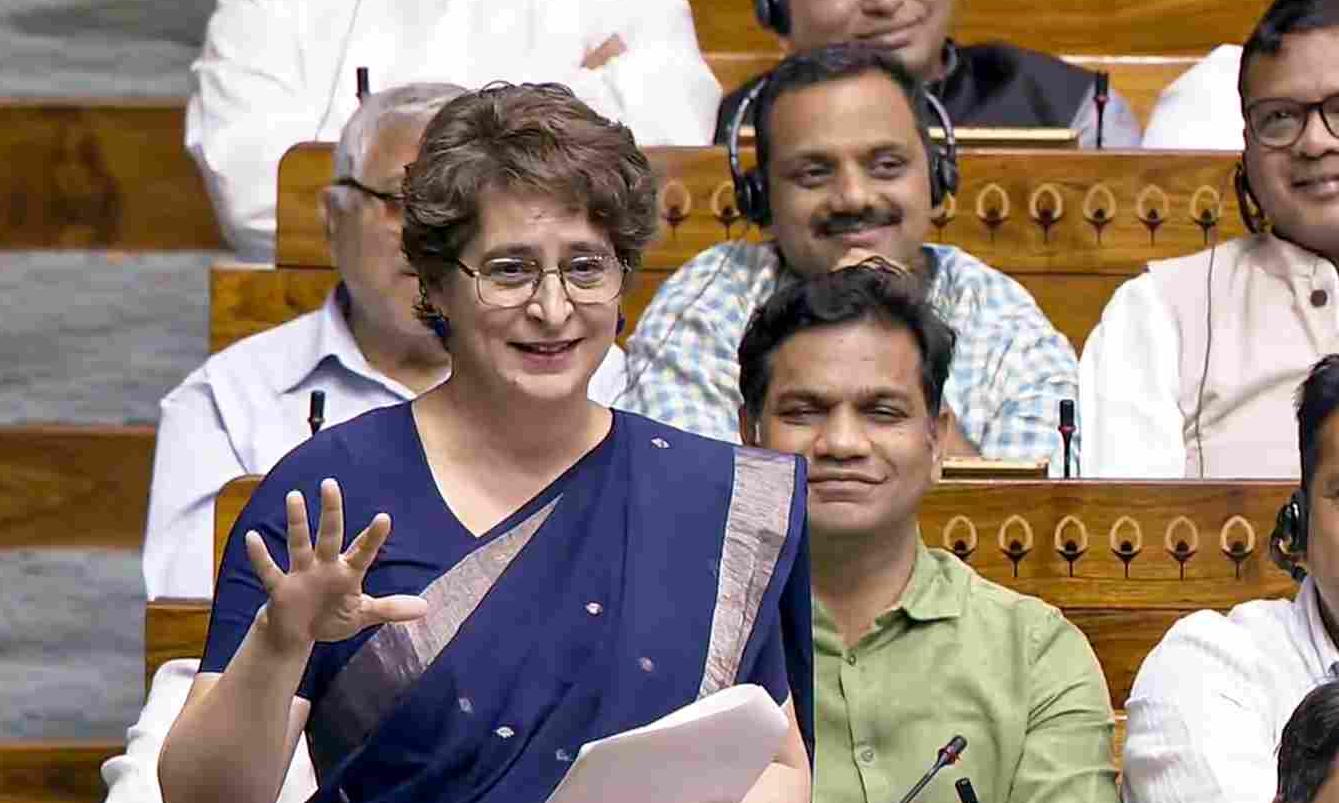
Throughout the highly charged discussion on the three Bills on Thursday, which saw Congress MPs Gaurav Gogoi, Priyanka Gandhi, Manish Tewari, Samajwadi Party’s Akhilesh Yadav, Trinamool Congress’s Kakoli Ghosh Dastidar, Shiv Sena-UBT’s Arvind Sawant and others tear into the “political intent” behind the proposed laws and Prime Minister Narendra Modi, Home Minister Shah and other voices from the government rebutting the charges, what was clear was that no meeting ground had been found between the Opposition and Treasury Benches on the contentious legislative business.
Numbers stack against Centre
This naturally raises the question of what could happen when, tentatively at 4 pm on Friday, the Bills are put to a vote to be passed by the Lower House. With three seats vacant, the Lok Sabha currently has 540 MPs, putting the two-thirds majority mark required to pass the Constitution (131st Amendment) Bill, at 360 MPs. The ruling NDA coalition, which consists of 293 MPs in the Lok Sabha – 67 MPs short of the two-thirds majority, cannot hope to have the amendment passed if the Congress and its INDIA bloc allies refuse to back the Bill.
Sources in the INDIA bloc say they expect at least 240 Opposition MPs, including AIMIM chief Asaduddin Owaisi, three AAP MPs and some independents, to vote against the Bill. Congress president Mallikarjun Kharge had already announced on Wednesday after his meeting with various Opposition party leaders that they would collectively vote against the constitution amendment as they saw it as a “trap” to conduct an unfair and politically-motivated delimitation exercise under the garb of implementing one-third reservation for women in Lok Sabha and state assemblies as mandated through the Naari Shakti Vandan Adhiniyam.
Also read | Is BJP electoral juggernaut deciding the shape of women’s quota, delimitation bills?
As the numbers currently stack up and given the sharp divisions between the Centre and the Opposition, it appears that the Centre’s avowed move to expedite the implementation of women’s reservation following a delimitation exercise based on the 2011 Census is likely to fail.
It was obvious from the discussions in Lok Sabha on Thursday that the Opposition remained both unconvinced and suspicious of the Centre’s explanations about hastily pushing these Bills through Parliament. Amit Shah’s repeated assertions that the proposed constitution amendment and the Delimitation Bill will, in no way, alter the current proportion of seats that each state has in the Lok Sabha following a fresh delimitation exercise or that the formula to uniformly increase the current seats for each state by 50 percent found no takers in the Opposition. The Opposition was also clearly unaffected by Prime Minister Narendra Modi’s claim that those opposing the Centre’s bid to expedite the women’s reservation rollout today will face the wrath of women voters for a long time to come.
Opposition firm, Centre unmoved
The Opposition’s stand is clear. As pointed out during the discussion by leaders like Congress’s KC Venugopal and Manish Tewari, Trinamool’s June Maliah and the DMK’s A Raja, none of the assurances Shah gave to the House actually find any clear mention in the text of the three Bills. Further, Opposition leaders variously told The Federal that “even if we take Shah on his word, which itself would be suicidal given our experience with this government over the past decade”, the doubts that the Opposition has raised on the “fairness of a potential delimitation exercise” and the “apprehensions of southern states like Tamil Nadu”, it is “impossible” for the INDIA bloc to back the Bills in their current form.
The Opposition has, of course, continued to reiterate its commitment to women’s reservation. Many of its speakers on Thursday dared the Centre to “amend the current laws before they are put to a vote” on Friday, “remove the parts about delimitation” and “reserve one-third seats for women in the current strength of the Lok Sabha and state assemblies”. Doing so, the Opposition has said, will “address the concerns of the southern and smaller states” and also “prove that these Bills are not being passed in such hurry for the BJP’s political gains”. The Centre, predictably, has rejected the Opposition’s stance.
The three Bills, thus, are at a stalemate. The Centre is unwilling to amend them. The Opposition is determined to oppose them, even if the assurances given by Shah and Modi are woven into the text of the Bills.
With numbers not on the Centre’s side, its proposed constitution amendment could very well fall on Friday. The question then would be, what befalls the fate of women’s reservation.
Opposition denies quota delay claims
Opposition leaders insist that their decision not to support the Bills will have no adverse impact on the timeline of the women’s reservation rollout envisaged under the 2023 Act, leave alone stalling women’s reservation entirely.
Also read | Centre’s push for women’s quota tied to delimitation puts Opposition in a bind
Congress MP Praniti Shinde told The Federal“Where is the question of stalling women’s reservation because that has already been made part of the Constitution with the unanimous passing of the Naari Shakti Adhiniyam… the Centre is only misleading the country by saying those opposing the Bills are against women’s reservation when the fact really is that these Bills have nothing to do with women’s reservation; they are only a way to alter India’s political map through a delimitation exercise that will be dictated by the BJP and the government is using the issue of women’s reservation to hide this.”
The constitution amendment being defeated in Lok Sabha would essentially continue the women’s reservation rollout scheme that is currently on the statute. This means that the implementation of the one-third quota will continue to be contingent on a delimitation exercise carried out on the basis of the 2027 Census as opposed to the Centre’s current push for taking the 2011 Census as the population reference for a gerrymandering exercise that can be initiated immediately.
Debate over quota timeline
Congress communications chief and Rajya Sabha MP Jairam Ramesh says that the timeline for implementation may still not be deferred to beyond the 2029 Lok Sabha polls if the constitution amendment falls through.
Ramesh quotes the statements made by the Census Commissioner and other top officials at a press conference earlier this year when they claimed that the final Census figures would be tabulated by 2027, which means there would still be an entire year to carry out the delimitation exercise, which can then factor in caste data too for including a “quota within quota” for OBC women. As per Ramesh, if the Census Commissioner’s statement is to be believed, then the Centre will still have enough time to rollout women’s reservation with the 2029 Lok Sabha polls, which is also the same timeline that the government claims it would achieve if the current Bills are passed.
Also read | ‘Delimitation by stealth’: Opposition sees Centre’s ploy in early women reservation rollout
Samajwadi Party MP Sanatan Pandey argues that it is “basically to prevent implementing a quota-within-quota that the Centre wants to hurriedly go for delimitation based on the 2011 Census, which does not have caste-wise population figures, instead of the 2027 Census, which was the benchmark set in the 2023 Act that this same government had drafted.”
The Opposition believes that if the Bills fail to pass, the BJP is certain to “mislead the people” and claim women’s reservation rollout has been stalled by its rivals. The Opposition, however, believes that it can counter such a narrative by raising equally forcefully their demand to “delink women’s reservation entirely from delimitation” and “implement it immediately as per the current Lok Sabha and assembly numbers”.

Comments are closed.