
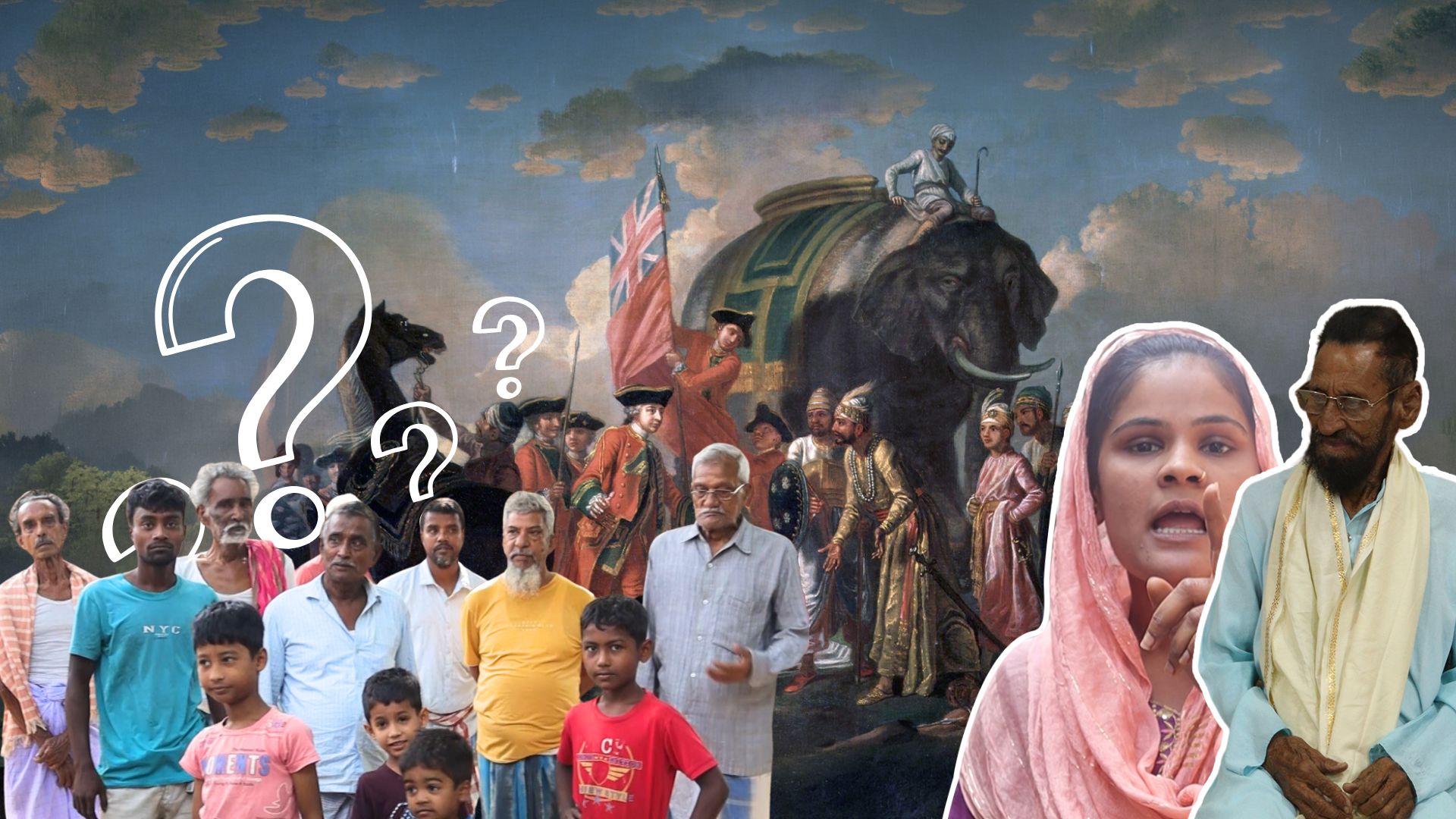

Murshidabad, once the capital of undivided Bengal which, also included modern-day Bihar and Odisha, Bangladesh, and other parts, has been in the news before the 2026 West Bengal Assembly elections for various reasons.
Also read: In Bengal’s migrant belt, women challenge identity politics with survival demand
One of them is a claim to history, identity and belonging in the district, which although steeped in royal legacy, is staring at an electoral crisis, thanks to a massive voter-roll revision. Even the descendants of the region’s noble families of the past have not found themselves above the crisis of identity and citizenship.
As the Muslim-majority district prepares to cast ballots on April 23, when the first phase of Bengal’s two-phase polling is held, let’s understand the situation from the perspective of a history which is more than two-and-a-half centuries old. Why are generations-old families, many of whose ancestors had enjoyed unparalleled authority in the region once, suddenly finding an existential crisis?
The turning point in history
In June 1757, a battle fought in Plassey (in the current-day Nadia district of West Bengal) between Nawab Siraj-ud-Daulah and the British East India Company forces led by Robert Clive changed India’s fate. The Nawab lost against the European opponents, and India’s independence was surrendered. However, it was not just a military loss. Even betrayal had a big say in the outcome.
Mir Jafar, a key commander of Siraj’s forces, was bribed by the British and he colluded with them, which proved to be crucial for the defeat of the Nawab, who was later killed by a Mir Jafar loyalist.
Also read: Polls a week away, 12,000 Murshidabad voters remain in a limbo | Ground report
Mir Jafar was installed as the Nawab after Siraj’s elimination, and the British East India Company’s rule in India had commenced. He had served two stints in the mid-18th century till his death in 1765.
Bengal’s history has not forgiven Jafar for his role in the Battle of Plassey. The name ‘Mir Jafar’ has become synonymous with a traitor in the state’s historical and political discourses even today. His descendants have always objected to this portrayal.
Amid historical ‘insult’, the SIR threat
Today, even as Mir Jafar’s descendants cope with the tag of “traitor”, they have confronted a new challenge, this time a political one. During the controversial Special Intensive Revision of electoral rolls in Bengal recently, around 190 members of the historical figure’s lineage have found their names removed from the voter rolls in Lalbagh in Murshidabad.
Among them are Syed Reza Ali Mirza, known as the “Choti Nawab”, his son—a sitting councillor—and Syeda Tarat Begum, all members of the former Nawab’s family.
Despite generations of residence and documented lineage, they are now being asked to prove their citizenship.
The case in Murshidabad involving the descendants of a former Nawab of Bengal is not an isolated one.
Also read: Bengal elections: Peace came to Jangalmahal, but prosperity didn’t follow | Ground Report
Across West Bengal, nearly 91 lakh names have been deleted from voter rolls for the 2026 elections, turning the exercise into a major political controversy.
Murshidabad alone has seen over 7.48 lakh deletions. The district of North 24 Parganas tops the list with more than 11.6 lakh names removed, followed by South 24 Parganas with over 10.19 lakh.
Howrah has recorded more than 5.95 lakh deletions, Hooghly over 4.68 lakh, Malda more than 4.56 lakh, and Kolkata North over 4.48 lakh.
Names vanish despite paper submissions
While the Election Commission maintains that the exercise aims to ensure accurate voter lists, the ground reality suggests widespread confusion and concern.
In several cases, names have reportedly been deleted despite submission of documents, some dating back to the British Era. Even booth-level officers appear unclear about why certain names are marked for removal or adjudication.
This lack of clarity has left many without answers, fuelling fears over documentation, identity, and the right to vote.
From royal descendants to ordinary citizens, the issue has evolved into a larger debate about belonging.
While a royal family of Bengal had receded into oblivion 269 years ago, after a decisive loss against the British, descendants of another Nawab have faced a similar ordeal today, this time, though in a democratic republic.
The content above has been transcribed from video using a fine-tuned AI model. To ensure accuracy, quality, and editorial integrity, we employ a Human-In-The-Loop (HITL) process. While AI assists in creating the initial draft, our experienced editorial team carefully reviews, edits, and refines the content before publication. At The Federal, we combine the efficiency of AI with the expertise of human editors to deliver reliable and insightful journalism.

Comments are closed.