
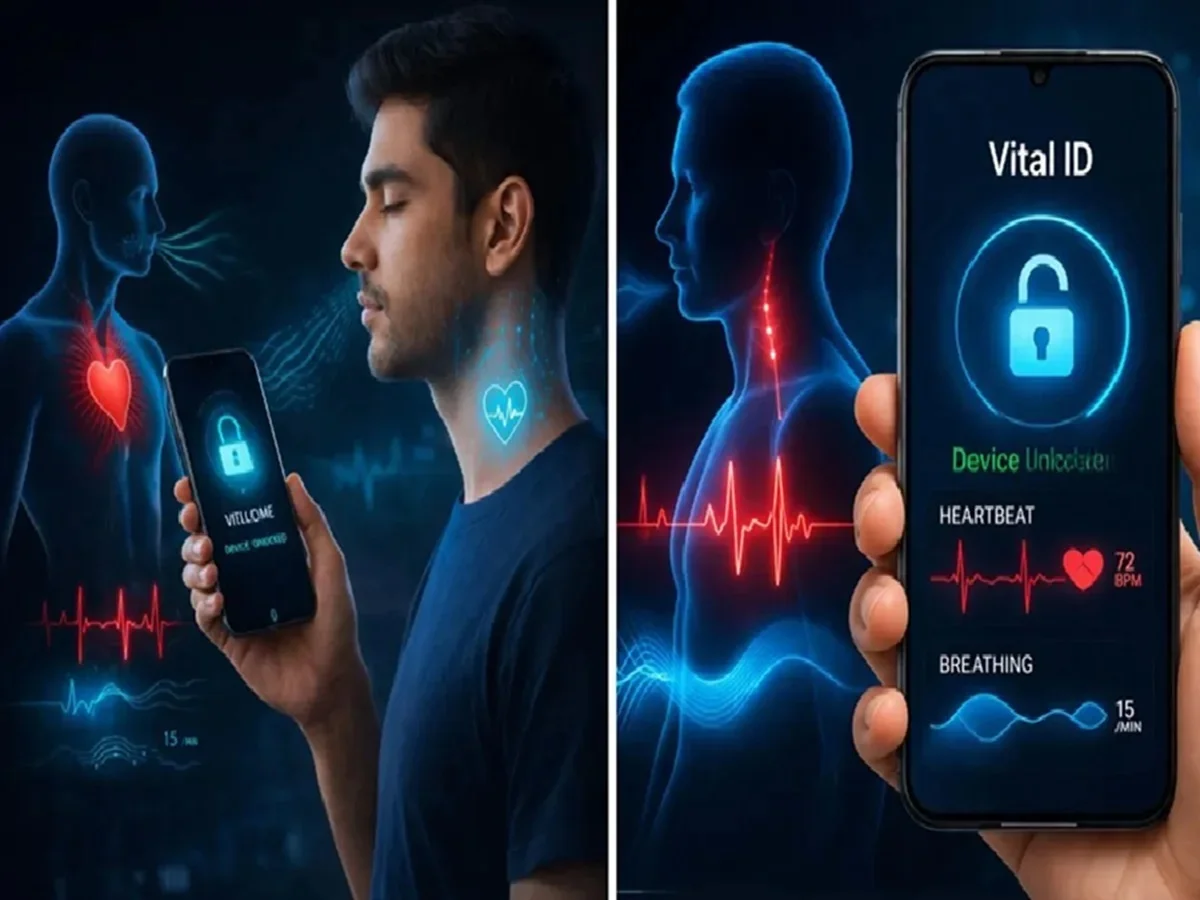

Friends, in today’s modern era, more than half of your world is contained in the smartphone, important numbers, data, photos, videos etc., hence it is important to keep them safe with a good password, but traditional methods like password, PIN, and even biometric scans like fingerprint or eye recognition are gradually losing their importance. In their place, a groundbreaking technology is emerging—one that uses your own heartbeat and breathing patterns as a secure password. This new system is called VitalID. It identifies users through very slight vibrations produced inside the human body. Let us know about this technology-
How does the VitalID system work?
VitalID detects very slight vibrations caused by your breathing and heartbeat.
These vibrations reach the skull through the neck.
Since every person’s skull structure is different, vibration patterns are slightly different for each person.
This creates a unique “biological signature” that can be used for identification.
Modern XR (Extended Reality) headsets are already equipped with very sensitive motion sensors, able to pick up these very light vibrations.
Using advanced software, VitalID analyzes these patterns and confirms the user’s identity—no additional hardware required.
In testing, the system achieved an impressive accuracy rate of 95% and effectively detected unauthorized access attempts.
Why was VitalID needed?
The use of extended reality (XR)—which includes virtual reality (VR), augmented reality (AR), and mixed reality (MR)—is growing rapidly.
XR is no longer just limited to gaming; It is now being used extensively in sectors like education, healthcare, workplaces and finance.
Traditional login methods such as passwords are not practical or efficient in an XR environment.
Security features like two-factor authentication can hinder the immersive experience.
These challenges created a great need for an intuitive, secure and user-friendly authentication system like VitalID.

Comments are closed.