
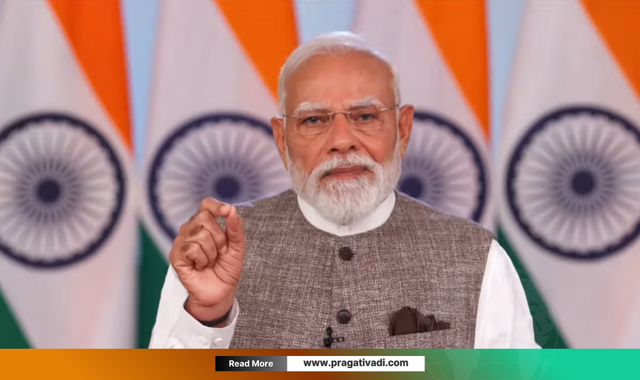

In an emotional address to the nation late on Saturday evening, Prime Minister Narendra Modi directly apologised to the mothers, sisters, and daughters of India after the government failed to secure the required two-thirds majority for the Nari Shakti Vandan Amendment in Parliament.
Speaking from the Prime Minister’s Office under the banner of *Azadi Ka Amrit Mahotsav*, PM Modi described the moment as a setback for “Nari Shakti” (women’s power) and accused opposition parties of prioritising narrow political interests over the rights of half the country’s population.
“Today I have come to talk to the mothers, sisters and daughters of the country on a very important subject,” the Prime Minister began. “Today every citizen of India is watching how the flight of India’s women power was stopped. Their dreams have been mercilessly crushed.”
He expressed personal sadness and extended an apology: “Despite our best efforts, we could not succeed, the Nari Shakti Vandan Adhiniyam could not be amended! And I apologize to all the mothers and sisters for this.”
The Constitution (131st Amendment) Bill, 2026, which aimed to facilitate the implementation of 33% women’s reservation in the Lok Sabha and state assemblies from the 2029 elections through increased seats and delimitation, fell short in the Lok Sabha on April 17. The bill received support but could not achieve the mandatory two-thirds majority, with opposition parties including Congress, DMK, TMC, and Samajwadi Party voting against it amid concerns over delimitation and its impact on southern states.
PM Modi sharply criticised these parties, calling their celebration in Parliament “a slap on the self-respect of women.” He said women never forget an insult and warned that the women of 21st-century India are watching closely.
“The same thing has happened this time. The women power of the country has suffered due to the selfish politics of parties like Congress, DMK, TMC and Samajwadi Party,” he said. He accused them of committing “foeticide” of women’s rights in the House and described the act as an attack on the Constitution and the sentiments of its framers.
The Prime Minister emphasised that the amendment was not about taking away rights from anyone but about giving long-pending opportunities to women. He highlighted that the bill sought to empower women across all states—north, south, east, and west—by increasing representation proportionally without reducing any state’s share.
He linked the opposition’s resistance to fear within dynastic parties that empowered women outside their families would challenge their leadership. “They fear that if women become empowered, the leadership of these dynastic parties will be in danger,” Modi said.
The PM also defended the government’s position on delimitation, stating clearly that no state’s representation would decrease and that seats would rise across the board. He accused the opposition of spreading lies to ignite divisive sentiments reminiscent of “divide and rule.”
Recalling Congress’s history of opposing major reforms—from digital payments and GST to the abrogation of Article 370 and the law against Triple Talaq—Modi portrayed the party as anti-reform and responsible for stalling India’s progress for decades.
Despite the setback, the Prime Minister struck a resolute note. He assured the women of India that the BJP and NDA’s commitment to women’s empowerment remains firm.
“I assure every woman of the country that we will remove every obstacle coming in the way of women’s reservation. Our morale is high, our courage is unwavering and our resolve is unwavering,” he declared.
He added that although the government lacked the numbers in Parliament yesterday, it has the “blessings of 100 percent women power of the country.”
The address ended with a firm promise: “The parties opposing women’s reservation will never be able to stop the women power of the country from increasing their participation in Parliament and Legislative Assemblies.”
The failure of the amendment has sparked intense political debate, with the government terming it a loss for women’s empowerment and the opposition raising concerns over federal balance and the timing of delimitation. As India prepares for future electoral battles, the issue of greater representation for women is likely to remain a central and emotionally charged topic in national politics.
Comments are closed.