
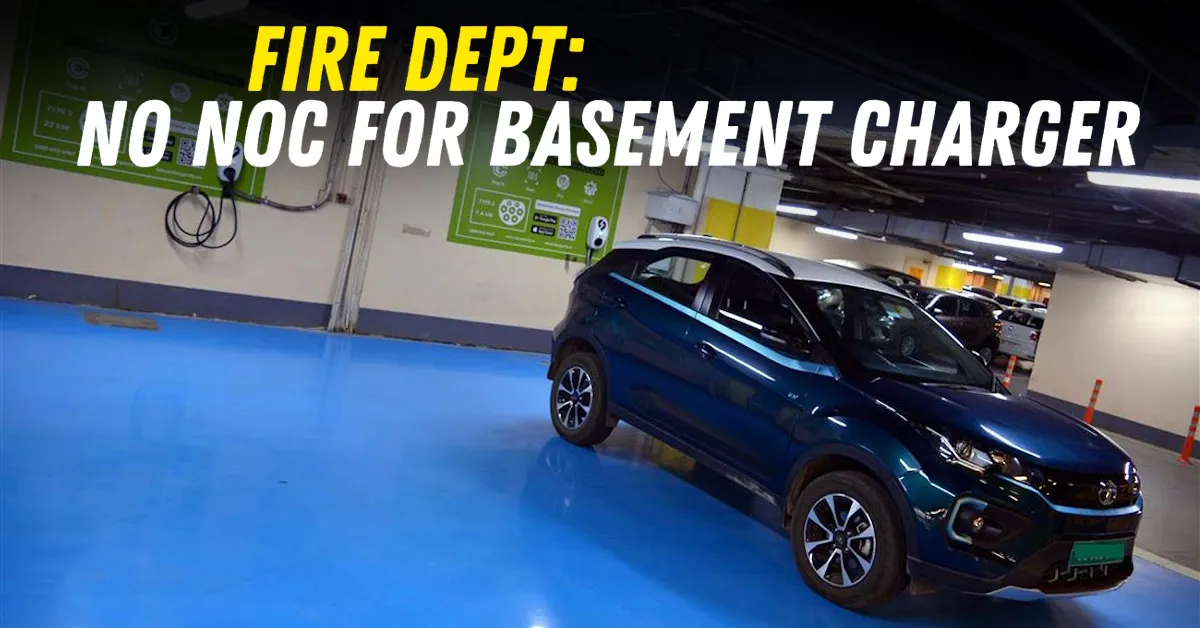
Why Are Fire Departments Not Giving NOC For Electric Car Chargers In Covered Apartment Parking

Electric vehicle adoption has lately been on the rise in India. Of late, we have also come across news of EV owners facing major hassles in setting up and using chargers in covered apartment parking. In many cases, EV owners have been asked by RWAs (Resident Welfare Associations) to not install chargers in housing societies or apartment complexes. They are citing safety concerns as the reasons. Wondering what these are? Let us explain…
AI image used for representation only
To put it straight, potential EV fires! Electric vehicles catching fire can be disastrous. They are much harder to put out than regular fires or a burning internal combustion vehicle. The gravitas is much larger. A research by EV Fire Safe shows that 15% of verified EV fires occurred when the vehicle was connected to the charger. These include EVs that faced thermal runaway while still connected to the charger and those that ignited within an hour of being disconnected. This data naturally adds to concerns and anxiety within RWAs and similar bodies.
Next is the nature of EV fires. Thermal runaway is said to be the starting point of every EV fire. Lithium ion batteries store a large amount of energy in a rather small space. It converts chemical energy into electrical energy, safely and rapidly under normal operation. EV fires typically stem from failures in either the vehicle’s battery or BMS, infrastructure limitations, or from the external charging equipment installed.
In the event of a thermal runaway, a battery cell overheats and triggers an internal chemical reaction. This generates more heat and spreads to adjacent cells. Since this is a self-sustaining cycle, the surest approach is to stand back and watch it burn! That might sound ridiculous, we know.
Lithium-ion battery fires are very hard to extinguish. Dousing an EV fire the conventional way will require a huge amount of water. According to a report by Driving.cait would take around 40 fire engines to put out an EV fire completely, provided a single engine carries around 1,000 gallons of water. Even the lowest estimates hover around 8,000 gallons (or 8 trucks!). Large fires may even require 20,000 gallons. Also, it takes much longer to control EV fires than conventional fires.
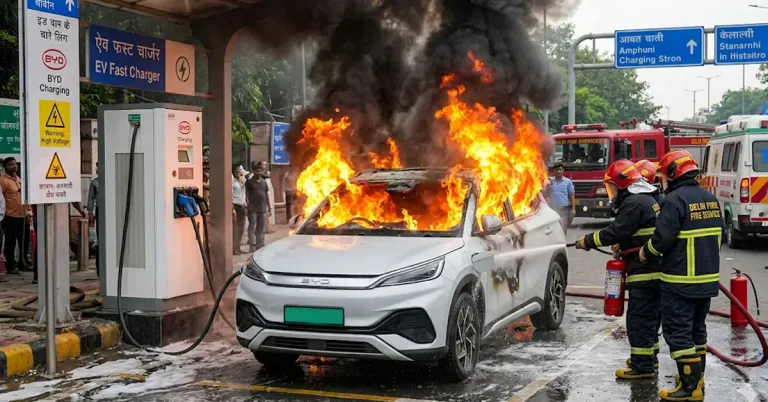
AI image used for representation only
Lithium-ion batteries generate a lot of heat and dense smoke when they burn. Visibility can drop so rapidly that even fire fighters would find it extremely hard to make things under control. Even worse, they can re-ignite even after being put out completely. Now, heat and smoke getting trapped in covered and basement parking is a major issue. Most basement parkings have limited airflow and mechanical ventilation systems. The smoke from EV fires contains toxic gasses and inhalation can cause various health issues.
Fire can also spread to vehicles parked nearby and make the situation escalate further. This can potentially cause harm to property and people. Fire departments even fear that in the worst case, EV fires can even set the building structure ablaze.
High electrical load is another major concern. Most old apartment complexes and buildings were not designed for high electrical loads such as the ones from EV chargers. This can lead to overloading especially when there are multiple chargers installed, and functioning simultaneously. This can cause issues like cable overheating, panel failures and short circuits, eventually leading to electrical fires.
The fire safety systems in most buildings aren’t designed specifically for EV fires. They are for regular fires. This is another major concern.
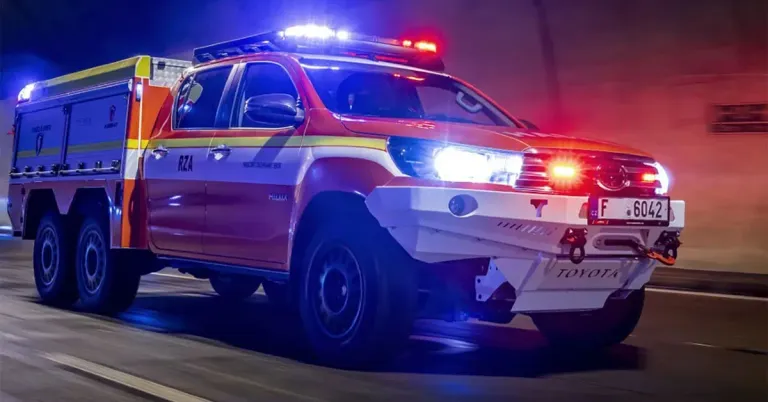
Image: Hiload
The best way to douse an EV fire is to literally plunge the whole vehicle in a pool of water and just leave it there! That sounds very impractical. The idea here is to get the burning battery pack fully submerged in water till it cools down. In electric cars, the battery pack is usually mounted under the floor. New, more effective methods are now being devised to put out EV fires.
One such is the Swedish Coldcut ‘Cobra’ system. It uses an Ultra High Pressure Lance (UHPL) to shoot a mix of water and an abrasive material with over 4,000 pounds pressure at the burning vehicle. The water jet will cut through the battery casing and access the burning cells. This will help firefighters to properly douse EV fires quickly. The entire setup is mounted on a Toyota Hilux.
Rosenbauer America has a Battery Extinguisher System Technology (BEST) that’s even more effective. It uses pressurised air (600 psi) to punch through the battery casing, and then floods its interior.
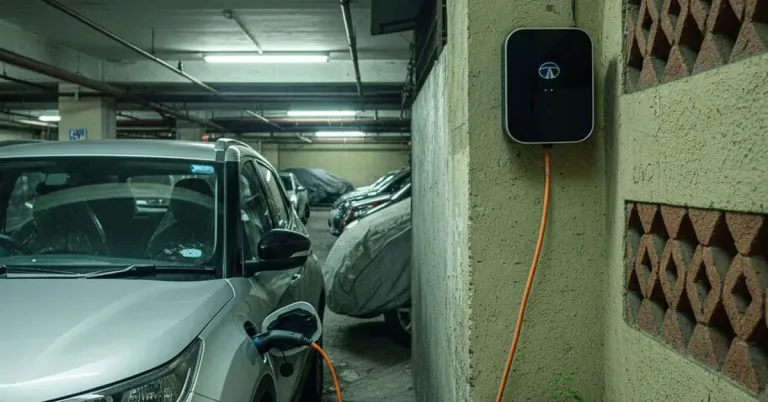
Circling back, the Fire departments in many cities are now asking for stricter compliance with set guidelines, and not really rejecting NOC (No Objection Certificates) outright. In many cases, they are delaying approvals until all standards are met. (There are exceptions).
Typical requirements include dedicated wiring and circuit protection, fire-rated cabling, proper earthing, adequate ventilation, and fire extinguishing systems. Newer policies and building codes are also factoring in EV- ready infrastructure, dedicated charging zones, and relevant fire safety protocols.
Comments are closed.