


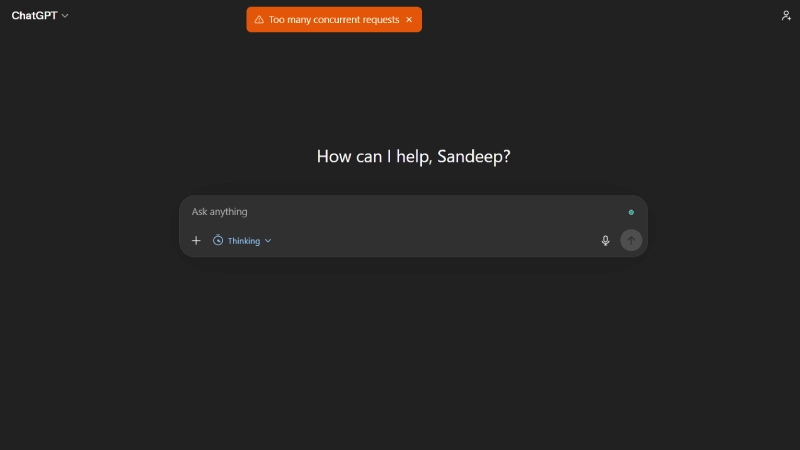
ChatGPT down across several countries on April 20, 2026, leaving users staring at blank screens, endless loading spinners, or error messages. The widespread outage was a stark reminder of just how dependent we’ve become on AI tools in our daily lives.
What Happened?
At about 10:05 AM ET, Downdetector, a site that tracks outages, saw a significant increase in reports. At its peak, the number of reports rose from a few hundred to over 13,000, indicating a significant problem on OpenAI’s end.
The ChatGPT downtime led to various problems, including blank pages, timeouts, and login issues. Some could open ChatGPT but couldn’t send or get messages. Voice mode, image generation, and Codex, OpenAI’s coding tool, also stopped working.
OpenAI’s Response
OpenAI acknowledged the issue on its official status page, initially labeling it as “degraded performance” before upgrading the classification to a “partial outage.” The outage impacted a wide range of services, including conversations, logins, voice mode, and image generation. The company confirmed it was investigating the problem, noting that affected users were unable to access ChatGPT, Codex, and the API Platform.
While OpenAI kept its public communications brief and offered little technical explanation, its status updates closely aligned with the widespread difficulties users were already reporting on social media. The company issued regular updates as the situation unfolded, reassuring users that the problem was being actively investigated. While details remained scarce, the acknowledgment confirmed that the ChatGPT downtime outage was widespread — not isolated to individual users or devices — giving those affected confidence that a fix was in the works.
Who Was Affected?
The ChatGPT downtime didn’t affect every region equally. The United Kingdom was hit hardest, recording over 8,000 reports at its peak, while the United States saw around 1,875. India was also among the affected countries.

What made the situation more frustrating was the inconsistency. In the same country, some users could start new chats without any trouble, while others couldn’t even log in. There was no clear pattern, which made it difficult for users to determine whether the problem was on their end or OpenAI’s.
Rather than a complete shutdown, the ChatGPT Downtime outage played out in patches – some features worked for some people, while others lost access entirely. This uneven disruption added to the confusion, leaving users unsure of what was actually broken and what wasn’t. The lack of a straightforward, widespread failure made the whole experience harder to understand and navigate.
The Bigger Picture
Today’s outage highlights a growing concern in the tech world – our reliance on a handful of AI platforms. OpenAI alone reaches hundreds of millions through ChatGPT, while countless businesses and apps depend on its API. When something goes wrong, the impact is widespread and immediate. This isn’t just an inconvenience; it’s a sign of how deeply embedded these tools have become in our daily lives and workflows. As AI becomes more central to how we work and communicate, the risks of relying on so few providers become harder to ignore.
What Should You Do?
If you’re still experiencing issues, you can check real-time updates on OpenAI’s official status page. OpenAI has confirmed that the root cause has been identified, fixes have been applied, and the situation is being closely monitored. Downdetector reports dropped significantly as services were gradually restored.
Notably, other AI services, including Claude, Google Gemini, Microsoft Copilot, and Meta AI, remained fully operational throughout the ChatGPT downtime outage, as they run on separate infrastructure.
While things are now back to normal, the incident serves as a reminder of how dependent many users and businesses have become on a single AI platform. Diversifying the AI tools you rely on can help ensure continuity when one service goes down. Keeping alternative tools on hand means disruptions like this one won’t bring your workflow to a complete halt.

Comments are closed.