
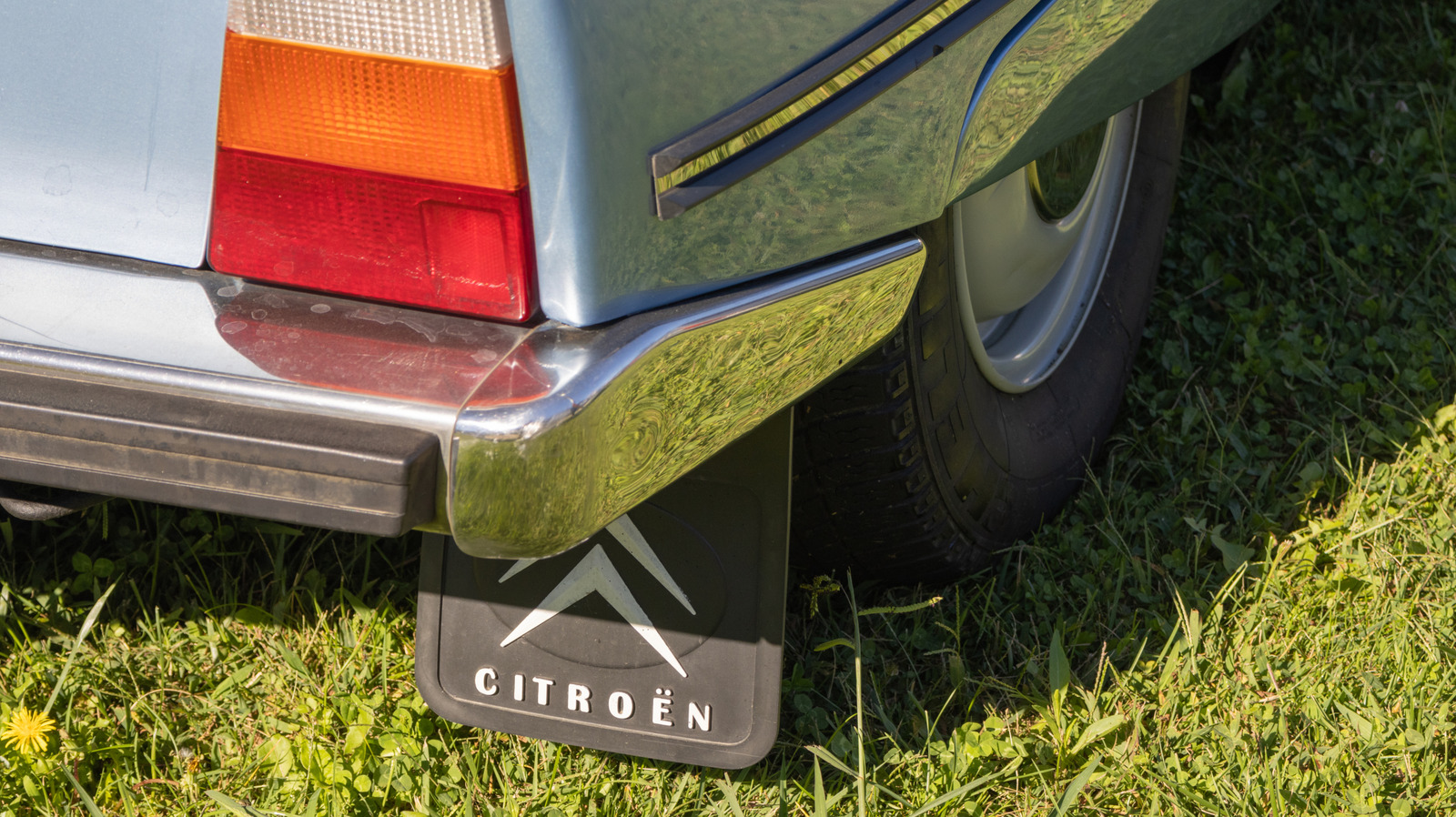

Citroën is one of the oldest automakers on the planet, having been founded by André-Gustave Citroën in 1919. Today, Citroën is owned by Stellantis, and while it’s still going strong in most global markets, it hasn’t sold a single car in the U.S. since 1974 — the very same year the Citroën CX hit the market.
Known internally as Project L, the CX’s name was based on the European symbol used to designate an object’s aerodynamic coefficient. It referred to how the company hoped to solve the era’s fuel-economy problem through aerodynamics, all while improving safety and ride quality. The CX’s sleek lines and covered rear wheel arches created an elongated, elegant silhouette that swept back to a concave piece of glass used for the rear window, which essentially kept itself clean. Aside from its radically experimental looks, the CX had some incredibly advanced features.
Thanks to Citroën’s centralized hydropneumatic suspension, known as Hydractive, the car could — quite literally — level itself. The system used hydraulic fluid and nitrogen-filled spheres instead of the usual steel suspension springs, which provided consistent ground clearance and a supremely luxurious ride. Disk brakes were also a standard feature, pioneered by the automaker on the DS, the first car to come with factory disk brakes. All of these features made the CX very alluring. Unfortunately, even the coolest car can be stymied by bad timing and factors beyond the manufacturer’s control — as the CX’s American tale shows.
The CX came with fancy tech and clever design touchers
The CX featured a peculiar steering system that automatically centered itself. The DIRAVI — “DIrection à Rappel AsserVI” in French — first appeared on Citroën’s SM model and, like the company’s ahead-of-its-time suspension system, was fully hydraulic. Instead of directly and mechanically attaching the steering wheel to the wheels, DIRAVI sent a signal to a controller that manipulated the steering rack, so drivers didn’t have to deal with potholes or torque steer (when a front-wheel-drive car pulls to the right or left under hard acceleration).
Citroën planned to power the front-wheel-drive CX with a line of reliable front-mounted Wankel rotary engines, but scrapped that idea late in the development phase. It instead opted for a series of four-cylinder gas and diesel engines developed with NSU (called Comotor). However, by rotating those engines 90 degrees and mounting them transversely, Citroën managed to retain the same interior space as the DS, despite the CX being eight inches shorter than its predecessor.
When the CX hit the road a year after its 1973 unveiling at the Paris Motor Show, it looked every bit like a worthy successor to said DS. While it would never earn the same accolades as the DS — which placed third in the 1999 “Car of the Century” vote, and was named the most beautiful car of all time by Classic & Sports Car Magazine — it eventually won several awards of its own, including Europe’s Car of the Year award in 1975.
Citroën’s offering was perhaps a bit too strange for Americans
Europeans may have gone gaga over the CX, but Americans were never as enamored. Car and Driverfor example, wasn’t that keen on the idiosyncratic dashboard instrumentation and control-switch layout. The left side of the CX’s futuristic dashboard pod housed non-self-canceling switches, such as turn signals, lights, and the horn; washer and wiper controls were located on the right. Both the speedometer and tachometer were technically digital but not electronic, as they used rotating drums rather than dials or needles.
Car and Driver also noted that the engine vibrated, the windows didn’t keep out noise, and the seats — while plush — may have been too soft. Lastly, the vehicle’s hoodline was so high that it hindered the driver’s view. On top of that, each time the CX was started, the Hydractive suspension went through a quirky ritual: first lifting the rear, then the front, to reach the appropriate ride height before going into full operational mode.
While these quirks probably don’t sound like dealbreakers, they certainly wouldn’t have helped. Despite OPEC’s 1973 oil embargo, many Americans were still driving around in huge gas-guzzling cars. The market perhaps wasn’t ready for an odd-looking little car with gas-sipping aspirations, especially given its many idiosyncrasies. Sure, it was pretty normal compared to Citroën’s Karin concept car, but it was still quite a departure overall. However, the biggest reason the CX never made a mark in the U.S. was unfortunate timing.
Bad timing stopped the CX from coming to the U.S.
In 1971, U.S. regulators introduced the nation’s 5 mph bumper rule, which was set to take effect for the 1973 model year. This rule regulated bumper height and required that front bumpers on new cars withstand a collision at up to 5 mph. This resulted in radical changes to the bumper designs for U.S.-market cars, but the real killer came the following year. By 1974, additional bumper laws made height-adjustable suspensions illegal – eliminating one of the defining and integral features that made Citroëns like the CX so cool in the first place. That same year, financial woes forced Citroën to merge with Peugeot, effectively putting the kibosh on sales in the United States.
The U.S. repealed its bumper rule in 1981, opening up a gray market that saw some 1,000 CXs enter the country. However, with the U.S. dollar in free fall, importers were forced to sell them at twice the original European asking price. At over $30,000, they were just as costly as Cadillacs — making them a non-starter for most Americans. But there’s one final twist, which comes courtesy of Robert Boston, CEO of both Citroën Importers of North America and Euro-Car in the ’80s.
In a blog post on Citroën fansite Citroënvie!Boston revealed that the majority owners, Peugeot, simply didn’t want Citroën-branded cars in the U.S. — especially since Peugeot cars weren’t selling. Basically, the suits were jealous. Ultimately, all of these combined mean that the CX goes down as one of the greatest examples of “wrong place, wrong time” in automotive history.

Comments are closed.