

“After completing the foundation and preparing to erect the poles, residents suddenly fenced off the land and put up dispute signs, blocking construction,” Nguyen Xuan Truong, site manager for the 110 kV Phu Quoc – South Phu Quoc transmission line, being installed for the summit in November, said.
The line includes 79 tower locations, of which seven have yet to be handed over and some even reoccupied by the sellers.
At tower site No. 60 in Suoi Lon neighborhood, the land was cleared and handed over to the contractor last year, and even the foundation was completed.
But during the installation phase, a family in protest erected metal fencing around the site, blocking access on the grounds that construction would affect access to the lands at the back.
The foundation of Power Pylon No. 60 in Suoi Lon neighborhood, part of the 110 kV Phu Quoc – South Phu Quoc transmission line project, is surrounded by solid metal fencing on April 9, 2026. Photo by Read/Le Tuyet |
“We are under pressure from multiple sides,” Truong said, pointing to tight deadlines, limited manpower, and the need to have personnel to guard construction equipment worth more than VND2 billion (US$76,000).
This is no isolated case,and three other power projects have yet to complete even land clearance.
Currently at the site of a 220 kV substation, three families are refusing to hand over their lands, while the 110 kV Phu Quoc – North Phu Quoc line has 43 out of 75 tower positions yet to be implemented.
Another 24 are awaiting approval for conversion of forest lands, and less than two months remain in the dry-season construction window.
The Southern Power Corporation stated that the handover is delayed because the power line’s long route crosses many properties. This has increased the amount of surveying and measurement work required to process each affected household.
Compensation for lands in some areas is lower than market rates, leading to prolonged disagreements and complaints.
Land ownership complexities have added to the challenge.
Some lands have exchanged hands many times with just handwritten deeds and no ownership certificates, making it now difficult to determine their rightful users.
Where people obstruct construction, authorities must first hold negotiations and dialogue, and complete legal documents.
Progress on other critical infrastructure is also stalled by land issues.
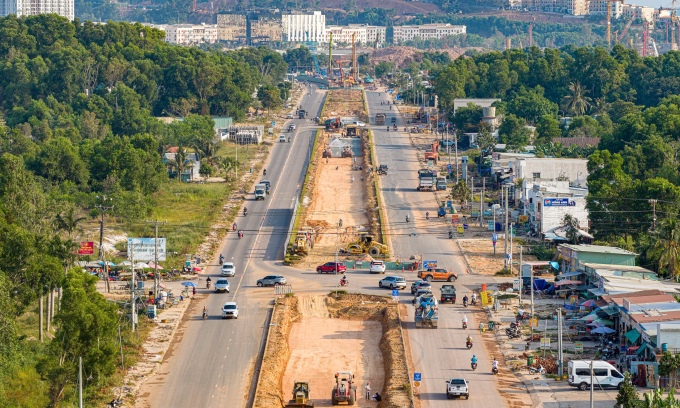
DT975, a 10-lane highway intended to link Phu Quoc airport with the APEC conference center, remains blocked across a four-kilometer stretch.
Here, 2.5 km of land has yet to be handed over to contractors, and 15 legal violations remain unresolved.
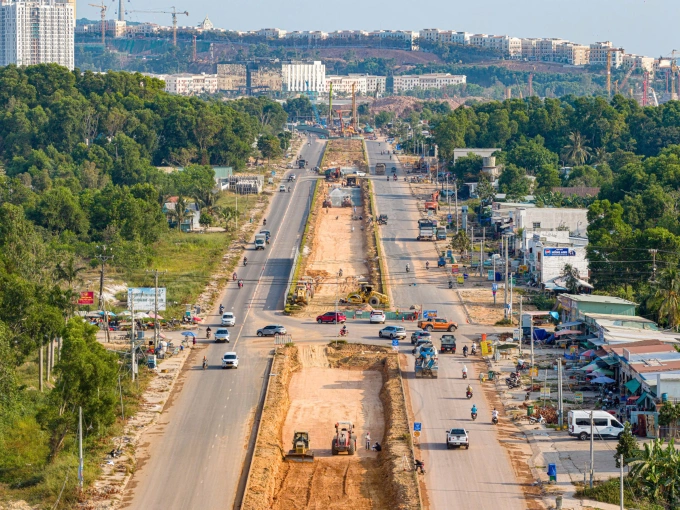 |
The DT975 road is under construction on Phu Quoc Island to link Phu Quoc airport with the APEC conference center. Photo by Read/An Phuong |
Elsewhere, the Bai Dat Do mixed-use urban project has seen only 42 hectares out of more than 88 ha required cleared.
Nguyen Tien Hop, director of BT projects at Sun Group, its developer, said that even six months after starting work many sections of the DT975 road cannot be developed despite it being an urgent task.
He said the lack of contiguous access has affected the construction.
The lack of continuity means machinery has to sit idle and project costs rise, he said.
The official deadline is April 30 next year, but delays seem inevitable if the land issues are not resolved soon.
An Giang Province is implementing 21 projects to prepare for the APEC summit, including 16 that require land clearance covering approximately 1,050 hectares. More than 912 hectares will be reclaimed, affecting nearly 4,000 households, with about 2,906 households eligible for resettlement.
Tran Minh Khoa, chairman of the Phu Quoc administration, said the biggest challenge is resettlement policy, as many residents have built homes on agricultural land, a long-standing issue in the locality. Under current regulations, such cases are not eligible for resettlement support, meaning affected residents could be left without housing.
“More than 1,000 households fall into this category. It’s a very difficult problem,” he said, adding that current land reserves can only accommodate around 100 temporary resettlement cases, while permanent resettlement areas are still under construction.
Phu Quoc has proposed that higher authorities consider special resettlement mechanisms for these households, while also calling on investors to provide financial support to encourage residents to hand over land.
In the long term, the locality plans to develop social housing for low-income residents.
Authorities are also stepping up direct dialogue with affected households to resolve disputes. At the same time, infrastructure conflicts involving electricity, telecommunications, and water supply are being addressed and are expected to be resolved soon.
“We are doing everything possible to ensure progress and minimize disruption for contractors,” Khoa said.
Comments are closed.