
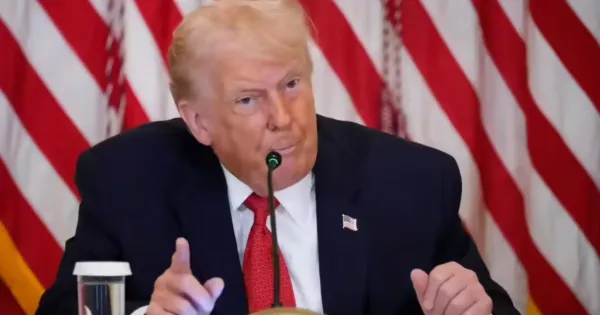

President Donald Trump’s announcement of extending the ceasefire period will provide additional time to hold a new round of face-to-face talks with Iran, but the situation between the two is still tense.

Vivek Saxena, Ayodhya
In the geopolitical scenario of April 2026, the ceasefire announced by Donald Trump with Iran has exposed a major failure of US foreign policy. After initial boastful claims of ‘complete victory’ and ‘complete destruction’ of Iran’s military power, the ceasefire is being seen as an embarrassing turn for the Trump administration. The conflict not only failed to bring stability to the Middle East, it also exposed the limitations of American diplomacy.
President Donald Trump’s announcement of extending the ceasefire in the Iran war will give mediators additional time to hold a new round of face-to-face talks between the US and Iran, but the situation is still tense. The US and Israel began war on February 28, sending oil prices soaring and shaking the global economy. The war has disrupted energy supply chains globally, causing fuel prices to rise and threatening attacks on power plants in other countries as well.
Trump had claimed that America had destroyed Iran’s nuclear and missile infrastructure, but the reality was that Iran maintained its control over the Strait of Hormuz and continued retaliatory attacks, ignoring American threats. When the ceasefire was announced after the 48-hour ultimatum, it appeared more like a tactical retreat and a capitulation to Iran than a victory. Iran clarified that it had not asked for a ceasefire, raising serious questions about the credibility of Trump’s claims.
The announcement temporarily avoided a resumption of fighting, but wide differences remain between the two sides. The current ceasefire between Iran, Israel and the United States began on April 8, after Trump repeatedly set a deadline. The previous round of talks between Iran and the US was held in Pakistan. Vice President JD Vance, who is leading the US negotiating team, took part in the highest-level talks between the US and Iran since the 1979 Islamic revolution, which ended without any agreement.
Vance’s visit to Pakistan is still postponed and the US blockade of Iran continues. Trump said he took the step at Pakistan’s request just hours before the existing ceasefire expired as he was waiting for a ‘unified resolution’ from Iran and blamed Iran’s ‘severely divided’ leadership for the indecision. Amidst all this, two regional officials told The Associated Press on Tuesday that the US and Iran have indicated that a new round of talks will be held.
Pakistan-led mediators have received confirmation that Vance, the top negotiator, and Iran’s Parliament Speaker Mohammad Bagher Qalibaf will lead their respective teams, but late on Tuesday, Iran’s Foreign Ministry spokesman said no ‘final decision’ had been taken about attending the conference. The spokesman, Ismail Bagai, told state TV that the lack of decision was due to “contradictory messages” and “unacceptable actions” from the Americans, particularly the US naval blockade of Iran.
Even if Pakistan succeeds in holding the meeting, serious challenges remain regarding the future of the Strait of Hormuz, Iran’s nuclear program and the blockade. Iran targeted ships in the strait over the weekend. The US also attacked and captured an Iranian ship trying to evade the US naval blockade in the strait, indicating that the situation remains volatile. All of Iran’s highly enriched uranium is still in the country, possibly buried in enrichment sites that were bombed by the US during the 12-day war in June last year.
Iran says it has the right to do so for peaceful purposes and denies trying to build nuclear weapons, while Trump, along with Israel, has called on Iran to completely end its nuclear program and give up its stockpile. Iran rejected this in its 10-point proposal to end the war. Talks were to be held between Iran and America in Islamabad, but the Iranian delegation did not arrive. The US delegation led by US Vice President JD Vance was scheduled to leave for Pakistan on Tuesday, but this did not happen.
Even before the ceasefire ended, Trump announced extension of its deadline on Truth Social. Said that this decision was taken on the request of Pakistan, ‘We have been asked to stop our attack on Iran until its leaders and representatives come up with a common proposal.’ Hours later, on Wednesday, Iran’s Revolutionary Guard Corps (IRGC) attacked three cargo ships and seized two. One of these ships was flagged by Greece and the other by Panama, while the third ship belonged to a UAE company. The Strait of Hormuz, the narrow mouth of the Persian Gulf through which 20 percent of natural gas and oil is transported, is nearly closed due to Iranian attacks on the waterway.

Comments are closed.