
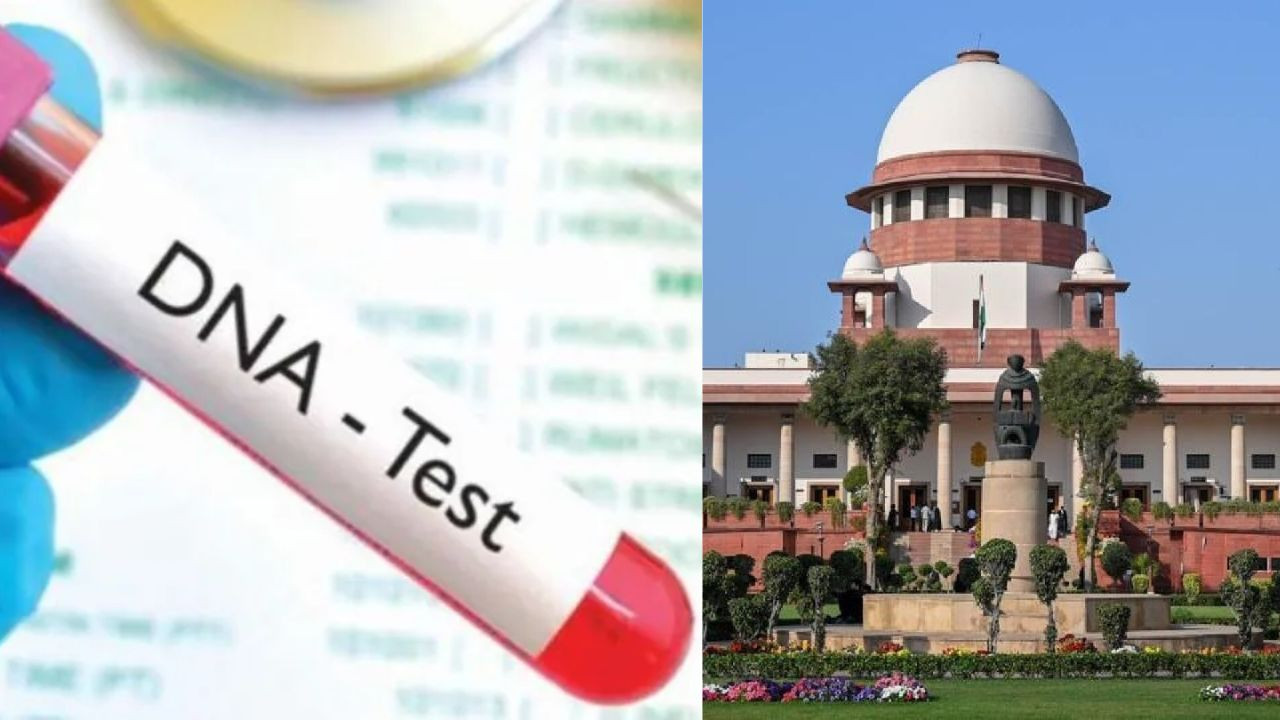
Alimony will not have to be paid if father is not proved in DNA test: Important decision of Supreme Court

New Delhi: In an important case related to alimony, the Supreme Court has given a big decision and made it clear that if a DNA test proves that a person is not the biological father of the child, then he cannot be forced to maintain the child. The court also said that this rule will apply even if the child is born during marriage.
The top court rejected the appeal filed by the woman, which challenged the order of the Delhi High Court in which child maintenance was denied.
Which bench gave the decision
This decision was given by Justice Sanjay Karol and Justice N. Kotishwar Singh’s bench pronounced. During the hearing, the court considered in detail the relationship between Section 116 of the Indian Evidence Act, 1872 and modern scientific tests, especially DNA tests.
Old decisions were also mentioned
In its decision, the court mentioned cases like ‘Aparna Ajinkya Firodia vs Ajinkya Arun Firodia (2023)’ and ‘Ivan Rattinam vs Milan Joseph (2025)’. In these cases it was said that DNA testing should not be ordered in general and caution is necessary.
The bench said, ‘One thing remains common in all these old decisions that the judges have always shown caution and hesitation in ordering or approving the DNA test. We completely agree with this stance.
However, the court also clarified that the present case is different as the DNA test has already been done and its report is on record.
Supreme Court’s argument
The court said, ‘DNA test has already been done in this case. The person who has appealed had not only given his consent for this test but also never raised any questions on the results of its report. In other words, this report is now completely final and valid.
The court also cited the case ‘Nandlal Vasudev Badwaik vs. Lata Nandlal Badwaik’ and said that when there is a conflict between scientific evidence and legal presumption, then scientific evidence should be given priority.
partial relief to women
Although the Supreme Court rejected the woman’s appeal, it has instructed the Women and Child Development Department to assess the condition of the child. Besides, it has also been asked to take appropriate steps if necessary.
what was the whole matter
This case is related to a couple who got married in 2016. After marital dispute, the woman had asked for maintenance allowance for herself and her child.
During the hearing, the husband demanded a DNA test, which was approved by the magistrate. In the investigation report it became clear that he is not the biological father of the child. On the basis of this, the trial court had refused to give maintenance allowance for the child.
Later the High Court also upheld this decision, which has now been upheld by the Supreme Court.

Comments are closed.