
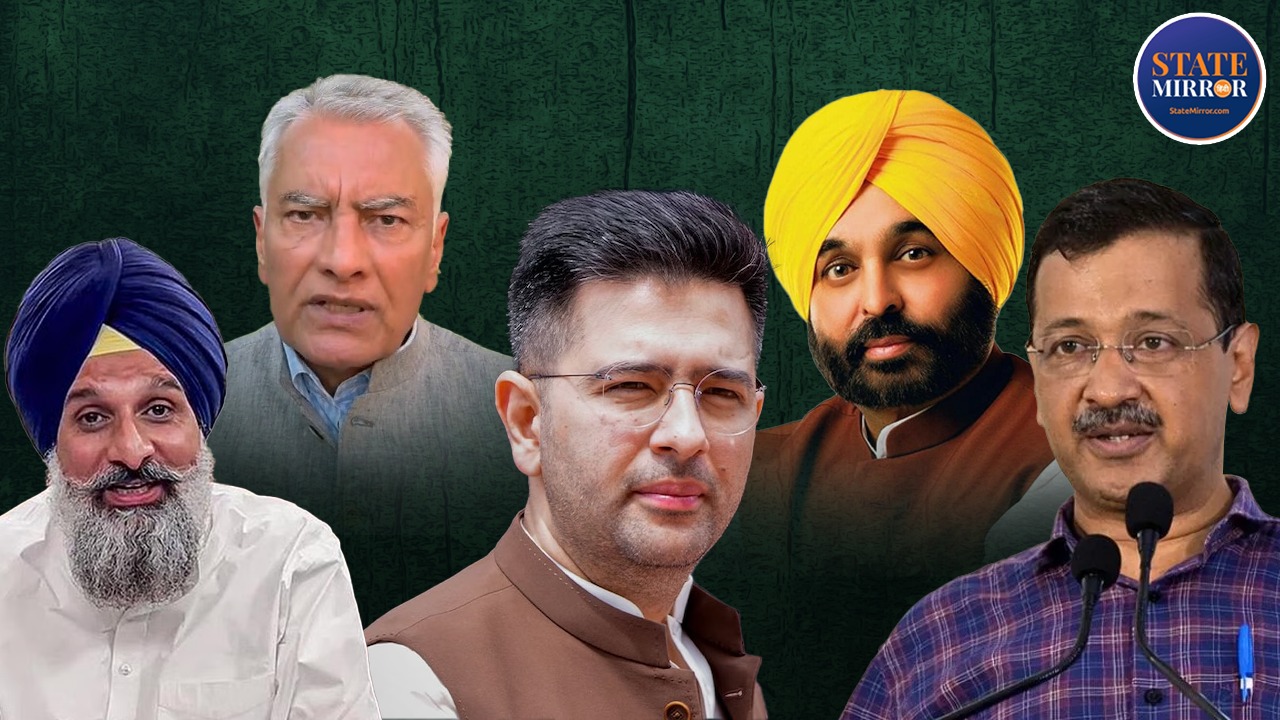
Punjab Politics Shake-Up: Raghav Chadha’s move changed the game, what is BJP’s big plan in 2027?

The sudden stir in Punjab politics has sparked a new debate regarding the 2027 assembly elections. The rebellion within the Aam Aadmi Party (AAP) and the decisions of big faces like Raghav Chadha have started changing the political equations. The government led by Chief Minister Bhagwant Mann now seems to be struggling not only with the opposition but also with internal challenges. Bharatiya Janata Party is seeing this development as an opportunity for its expansion. Whereas Congress and Akali Dal are also trying to convert this into a political opportunity. The question now is not why the rebellion happened, but whether it will change the entire game of power in the 2027 elections?
Why did there be rebellion in AAP?
The rift that has emerged within the Aam Aadmi Party (AAP) in the politics of Punjab has now come to the fore. Raghav Chadha Leadership conflict is believed to be the biggest reason behind many leaders keeping distance from the party. Questions have been raised for a long time regarding the coordination between Bhagwant Mann, who is running the government in Punjab, and the Delhi leadership. Apart from this, the feeling of being sidelined by some leaders in the organization further increased the dissatisfaction.
After this incident, AAP is continuously alleging that BJP is putting pressure under “Operation Expansion”, while BJP denies it. The reality is that both internal strife and external political opportunities have together given rise to this rebellion.
What is the caste and vote-bank equation of Punjab?
The electoral mathematics of Punjab is completely based on social structure. The Jat Sikh community is around 20 to 25% and is considered the most politically influential. The Dalit population is about 32%, which is the highest in the country and plays a decisive role in many seats.
Apart from this, 35–38% Hindu voters decide their electoral stance in urban areas. In 2022, AAP, under the leadership of Arvind Kejriwal, won a big victory by forming a strong alliance of Dalits, Jat Sikhs and anti-incumbency. But due to the current rebellion, this balance may now waver.
How much loss will AAP suffer from this rebellion?
This is the biggest blow for AAP because Punjab is its strongest state. The party’s cadre and organization may become weak due to the departure of big leaders. Due to this, there is a danger of the morale of the workers at the ground level falling. If the party is not able to control the damage in time, its direct impact can be seen in the 2027 elections. However, the party is still trying to maintain its hold in the poor and Dalit vote bank.
Will BJP be able to take advantage of this opportunity?
Bharatiya Janata Party is seeing this development as an opportunity for its expansion. Along with the urban Hindu vote bank, the party is also trying to strengthen its hold in rural areas through newly inducted leaders. If BJP reaches 20 to 25% vote share, it can play a decisive role in many seats.
What about Congress and Akali Dal? Is Opportunity ?
Congress is seeing this situation as an opportunity to make a comeback. Its traditional Dalit and rural vote bank is still present, which may come back if AAP weakens. Whereas, Shiromani Akali Dal is focusing on Jat, Sikh and rural votes. If the distribution of votes increases, both parties can make unexpected gains.
How do the 2027 elections look as of today?
The 2027 assembly elections now clearly seem to be four-cornered. Between AAP, BJP, Congress and Akali Dal. In such a situation, the vote share will be divided and the contest on many seats can be very close. This is why the possibility of a “hung assembly” is considered greater than before. While AAP got a one-sided victory in 2022, the picture may change completely in 2027.
Will the rebellion decide the outcome of the elections?
This rebellion does not directly decide the outcome of the elections, but it definitely leaves the whole game open. Now the competition will not be one-sided like before. While AAP faces the challenge of saving its hold, BJP, Congress and Akali Dal have new opportunities. That is, this development indicates the beginning of a new phase in the politics of Punjab, where tough competition and uncertain results can be seen on every seat.
Understand the political meaning from the statements of leaders?
Punjab Chief Minister Bhagwant Mann has termed seven Aam Aadmi Party (AAP) Rajya Sabha MPs who left the party as “traitors of Punjab” and “sellouts”, terming them a part of BJP’s Operation Lotus. told. Mann alleged that these leaders had gone for their own protection (fear of central agencies) and not for the issues of Punjab, as these people did not go among the public. Have joined BJP for their own selfishness.
Taking a dig at the leaders who left the party including Raghav Chadha, Mann has described them as “garlic, ginger, cumin, fenugreek, red chilli, black pepper and coriander. These 7 things together can enhance the taste of the vegetable, but alone they cannot become a ‘vegetable’.”
Who told AAP sinking ship?
Punjab BJP president Sunil Jakhar called it a “decision taken at the right time” and said the leaders had left a “sinking ship”. He accused the AAP government of bad governance, corruption and lack of law and order.
MLAs will also join BJP
Bikram Singh Majithia of Shiromani Akali Dal claimed that this development was already decided and in the coming days many AAP MLAs may also join BJP, due to which a big change is possible in the politics of Punjab.

Comments are closed.