
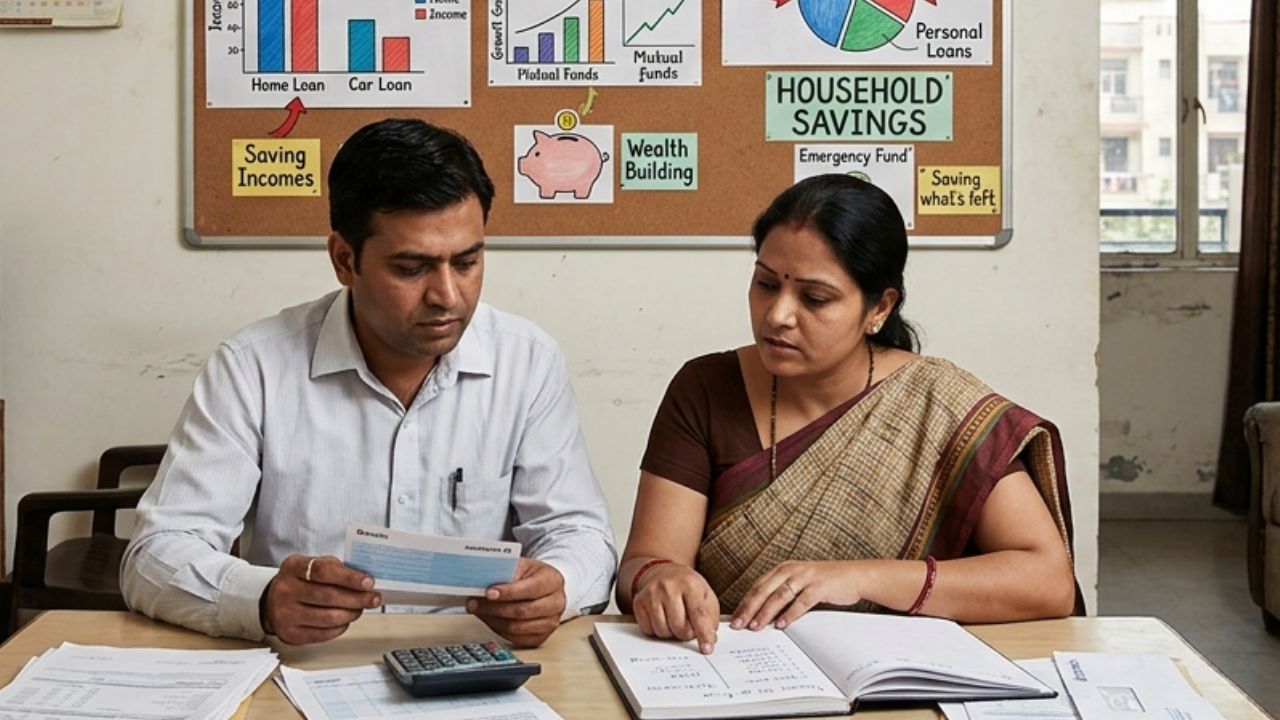

Nowadays, the middle-class who saves a little is so engrossed in everyday life that the biggest question that keeps roaming in his mind is, ‘I earn money with so much hard work, yet why is there nothing much left in the hand at the end? Where is my money going? As soon as the money comes into the account on the salary day, within the next two-three days a large part of it starts disappearing.
The bank automatically auto-debits the EMI, money for insurance, electricity/gas bill, mobile recharge, subscriptions like Netflix/Prime etc. is deducted. Money is deducted from Swiggy‑Zomato for food, transport from auto/cab, shopping from shopping apps, online courses and subscriptions. In this way, the money gets exhausted as soon as the salary comes. People just see the number decreasing in their account but it is very difficult to control it.
Also read: Tremendous increase in income from tourism, what is this in Tamil Nadu?
EMI burden
EMI (Equated Monthly Installment) means you have taken a big loan and now you have to pay an equal amount every month. Today about 70% of iPhones and 80% of new cars are purchased on EMI only. Most of which belong to the middle class. Many middle-class households spend 30–33% of their income every month just on EMIs and loan repayments and about 45% of the families are spending more than 40% of their income on loans and credit. That is, EMI has stopped the money of the middle class from where it is not able to be used as savings.
Credit and Fintech
The total outstanding on credit cards and the number of defaulters have increased continuously over the last few years. Many users are unable to pay the entire credit card bill, due to which this small bill turns into a big debt by charging high interest on the remaining amount. Along with this, fintech loan apps have also created a new trend by providing facilities like ‘Loan in a few seconds’, ‘Low KYC’, ‘No‑Cost EMI’ and people have started taking small loans again and again, on which the interest is very high. Because of all this, the savings of the middle class, including credit cards and fintech loans, are decreasing rapidly every year, while ostentation and expenditure are increasing.
SIP and investment culture
SIP (Systematic Investment Plan) means putting a little money every month in mutual funds or other schemes. Investment in SIP has increased very rapidly in the last few years. The full year SIP amount in 2023 will be around Rs 1.84 lakh crore, in 2024 it will be around Rs 2.68 lakh crore, and in 2025 the full year SIP amount will reach a record high of around Rs 3.34 lakh crore. NDTV and DD News report that SIP investment has increased almost 8 times in nine years and the monthly SIP collection has also reached around Rs 29,000 to Rs 31,000 crore. That is, today the money of the middle class is not only stuck in repaying the loan, but a good part has also been tied up in the name of future investment.
Also read: Want to learn business? These 5 movies can teach you more than MBA
Savings are falling while pretense is rising
EMIs, credit cards, fintech loans and SIPs have filtered the money from the middle class in such a way that most of the money is either going to repay the loan or is being tied up for the future and the remaining small amount is limited to daily needs. Its effect is that from outside life seems modern and stylish but from inside the pressure of debt and bills is increasing. Therefore, the real challenge for the middle class today is not how much they earn, but how to keep their money in their hands by understanding EMIs, credit cards, fintech loans and SIPs, so that life does not remain limited to just repaying loans and paying bills.

Comments are closed.