

On a sultry afternoon, sitting at the threshold of his family temple at Gutri, a quaint Matua village in West Bengal’s poll-bound North 24 Parganas district, Ananda Biswas carefully unfolded a stack of ageing papers—a 1964 migration certificate, a land deed, a decades-old ration card.
Also read: How ‘Khela Hobe’ become one of India’s most defining political battle cries
Each document, he said, tells the story of how his family crossed over from what is now Bangladesh and rebuilt their lives in India.
Yet, the documents were not enough for the Election Commission to recognise him as an eligible voter during the controversial Special Intensive Review (SIR) of the electoral roll.
‘Whom should we trust?’
“I was born here. Despite that, today my name has been deleted from the voter list. So, whom should we trust, and where will this Matua society end up? We cannot find any direction,” he said.
Across Matua-dominated constituencies of the district, such as Bongaon Uttar, Bongaon Dakshin, Gaighata, Bagdah, Swarupnagar, Habra, Haringhata and Baduria, thousands from the refugee-origin community have reported similar deletions.
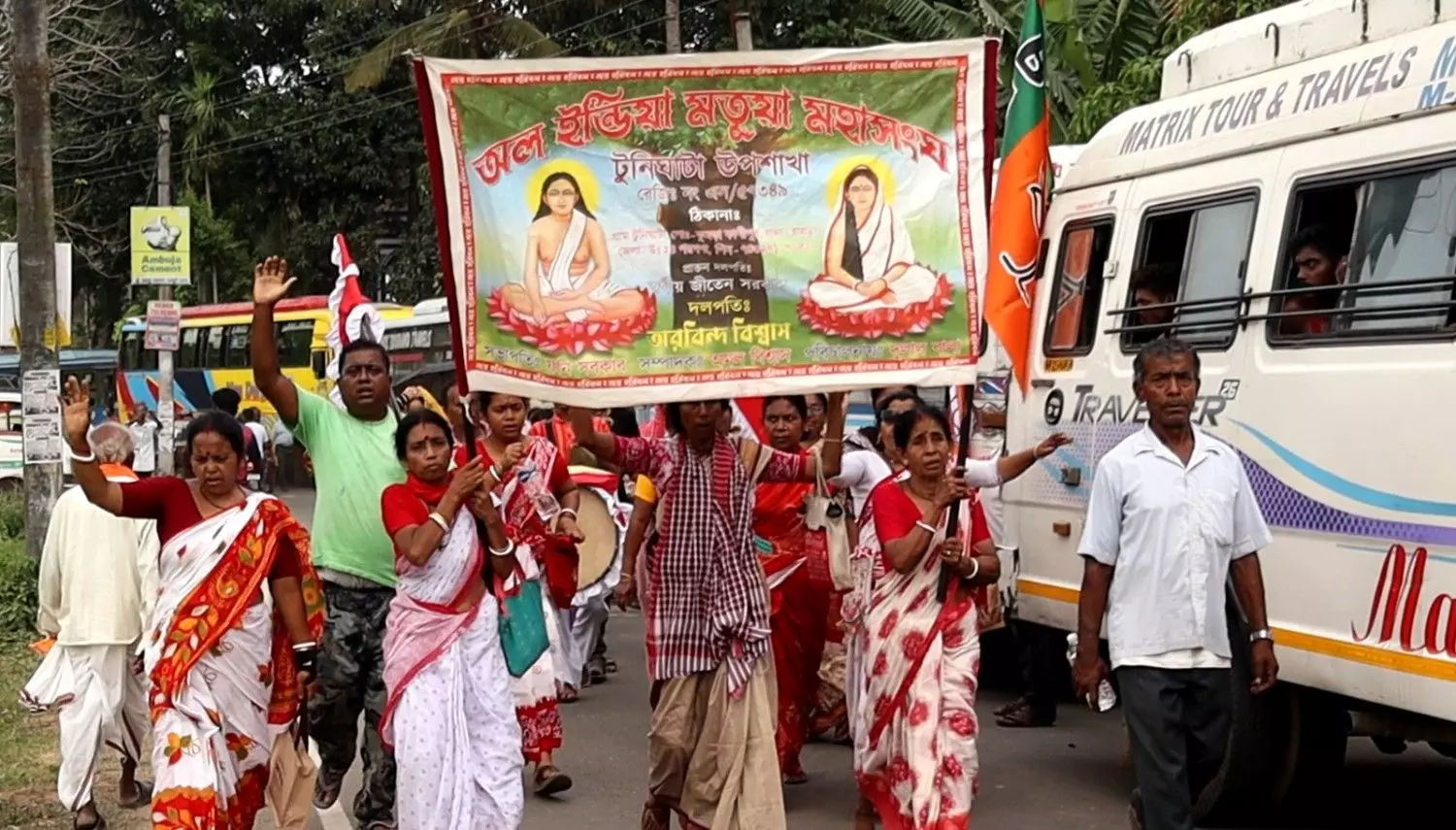
Prime Minister Narendra Modi on April 26 pays obeisance during a visit to Matua Thakur Temple in Thakurnagar in West Bengal’s North 24 Parganas district that will vote in the Assembly polls on April 29, 2026. Photo: @narendramodi/X via PTI
There is no community-wise data to indicate how many of those over 90 lakh removed during the SIR exercise are Matuas.
However, assessments by local community leaders, along with deletion figures from Matua-dominated districts, suggest that tens of thousands of names have been struck off, fuelling resentment within a community that has been a key pillar of the Bharatiya Janata Party’s (BJP) support since 2019.
Matuas are not infiltrators. All Hindus who came from Bangladesh, are refugees and they will be given citizenship. But any Muslim who has come from Bangladesh or Pakistan is an infiltrator and has no place in India.
In North 24 Parganas district, which has the largest concentration of Matua voters, more than 12 lakh names have reportedly been removed from the electoral rolls.
Also read: Bengal Phase 2 campaign ends amid row, sharp political exchanges | Capital Beat
“Everyone whose name has been deleted in this part of the state is a Matua Namasudra,” alleged Ranjit Bain, a community leader who in the past had campaigned for the BJP.
“These are people who have been voting for decades. Taking away voting rights is worse than killing a person… they lose their identity.”
The comments reflect the rising frustration over voter list deletions and bureaucratic hurdles across Bengal’s Matua belt.
Yet, conversations across the region suggest that beneath the frustration, a deeper current runs, one that may blunt any sweeping backlash against the Bharatiya Janata Party (BJP) as Bengal votes in the second phase of Assembly elections on April 29.
‘Matuas not infiltrators’
“What does it matter if names were dropped?” asked Rajkumar Sarkar, standing by a roadside near Gutri Primary School. “They will become voters again through the CAA (Citizenship Amendment Act). No one is going to drive them away. The BJP will not keep infiltrators, not in West Bengal, not in India.”
His view reflects a strand of opinion that continues to distinguish between “refugees” and “infiltrators”, a distinction that has long shaped the BJP’s outreach to the Matua community.
(From left), BJP leaders on their way to a campaign rally of Prime Minister Narendra Modi in Thakurnagar in North 24 Parganas of West Bengal; Anand Biswas, a Matua religious leader whose name has been deleted from the voter list; and a local agriculturalist in the Matua belt of North 24 Parganas. Photo: Abhishek Sharma
“Matuas are not infiltrators,” Sarkar told The Federal. “All Hindus who came from Bangladesh, are refugees and they will be given citizenship. But any Muslim who has come from Bangladesh or Pakistan is an infiltrator and has no place in India.”
That sentiment draws on the community’s collective memory of migration from present-day Bangladesh, often narrated in terms of religious persecution and displacement.
For many residents, these experiences and the stories built around them continue to shape their political choices.
Even among those directly affected by deletions, the anger is often tempered by that historical memory.
Also read: After Vande Mataram, it’s Bankim: Electoral politics heats up in Bengal’s Naihati
That memory has also generated competing perceptions about the intent of the SIR exercise.
“The goal of the SIR exercise to identify illegal immigrants might have been partially successful, as many left after the initiation of the SIR exercise,” opined Subrata Baidya, a medical assistant from Gaighata, another constituency in North 24 Parganas. His name has also been deleted from the voter list.
He was referring to interceptions of a few hundred Bangladeshi nationals by the Border Security Force in November last year at the Hakimpur check post near Swarupnagar while attempting to cross back into Bangladesh.
As reported earlier by The Federalamong those detained were several Rohingyas as well.
Most of the detainees admitted to the media that they had entered India “illegally” and had been living in areas around Kolkata such as Birati, Madhyamgram, Rajarhat, New Town and Salt Lake, where they worked as domestic help, daily labourers or construction workers.
Baidya’s comment reflects a perception shared by many residents in the Matua belt, echoing the BJP’s argument that the SIR exercise is needed to weed out illegal entries from the rolls.
Such views, analysts say, help explain why anger over deletions has not translated into major protests in the Matua belt, unlike in Muslim-dominated areas, or into a decisive political shift.
‘Grievance real, but layered’
“The grievance is real, but it is layered,” said the general secretary of the Matua Bikash Parishad, Partha Biswas. “The memory of why people came here still holds weight.”
Baidya said both his and his mother’s names were removed despite decades-old records.
“My father voted in 1983 and 1988. We have those lists,” he said. “I have my passport, school certificate, everything.”
Some allege that local, party-leaning booth level officers (BLOs) were complicit in irregular deletions, a charge that also feeds into the BJP’s narrative.
Also read: Record turnout in TN, Bengal: What’s behind the surge? | Talking Sense With Srini
Union Home Minister Amit Shah has been repeatedly blaming the state’s Trinamool Congress (TMC) government for the exclusion of names of genuine Indian voters.
“I am a BJP supporter, and perhaps that is why my name has been deleted. I had submitted all my documents to the BLO,” said Rajnandini Bala of Dhulani in Bagda, an allegation strongly denied by the BLO of Part 199 of the constituency.
“The BJP is misleading people through whisper campaigns to shift the blame onto us. We had no role in the deletions. The names of many TMC supporters have also been removed. There is no clarity on why these names were deleted, despite all the required documents being submitted,” said BLO Nagendranath Sardar.
Nonetheless, several Matuas appear to be subscribing to the “BLO sabotage” theory.
Even among critics of the BJP, their past complicates the electoral picture.
Will Matuas trust BJP again?
“We are hurt (due to the deletion of names),” said Ananda Biswas. “But we also want a solution to this refugee problem. We will support whoever offers us that solution.”
Prime Minister Narendra Modi, addressing a rally in Thakurnagar in Bangaon in North 24 Parganas on Sunday (April 26), promised that solution. But then the BJP has been holding out that promise to Matuas since 2019.
Also read: Bengal’s high turnout signals pro-incumbency, says Netaji kin Chandra Bose | Interview
Now it remains to be seen whether Matuas once again repose their faith in the BJP.
The electoral stakes are significant, particularly for the BJP.
The party won 14 of the 15 Matua-majority Assembly seats in the 2021 Assembly polls. Beyond these, the community is a decisive factor in at least 35 additional constituencies across North and South 24 Parganas and Nadia that are voting in this phase, many of which the BJP had also secured.
In several of these seats, even small swings could prove crucial. Yet, ground sentiments suggest that while trust in the BJP has been dented, it has not collapsed.

Comments are closed.