
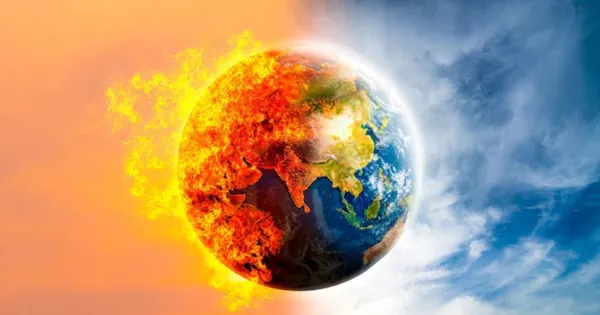

The devices that bring us solace from within are making the world outside even more scorching. We are paying a heavy price for this in the form of ‘global warming’.

Pankaj Chaturvedi, senior journalist
Now it has become a common thing to get heat before time and as the mercury starts rising, air conditioners i.e. ACs are started in the houses, offices and cars and buses of the middle and upper middle class of the country. What was considered the epitome of luxury decades ago has now become an essential part of the Indian lifestyle, but the irony is that the very devices that give us solace from within are making the world on the outside more scorching. Refrigerators and air conditioners have made the modern world comfortable, ensuring food security and enabling the storage of medicines, but we are paying a heavy price for these in the form of ‘global warming’.
Changing social perception and rise of middle class Recent surveys have demolished the old belief that AC is only the domain of the rich. Today, the penetration of AC has increased rapidly in a large middle and lower-middle income group of families in India. According to statistics, there are some 6.7 crore ACs in homes or offices in the country. Apart from this, ACs have now been installed in 5.5 crore cars and lakhs of buses and trucks. This is the government figure that every year 1.5 crore new ACs are being sold. This growing market is not only a sign of economic prosperity, but also a big warning from the environmental point of view.
Know that the AC does not ‘create cool’, rather it absorbs the heat inside your room and releases it into the outside environment. There is a ‘refrigerant’ gas inside the AC which absorbs the heat inside. Then the unit installed outside releases that heat into the outside air through a fan. If dozens of ACs are running in the same building or street, the local temperature of that area can increase by 1-2 degrees Celsius above normal. This is called the ‘urban heat island’ effect in cities.
Not only this, the gas (refrigerant) that circulates inside the AC is the biggest threat to the environment. Hazardous gases: Modern ACs often use gases like hydrofluorocarbons. These gases are 1,000 to 3,000 times more powerful at warming the atmosphere than carbon dioxide. ‘Global warming potential’ is a measure that tells how much heat a gas absorbs. The GWP of carbon dioxide is considered to be one. In comparison, the GWP of gases used in ACs is often between 1,000 and 2,000. This means that if one kg of gas leaks from your AC, it will provide the same amount of heat to the atmosphere as 2,000 kg of carbon dioxide.
A big crisis has arisen in India regarding the maintenance and quality of ACs. Technically an AC should require gas refilling only once in five years, but the reality in India is the opposite. Here about 40 percent of ACs are refilled every year. 80 percent of ACs older than five years demand gas every year and what is worrying is that one-third of new ACs (less than 5 years old) also require refilling. This unnecessary refilling is not only harmful for the environment but is also a huge hit on the common man’s pocket.
According to the data for the year 2024, India’s ACs consumed a total of 32 million kg of refrigerant. At an average rate of Rs 2,200 per refill, Indian households spent Rs 7,000 crore just on gas refills. If this leakage problem is not resolved, then by 2035 this bill will increase four times to Rs 27,500 crore. This money is directly coming out of public savings and is being wasted due to negligence which could have been prevented with better construction and service quality.
Car vs AC: When we talk about emissions, our attention often goes towards the vehicles running on the roads, but the pollution caused by air conditioners is no less than that. Including power consumption and gas leakage, total greenhouse gas emissions from India’s ACs reach 156 metric tons in 2024. How big this figure is can be estimated from the fact that it is almost equal to the total emissions from all passenger cars in India.
To put it simply, that wall-mounted AC in your house that’s asking for a gas refill every two years is causing as much damage to the environment in a year as a car. These emissions are estimated to increase to 329 metric tons by 2035, making the air conditioning sector the largest source of emissions in India. (These are the personal views of the author)

Comments are closed.