

Visa hurdles, security fears, high costs keep international fans away from 2026 World Cup in US

A stadium in Seattle, one of the host cities for the 2026 World Cup in the U.S. Photo by Seattle Sounders FC |
Steve Schwarzbach, a German fan, has attended every World Cup since 2006. He traveled to South Africa and Brazil, places often associated with security risks.
“I felt very safe because they had so many police, army and security that I didn’t have any fears of going out,” Schwarzbach told CNN.
However, he plans to skip the tournament in the U.S. this time. Despite owning $1,600 tickets for the quarterfinals and semifinals, he abandoned the trip due to the Immigration and Customs Enforcement (ICE) raids and social media checks. He also fears his mixed German-Korean heritage might trigger extra scrutiny.
Schwarzbach is not alone. A Dutch online petition demanding that the national team withdraw has 174,000 signatures. A Facebook boycott group has attracted over 25,800 members.
Former FIFA president Sepp Blatter and the leader of German club St. Pauli have also voiced support for boycotts.
The host’s strict immigration policies are a major hurdle for international fans this World Cup. U.S. visa interview wait times for people from countries like India and Colombia currently range from 400 to 700 days, making travel planning nearly impossible for fans without visa exemptions.
New security measures from the U.S., including demands for social media passwords and biometric data, are scaring fans away. Many people are concerned about privacy and potential legal problems upon entry.
Omar Hassan, a software developer in Montreal, Canada, is reselling his match tickets at Boston and New York. Previously, Hassan had planned to travel with his cousin from Tanzania, a country on the list of restricted entry points.
English fan Peter Holmes chose matches in Mexico over the U.S., citing a recent federal agent shooting in Minneapolis.
There were people who remained optimistic, like Arjun Modhwadiam, a Canadian of Tanzanian descent. He spent $1,300 for his ticket and has already booked his flight and hotel for Kansas.
Modhwadiam believes his Canadian passport and non-political online profile will ensure his entry, noting the U.S. relies heavily on the tournament’s revenue.
“I don’t think the U.S. government would be that stupid not to take care of the people coming over because it’s a big source of revenue as well,” he told CNN. “All the measures will be in place, so I’m not concerned.”
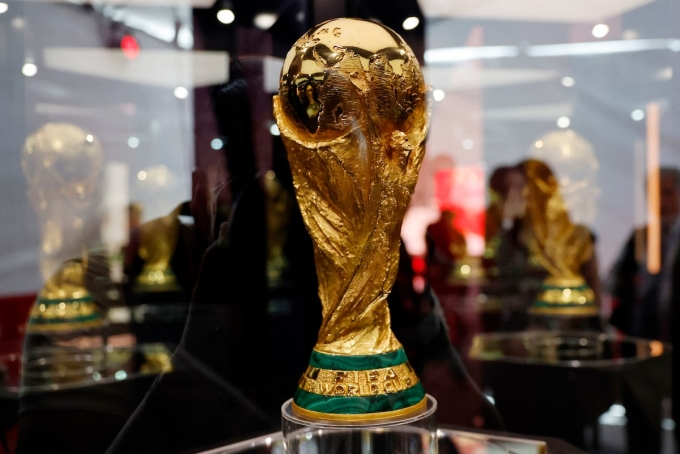 |
The FIFA World Cup trophy on display in Monterrey, Mexico on March 14, 2026. Photo by Reuters |
The U.S. Department of State and host cities say they are working to optimize the entry process, but international bookings continue to fall short of the host’s expectations.
While FIFA hopes to break the 1994 record of 3.5 million tickets sold, the hotel industry is worried.
Hotels in Dallas, Miami, and San Francisco are lowering rates to attract bookings. In Houston, June bookings are up 30%, but 85% of those are domestic travelers.
Travel costs add another massive barrier. Matches span the U.S., Canada, and Mexico, but the vast majority are in the U.S. The 5,000 km distance between cities like Seattle and Miami makes flying mandatory.
Experts estimate the U.S. needs a US$10 billion infrastructure upgrade to handle the 40 million expected visitors.
Skyrocketed match ticket prices are also a problem for fans. A lag in ticket sales for big matches, including USA vs Paraguay, is proof of the high price tag, Al Jazeera reported.
Prices for the U.S. opener against Paraguay on June 12 at Inglewood, California, were listed at $4,105, $2,735, $2,330 and $1,940, while seats for the Americans’ second match against Australia on June 19 at Seattle cost $2,715, according to AP.
FIFA put new blocks of tickets on sale last Wednesday on its direct tickets site. Available tickets for the final cost $10,990, for the July 14 semifinal in Arlington, Texas at $11,130, and for the July 15 semifinal in Atlanta at $9,660 and $4,360.
Comments are closed.