
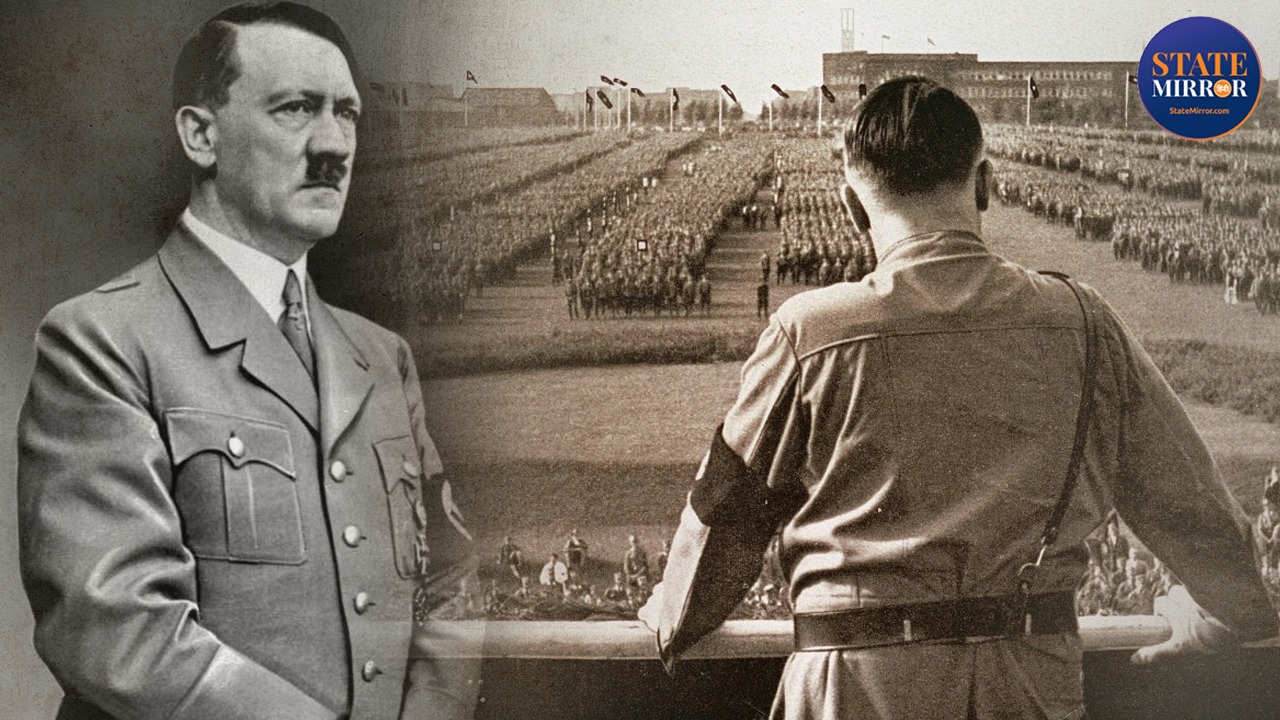
What happened when Hitler rejected, the history of the world changed: From failed artist to dictator and the last 10 days

Whenever the history of the 20th century is reviewed, one name comes up with the most controversy, fear and curiosity. That name is- Adolf Hitler. His story does not follow a straight line, but is made up of a complex combination of failures, radical ideas, political opportunity and circumstances. A person who once wanted to become an artist, later became one of the most dangerous dictators in the world.
This story is not just about the rise and fall of one person, but also about a period where economic crisis, political instability and social tension changed the course of history across the world, including Germany. Especially the last 10 days of his life – where the illusion of power, the reality of defeat and the end are visible together. Understand how the history of the world changed because of Hitler’s thinking.
1. Dream of becoming an artist and first failure
Young Adolf Hitler’s dream was to become a painter. He applied for admission to the Vienna Academy of Fine Arts in 1907 and 1908, but was rejected both times. The institute considered his artistic ability, especially the drawing of human figures, weak.
His failure to gain admission to the Vienna Academy of Fine Arts proved to be the first major turning point in his life. After this he started living amidst poverty and struggle in Vienna. During this time, extreme nationalism and anti-Semitism gradually started developing within him. This was the same time when the foundation of his ideas was laid, which later influenced the whole world badly.
2. Inclination towards war and fanaticism
World War I started in 1914, which gave a new direction to Hitler’s life. He joined the German army and had many experiences during the war, which hardened his thinking. When Germany lost the war and the Treaty of Versailles came into force, there was widespread discontent in the country. Hitler took this defeat as a personal and national humiliation. This was the period when the feeling of revenge and the desire for strong leadership deepened within him.
3. Entry into politics and access to power
After the war, Hitler joined the Nazi Party and attracted people’s attention with his passionate speeches. He blamed the Jews and the Versailles Treaty for Germany’s problems. In 1923, he attempted the Beer Hall Putsch to seize power, which failed. However, while in jail, he wrote Mein Kampf, in which his ideology was clearly revealed.
In the 1930s, economic recession and unemployment disappointed the public. Hitler took advantage of this environment and became Chancellor of Germany in 1933. After this, he gradually eliminated democratic institutions and established dictatorship.
4. Dictatorship, war and global catastrophe
After coming to power, Adolf Hitler adopted a policy of aggressive expansionism, which gave rise to World War II. This war brought the whole world to the brink of destruction.
During this time, a terrible tragedy like the Holocaust occurred, in which millions of Jews and people of other communities were murdered. The Holocaust was one of the most horrific and organized genocidal events of the 20th century. This genocide took place during the reign of Nazi Germany, when millions of people were systematically killed under Hitler and his ideology.
Hitler’s journey shows how economic crisis, weak democracy and fanatic ideology can together make a person a dictator. It is also often said that if he had got admission in art school, perhaps history would have been different. Although this is an imaginary thinking, it definitely makes us understand that even small decisions can bring big results.
5. What happened in the last 10 days of Hitler’s life?
- The Battle of Berlin had started in April 1945. The Soviet army was rapidly moving towards Berlin. The city was on the verge of destruction and the German army was weakened.
- Hitler was hiding in his Fuhrer bunker. There was a war going on outside, but inside he was still imagining victory. He had almost lost touch with reality.
- During this time, big leaders like Heinrich Himmler and Hermann Göring also kept their distance. Due to this Hitler became completely isolated.
- On April 29, 1945, Hitler married his companion Eva Braun. That very night he wrote his political will, in which he decided his future leadership.
- On April 30, 1945, as Soviet troops advanced, Adolf Hitler and Eva Braun committed suicide. With this the end of Nazi rule was decided.
- Germany surrendered just days after Hitler’s death, ending World War II in Europe.
In fact, the last 10 days of dictator Hitler are not just the story of the end of one person, but it is also a warning of the consequences of arrogance of power and wrong decisions. This is why the Battle of Berlin changed the course of history forever.

Comments are closed.