
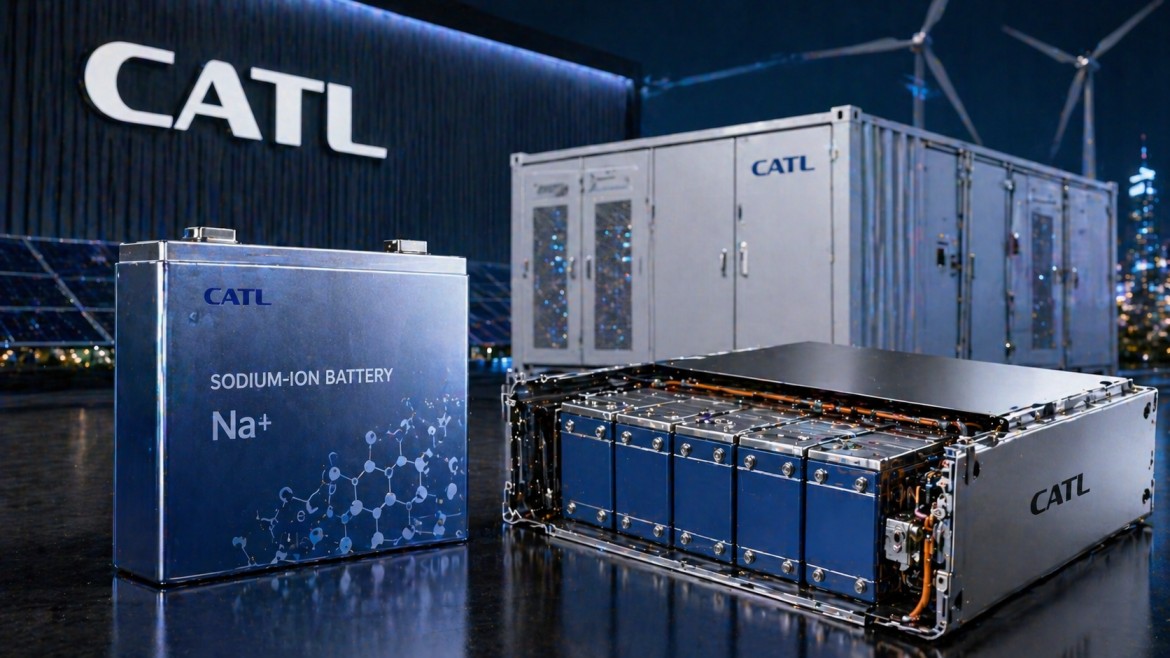

Battery breakthroughs are often announced in careful language, buried in technical papers and pilot projects. This one arrived with a number that is hard to ignore. A 60 gigawatt-hour order.
That is the scale of the deal signed by CATLthe world’s largest battery maker, with Beijing-based energy storage firm HyperStrong. The agreement, spread over three years, is the largest known commercial commitment for sodium-ion batteries to date. It is also being read as a signal that a technology long treated as an alternative is moving into wider use.
The numbers put the shift into perspective. The 60 GWh volume is roughly half of the total energy storage batteries CATL delivered in 2025. For a chemistry that until recently sat on the margins of commercial deployment, that scale changes the conversation. It suggests that sodium-ion is no longer confined to pilot projects or limited trials. It is being ordered in quantities that demand manufacturing at scale.
CATL has framed the agreement as proof that it has resolved the main barriers to production. Those barriers have been well known in the industry: lower energy density compared with lithium-ion, manufacturing issues linked to moisture sensitivity, and the challenge of maintaining stable performance across different conditions. The company says it has addressed these constraints, allowing it to move from development to delivery.
A chemistry built on cost and supply
Sodium-ion batteries differ from lithium-ion in one central way. They replace lithium with sodium as the charge carrier. That change carries a trade-off. Sodium is far more common and less expensive to source, but it typically delivers lower energy density. In practical terms, that means sodium-ion batteries store less energy for a given weight.
For electric vehicles, where range and weight matter, that limitation has kept sodium-ion on the sidelines. For stationary energy storage, the calculation is different. Weight is less important. Cost, lifespan, and stability take priority. That is where sodium-ion begins to make sense.
CATL’s current sodium-ion cell is a large-format design with capacity above 300 ampere-hours and an energy density around 160 watt-hours per kilogram. These figures place it below many lithium-ion variants but within a range that can support grid storage. The company also reports a cycle life exceeding 15,000 cycles while retaining 80 per cent capacity. That metric matters for projects that depend on long-term use rather than short bursts of power.
Temperature performance is another factor. Sodium-ion cells can operate across a wider range, from deep cold to high heat, without the same level of degradation seen in some lithium-based systems. For storage installations in varied climates, this flexibility can reduce the need for additional cooling or heating systems.
One design decision stands out. CATL has kept the physical dimensions of its sodium-ion cells consistent with its lithium-ion products. This allows the batteries to fit into existing manufacturing lines and storage systems without major changes. For companies building large storage projects, avoiding a full redesign reduces cost and time.
The appeal of sodium-ion rests on this combination. Lower raw material costs, longer cycle life, and compatibility with existing setups. None of these features alone would be enough to displace lithium-ion. Together, they create a case for use in specific applications, particularly where cost per cycle matters more than maximum energy density.
The scale of the agreement with HyperStrong suggests that at least one part of the market is ready to test that case in practice.
Competition, timing, and what comes next
CATL is not the only company working on sodium-ion technology. BYDone of its main rivals, has also developed sodium-ion batteries, with claims of long cycle life and improved performance at high temperatures. Smaller firms, including Natron Energy and Othersare pursuing similar approaches, often focusing on niche applications.
What sets CATL apart at this stage is scale. A 60 GWh order places it ahead of other manufacturers in terms of commercial deployment. It also reflects the company’s position in the broader battery market. With a large share of electric vehicle battery supply, CATL has the manufacturing base and supply chain links needed to expand into adjacent areas.
The timing of the deal matters as well. Lithium prices have shown periods of volatility in recent years, affecting the cost structure of lithium-ion batteries. Sodium, by contrast, is widely available and less subject to concentrated supply risks. This difference has drawn attention from companies looking to reduce exposure to raw material swings.
The comparison to a “DeepSeek moment,” made by some industry observers, reflects this line of thinking. The reference is to a shift in cost assumptions, where a new approach changes how a technology is priced and deployed. Whether sodium-ion will have that effect remains uncertain, but the scale of current orders suggests that companies are willing to test the idea.
CATL has also signalled plans to extend sodium-ion into electric vehicles. Its chief scientist has indicated that mass production for vehicles could begin by the end of 2026, with a target of reaching energy density levels comparable to lithium iron phosphate batteries within a few years. A prototype vehicle using sodium-ion cells has already been introduced by a Chinese automaker.
That direction adds another layer to the story. If sodium-ion can approach the performance of existing EV batteries while maintaining cost advantages, it could move from a niche role in storage to a broader presence. For now, however, the main focus remains on stationary use, where the trade-offs are more favourable.
The agreement with HyperStrong does not settle the question of how widely sodium-ion will be adopted. It does, however, mark a point where the technology moves from discussion to deployment at scale. Delivering 60 GWh of batteries over three years will test not only manufacturing capacity but also performance in real-world conditions.
Energy storage sits at the centre of a wider shift toward renewable power. Solar and wind generation depend on the ability to store energy for use when production is low. The cost and durability of storage systems shape how quickly those sources can be expanded. In that context, battery chemistry is not just a technical choice. It affects the economics of power systems.
Sodium-ion enters that picture as a possible way to lower costs for large installations. Whether it can do so consistently will depend on how these early large-scale deployments perform. The deal between CATL and HyperStrong provides one of the first opportunities to observe that performance outside controlled trials.

Comments are closed.