
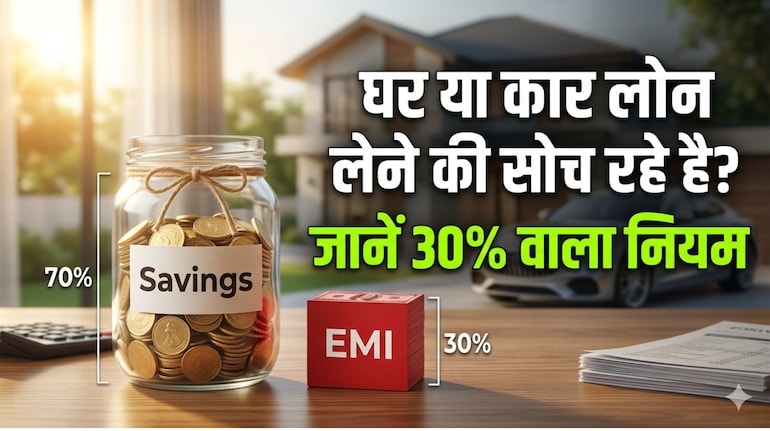
‘Golden Rule’ of personal finance: What percentage of salary should go towards EMI? Know this 30% rule before taking loan

Be it your own house or your own shining car, these dreams are in everyone’s eyes. In today’s times, banks also offer loans to fulfill these dreams in the blink of an eye. But have you ever thought that as easy as it is to take a loan, it can be equally challenging to repay it without stress? This is where the most famous of personal finance comes in handy. ’30 percent rule’. This rule not only tells you your loan eligibility, but also ensures that you do not have to spend sleepless nights while repaying the loan.
What is 30% EMI rule and how does it work?
If you understand in simple language, this rule says that the maximum of your total monthly income (In-hand Salary) 30 percent Only a portion should go towards all types of EMIs. For example, if your monthly income is ₹1 lakh, your home loan, car loan, personal loan and credit card dues combined should not exceed ₹30,000.
Although banks are ready to give a loan of 40 to 50 percent of your salary after seeing your profile and credit score, but financial experts believe that ‘affordability’ (ability to bear expenses) is always different from ‘eligibility’. The limit of 30% provides you a secure financial cushion.
Why is this limit necessary for budget and investment?
Monthly salary is not just for paying the installments. This includes household ration, children’s school fees, electricity bill, insurance premium and most importantly – investment for the future. When you limit your EMIs to 30%, you have a strong emergency fund Sufficient money is left to create and invest in mutual funds or other schemes. If the debt is within a limit, you do not have to worry about the budget at the end of the month or face mental stress.
What are the dangers of crossing Lakshman Rekha?
EMI of up to 40% may not seem heavy initially, but as time passes and inflation increases, problems may arise. If suddenly there is a medical emergency or there is a change in job, then you are left with very less ‘financial margin’. It is often seen that people burdened with heavy debt first stop their savings and investments, due to which their goal of long-term wealth creation remains unfulfilled. Excess debt also blocks your ability to take loans for new needs.
When can this limit be increased?
There are some exceptions to every rule. If you are in the early stages of your career and expect a good salary increase in the next few years, then this limit can be slightly increased for assets like home loan. Apart from this, if a person is unmarried and has less family responsibilities, he can take a little more risk. But as family and responsibilities increase, it makes sense to keep the EMI burden low.
Decide your own ‘comfort zone’
How much loan the bank will give is the decision of the bank; But how much you will be able to pay is your responsibility. Before taking a loan, definitely check these three categories:
20-30% (Safe Zone): You are completely financially secure and are also able to invest.
30-40% (Alert Zone): You need to keep a close eye on your expenses and plan better.
Above 40% (Risk Zone): This situation can be dangerous, unless your salary is very high and lifestyle expenses are very low.
Remember, taking a loan is not bad, but borrowing more than you can afford can destroy your financial freedom.

Comments are closed.