
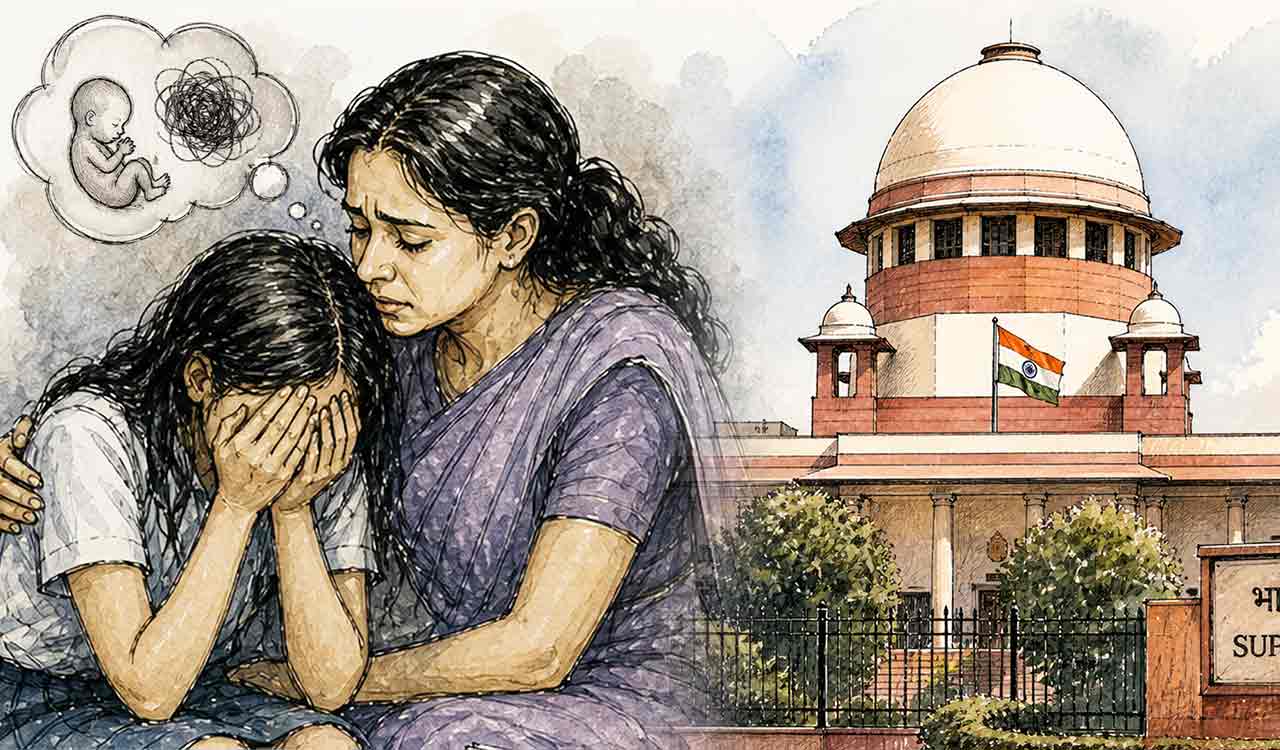

The apex court’s recent order reaffirms a principle often lost in legal and medical processes: reproductive choice rests with the individual, not with institutions acting on her behalf
Published Date – 4 May 2026, 12:41 AM
The trauma of rape survivors in India is often accentuated by insensitive legal system and toxic social practices. The plight becomes heart-wrenching when they get pregnant but cannot go for abortion because of legal restrictions. It is as if the entire system is ranged against these hapless rape victims. In this gloomy scenario, the Supreme Court’s recent order permitting the termination of a 30-week pregnancy of a 15-year-old rape survivor is a welcome development. It is an assertion of constitutional morality over procedural inflexibility. Importantly, the decision was backed by medical inputs, which flagged severe mental trauma, psychological impact of continuing the pregnancy and elevated medical risks associated with advanced gestation. At the same time, the court made it clear that while medical opinion informs the decision, it does not determine it. The final threshold remained constitutional — centred on dignity, autonomy and the right to life. Acting on medical assessments, the apex court held that forcing continuation would violate the survivor’s bodily autonomy and mental well-being. In doing so, it reaffirmed a principle often lost in legal and medical processes: reproductive choice rests with the individual, not with institutions acting on her behalf. At the heart of the issue is the framework of the Medical Termination of Pregnancy (MTP) Act, which prescribes gestational limits but allows exceptions where there is grave risk to physical or mental health. These exceptions are mediated through medical boards whose cautious interpretations can delay or deny access.
The apex court has rightly asked the central government to amend the abortion law to remove the time limit on medical termination of unwanted pregnancies in the case of minor rape victims. In such situations, it was not for the doctors or the State alone to choose what is best for rape survivors. The final decision should be left to the parents of the survivor and the survivor herself. A minor rape victim should not be compelled to carry and give birth to a child. Her victimisation cannot remain with her for the rest of her life as a permanent scar. There is a need to bring an amendment not only to the MTP Act, but also to the penal law, making it mandatory for speedy completion of trials in such cases. The 1971 MTP Act, which imposes a 20-week limit beyond which abortion is prohibited, is regressive and out of sync with 21st-century realities. This has, in fact, proved tragic in many cases. The Union Cabinet had, in February 2020, given its nod for amendments to the Act seeking to raise the permission limit from 20 weeks to 24 weeks. This was certainly a move in the right direction as it strengthens access to comprehensive abortion care without compromising service and quality of safe abortion. The increase in gestational age will ensure dignity, autonomy, confidentiality and justice for women.

Comments are closed.