
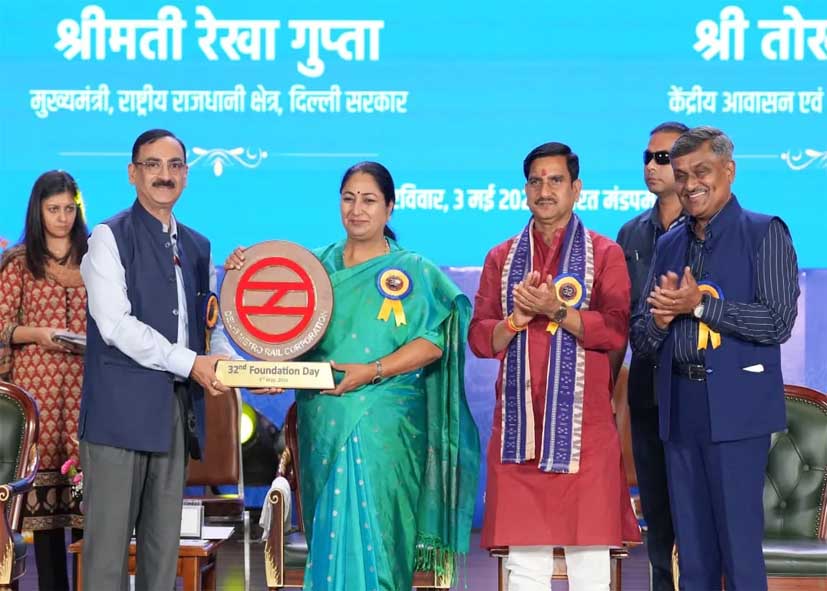
CM Rekha Gupta’s announcement on the 32nd foundation day of Delhi Metro, 7 new corridors will be built in Phase-V (B)

On the occasion of the 32nd foundation day of Delhi Metro Rail Corporation, Delhi Chief Minister Rekha Gupta made a big announcement regarding the public transport of the capital. On Sunday, he announced the development of new corridors under Phase-V (B) of Delhi Metro. According to the Chief Minister, a total of 7 new metro corridors will be built in this phase. The total length of these corridors will be 97.158 kilometers, which will improve connectivity in many areas of Delhi-NCR. Along with this, 65 new metro stations will also be built under the project. The total cost of the seven corridors proposed in this phase is estimated to be approximately Rs 48,204.56 crore. Delhi Chief Minister Rekha Gupta said that this ambitious project will connect those remote and rapidly developing areas of the capital with the metro network, where there is no adequate public transport facility.
Elevated corridor from Dhansa bus stand to Nangloi
Chief Minister Rekha Gupta said that Corridor-1 will be developed from Dhansa Bus Stand (Najafgarh) to Nangloi. This corridor will be 11.859 kilometers long and will be built in a completely elevated (above track) format. A total of 9 metro stations will be built on this route, all of which will be elevated. This new corridor will directly connect many important and rapidly developing areas of Delhi – Naresh Park Extension, Ranhaula, Bakkarwala, Baprola, Dichaun Kalan and Najafgarh Extension to the metro network, which will provide great relief to the people living in these areas. Apart from this, a major feature of this corridor is the interchange facility. Passengers will have the option to join the Green Line at Nangloi station and the Gray Line at Dhansa bus stand, which will make the journey even easier and faster.
Underground corridor from Central Secretariat to Kishangarh
According to Chief Minister Rekha Gupta, Corridor-2 will be developed from Central Secretariat to Kishangarh. This corridor will be a total of 15.969 kilometers long, most of which will be underground. Under the project, 13.721 km underground and 2.248 km elevated section will be prepared. A total of 10 metro stations will be built on this route, which will include 9 underground and 1 elevated station. This corridor will connect many important and sensitive areas, including GPRA colonies of New Moti Bagh, R.K. Puram Sector-1 and 7, Jawaharlal Nehru University and Prime Minister’s Museum are prominent. A major feature of this corridor is its multi-line interchange facility. Passengers can avail the services of Violet, Yellow and Magenta Line at Central Secretariat, Pink Line at Moti Bagh, R.K. Connectivity will be available through the Magenta Line at Puram and the proposed Golden Line at Kishangarh.
Samaypur Badli to Narela DDA Sports Complex
Chief Minister Rekha Gupta said that Corridor-3 will be developed from Samaypur Badli to Narela DDA Sports Complex. This corridor will actually be an extension of Line-2 (Yellow Line) and will be made completely elevated. Its total length will be 12.89 kilometers, in which 8 elevated stations will be built. This new metro route will directly connect many important areas of the northern part of Delhi, namely Siraspur, Kheda Kalan, Holambi Kalan, Alipore, Shahpur Garhi and DSIIDC Narela, with the metro network, which will provide better connectivity to millions of people in these areas. The specialty of Corridor-3 is also its interchange facility. Commuters will get connectivity with the Yellow Line at Siraspur and the Red Line at Narela DDA Sports Complex, which will make traveling to other parts of Delhi easier.
Underground and elevated corridor from Kirti Nagar to Palam
According to Chief Minister Rekha Gupta, Corridor-4 will be developed from Kirti Nagar to Palam. This corridor will be an extension of Line-5 (Pink Line) and will include both underground and elevated sections. Its total length will be 9.967 kilometers, of which 8.397 kilometers will be underground and 1.57 kilometers will be elevated. A total of 6 metro stations will be built on this route, which will include 5 underground and 1 elevated station. This corridor will connect many important areas of West Delhi like Saraswati Garden, Mayapuri Industrial Area-III, IITM Janakpuri and Sagarpur with the metro network. An important feature of Corridor-4 is its interchange facility. Passengers will get connectivity with Pink Line at Mayapuri and Magenta Line at Palam, which will make travel between different routes more convenient.
Underground and elevated corridor from Jor Bagh to Mithapur
According to Chief Minister Rekha Gupta, Corridor-5 will be developed from Jor Bagh to Mithapur. This will be an independent metro corridor, which will include both underground and elevated sections. Its total length will be 16.991 kilometers, of which 12.275 kilometers will be underground and 4.716 kilometers will be elevated. A total of 12 metro stations will be built on this route, which will include 7 underground and 5 elevated stations. This corridor will directly connect many important areas of South and South-East Delhi like Lodhi Colony, Old Ishwar Nagar, Ali Gaon, Jaitpur, Moldaband and Mithapur to the metro network. The biggest feature of this corridor is its multi-interchange facility, which will give the passengers easy access to many major lines like Yellow Line at Jor Bagh, Violet and Pink Line at Lajpat Nagar, Magenta Line at NSIC Okhla, Violet Line at Jasola Apollo, proposed Golden Line extension at Madanpur Khadar.
Shastri park From Peacock Vihar phase–III till Independent corridor
According to Chief Minister Rekha Gupta, Corridor-6 will be developed from Shastri Park to Mayur Vihar Phase-III. It will be an independent corridor, which will include both underground and elevated sections. Its total length will be 13.197 kilometers, of which 8.99 kilometers will be underground and 4.207 kilometers will be elevated. A total of 8 metro stations will be built on this route, which will include 3 underground and 5 elevated stations. This corridor will directly connect East Delhi and surrounding important areas like Mayur Vihar Phase-III, New Kondli, Mother Dairy (Patparganj), Geeta Colony, Gandhi Nagar Market and Kailash Nagar to the metro network. The key feature of this corridor is its interchange connectivity, which will give passengers easy access to multiple lines like Red Line at Shastri Park, Blue Line at Nirman Vihar, Pink Line at Trilokpuri.
Keshavpuram From Rohini Sector–34 till New corridor
Corridor-7 will be developed from Keshavpuram to Rohini Sector-34. This will be a new and completely elevated corridor, whose total length will be 16.285 kilometers. A total of 12 elevated stations will be built on this route. This corridor will connect many important areas of North-West Delhi – West Shalimar Bagh, East Pitampura, Rohini Sector-16, Delhi Technological University (DTU) and Rohini Sector-29 with the metro network, which will make commuting in these areas easier. The main feature of Corridor-7 is its interchange facility with Red Line at Keshavpuram, Pink Line at North Pitampura, Rohini Sector-34. Red Line.
According to the Chief Minister, four out of seven corridors will be developed rapidly on priority basis. The target has been set to complete these primary corridors by the year 2029. Whereas, the remaining three corridors will be developed later in a phased manner. The government has directed Delhi Metro Rail Corporation to prepare and submit revised detailed project reports (DPRs) separately for priority corridors and other corridors, so that the work can be expedited and brought clarity. The Chief Minister said that with the completion of this big expansion project, Metro’s reach to every part of Delhi will be strengthened, travel time will be reduced and citizens will get safe, convenient and environment-friendly transportation.
Follow the LALLURAM.COM MP channel on WhatsApp

Comments are closed.