

According to the 2026 rankings by Times Higher Education and QS World University Rankings, Tsinghua ranks 12th and 17th worldwide, respectively.
In the THE Asia University Rankings 2026 released last month, it retained first place, as Chinese universities dominated the regional table. QS ranked it ninth in the region.
Tsinghua is the only Asian institution to rank in the global top 10 for Physical Sciences, often categorized under Natural Sciences, in the 2026 THE subject rankings, placing it on par with leading U.S. universities.
The university’s strength is most evident in its research performance. In 2025, it retained the top spot in CSRankings, a metrics-based ranking of computer science institutions based on faculty publications at selective conferences. It surpassed major U.S. institutions such as Carnegie Mellon University and Stanford University in top-tier output in artificial intelligence and computer systems.
Tsinghua also leads U.S. News & World Report rankings across key disciplines, including Engineering, Materials Science, and Chemistry.
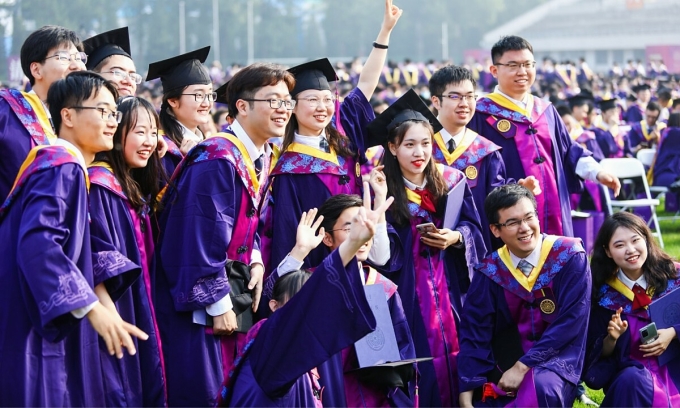
Graduating students from Tsinghua University during a commencement ceremony. Photo from the university’s website |
Founded in 1911, Tsinghua initially served as a preparatory school for Chinese students planning to study in the United States, introducing a four-year undergraduate program in 1925.
Following the founding of the People’s Republic of China in 1949, a nationwide restructuring of higher education began. By 1952, Tsinghua had become a multidisciplinary polytechnic university focused on engineering training, according to its website.
During China’s higher education reforms in the 1980s, Tsinghua consolidated its position as one of the country’s leading universities. It is a member of the elite C9 League, often described as China’s “Ivy League,” alongside Peking University.
Both institutions received substantial state support through national initiatives such as Project 211, Project 985, and the Double First Class program, which combined funding and policy backing to elevate academic quality, attract global talent, and strengthen international collaboration.
Admission to Tsinghua is intensely competitive. With an acceptance rate of around 0.1%, applicants typically need to score between 680 and over 710 out of 750 on the national college entrance examination, the Gaokao.
A key pillar of Tsinghua’s strength lies in its graduate-focused structure. Of its roughly 63,000 students, only about 16,500 are undergraduates, while the majority are master’s and doctoral candidates, more than 21,700 and 24,800 respectively, along with over 3,400 postdoctoral researchers, according to official data as of last December.
The university has also educated many of China’s top leaders, including President Xi Jinping, an alumnus of chemical engineering.
Its academic staff numbers more than 17,000, including 56 members of the Chinese Academy of Sciences and 36 from the Chinese Academy of Engineering.
National science and technology programs and special funding schemes form Tsinghua’s primary financial backbone. In 2024 alone, the university secured more than 2 billion yuan (US$290 million) in research funding. It is also among a select group of Chinese universities with annual budgets exceeding US$5 billion on a purchasing power parity basis, according to a 2019 report by the Center for Security and Emerging Technology.
In 2025, Tsinghua published more than 3,000 papers in leading journals, ranking seventh globally, according to the Nature Index.
In the QS rankings, Tsinghua scores near-perfect marks (above 99/100) in academic reputation, research citations, and employer reputation.
The university has established partnerships with more than 290 institutions across 50 countries, reinforcing its status as a global knowledge hub linking China with the world’s academic elite.
Beyond academics, Tsinghua is also known for its sprawling 483-hectare campus in Beijing. Built on the former imperial gardens of the Qing Dynasty, it blends traditional Chinese architectural heritage with modern Western-style facilities. Artificial lakes filled with lotus flowers sit alongside cutting-edge laboratories, creating an environment that is both tranquil and intellectually rigorous.
In 2010, Forbes named it one of the most beautiful university campuses in the world.
Tuition fees for international undergraduate students typically stand at around 30,000 yuan per year, with medical programs costing up to 70,000 yuan.
Comments are closed.