

Peter Thiel has led a $140 million investment in Panthalassa, a young company that wants to move data centres out to sea. The idea is simple to state but hard to build: place large, floating compute units in the ocean, power them with waves, and use seawater to keep them cool.
Panthalassa is based in Oregon in the United States. This new funding round values the company close to $1 billion. That puts it among a small group of early-stage firms trying to rethink how and where AI infrastructure runs.
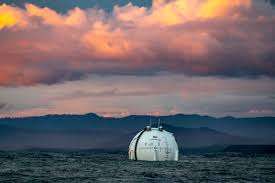
At the core of Panthalassa’s plan are large floating nodes. Each unit is about 85 meters wide and made of steel. The company describes them as “orbs,” though they act more like compact data centres. These structures sit in the open ocean and rise and fall with the waves.
Instead of drawing power from the grid, each node generates its own energy. It converts wave and tidal motion into electricity. This energy runs onboard AI chips and systems. If the system produces extra power, it can store it or redirect it within the unit.
Cooling is another key part of the design. Traditional data centres use large cooling systems that consume a lot of power and water. Panthalassa skips this by using the ocean itself. Seawater flows around the structure and removes heat from the compute hardware. This reduces the need for heavy cooling equipment.
The nodes also move, but not in the usual way. They do not rely on engines. Instead, their shape allows them to steer with currents and wave motion. This lets them drift to remote areas of the ocean. By doing so, they avoid busy shipping lanes and reduce the risk of interference with coastal zones.
Taking AI to the High Seas for Sustainable Computing
For connectivity, the system depends on satellites. Data is sent back to land using Starlink, which is operated by SpaceX. This link allows the nodes to support remote workloads, including AI inference and other compute-heavy tasks that do not need constant low-latency connections.
Panthalassa is not aiming to replace all data centres. Instead, it targets a specific problem: the growing energy demand of AI systems. Training and running large models require vast amounts of power. Many land-based facilities struggle to scale due to grid limits, land costs, and cooling needs.
By moving offshore, Panthalassa tries to ease these limits. The ocean offers space, natural cooling, and a steady source of kinetic energy. In theory, this setup can lower both operating costs and carbon emissions.
The new funding will help the company move from concept to deployment. Panthalassa plans to complete a pilot factory near Portland, Oregon. This facility will build the first set of floating nodes. After that, the company aims to place early units in the Pacific Ocean for testing.
These sea trials will check how the systems perform in real conditions. Engineers will study durability, energy output, and data reliability. If results meet expectations, Panthalassa plans a commercial rollout in 2027.
The idea fits into a wider trend in computing. As demand for AI grows, companies are exploring new environments for data centres. Some look to deserts for solar power. Others consider underground or even space-based systems. Panthalassa’s approach sits between these extremes, using the ocean as a middle ground.
The Thiel Vision: Panthalassa and the Future of Ocean-Scale AI
There are clear challenges. The open sea is harsh. Saltwater can damage materials. Storms can stress structures. Maintenance is harder than on land. Each node must operate with a high level of autonomy.
There are also legal and environmental questions. Operating in international waters may reduce some national rules, but it does not remove oversight. Maritime law still applies. Governments and global bodies may set limits on where and how such systems can run.
Environmental impact is another concern. Large floating structures could affect marine life. The company will need to show that its systems do not harm ecosystems over time.
Security is also a factor. Data centres at sea may face new risks, from physical access to signal interception. Strong safeguards will be essential.
Despite these hurdles, the concept has appeal. It offers a way to scale compute without adding pressure to land-based grids. It also aligns with efforts to reduce the carbon footprint of AI.
For Peter Thiel, the investment reflects a long-standing interest in bold infrastructure ideas. Panthalassa now has the capital to test whether ocean-based computing can move from vision to reality. The next few years will show if the ocean can become a new home for AI-scale systems.

Comments are closed.