
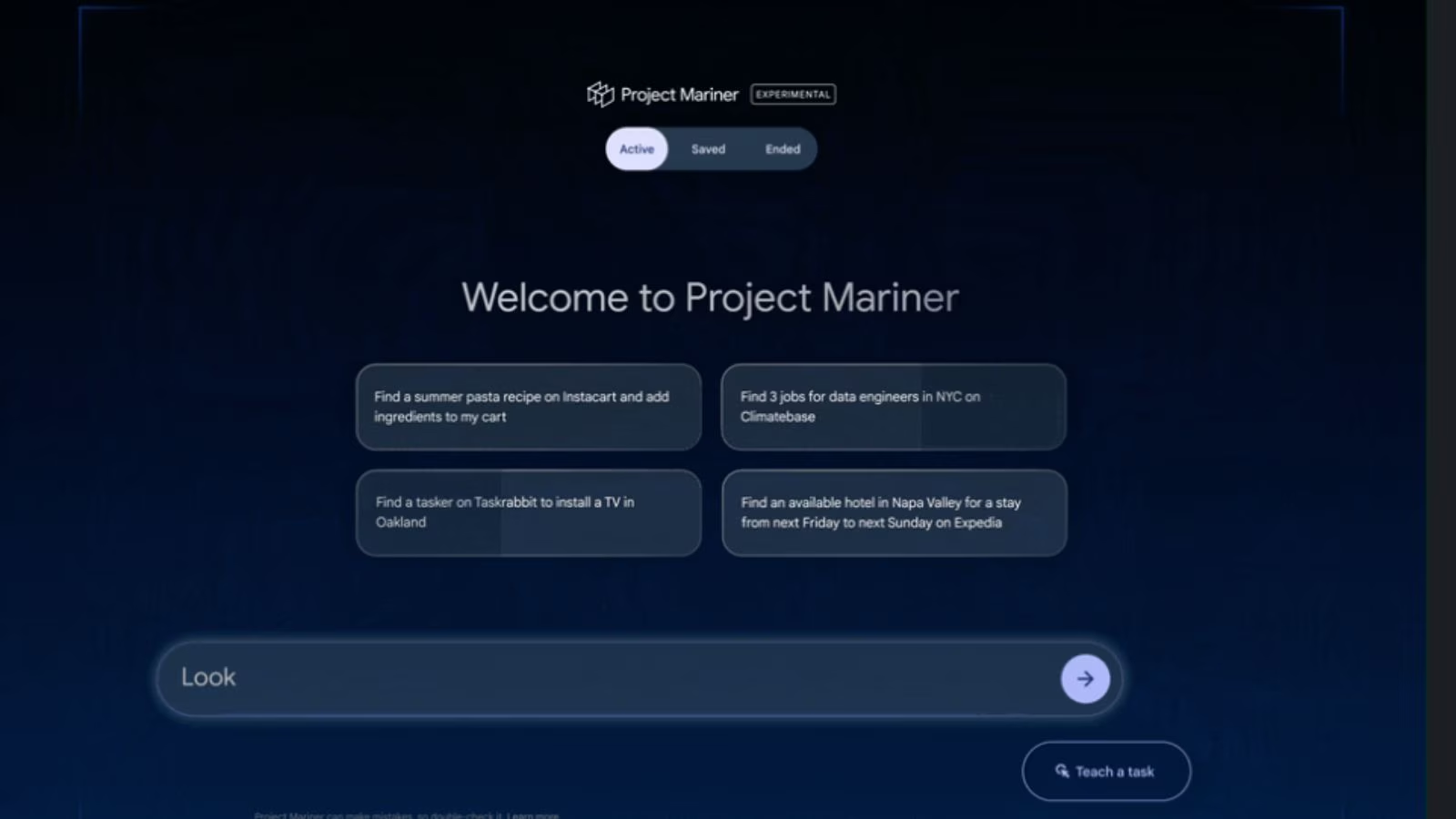

Google has reportedly shuttered Project Mariner, its experimental research project to build a web-browsing AI agent that was first announced at the search giant’s I/O developer conference in 2025.
It was shut down on May 4, 2026, and its technology “voyaged” to other Google products, as per screenshots of the landing page of Project Mariner posted by users on X. It comes nearly two months after Google moved researchers working on the research prototype to higher-priority projects, according to a report by Wired.
The move is said to be Google’s response to the surging popularity of OpenClaw-style AI agents. It also highlights the AI industry’s broader shift away from AI browser agents toward more capable agentic AI tools such as Claude Code and OpenClaw.
While most of these agents are currently used mostly by developers, tech industry leaders believe that they could be more effective in powering general-purpose AI assistants that carry out tasks autonomously on behalf of individual users and businesses.
Project Mariner, Google’s web browser agent, was shutdown 2 days ago.
People on the project have been moved, and the tech is being used elsewhere.
Gemini Agent is coming out of Labs (US only) soon? pic.twitter.com/NwHLQ4ReOn
— Kol Tregaskes (@koltregaskes) May 6, 2026
Note, Google has said that the computer use capabilities developed under Project Mariner will be incorporated into the company’s agent strategy moving forward. Other capabilities have already been folded into agent products such as the recently launched Gemini Agent, a Google spokesperson was cited as saying in the report.
What is Project Mariner?
Project Mariner was an AI agent that could navigate the Chrome browser and complete tasks on a user’s behalf like research, planning, and data entry. It was highlighted by Google CEO Sundar Pichai in his keynote address during last year’s I/O conference. At the time, it seemed like AI browser agents were the industry’s next bet. Both OpenAI and Perplexity launched their own versions of AI browser agents capable of automating online tasks for users such as clicking, scrolling, and filling out forms on a webpage.
However, the adoption of AI browsing agents has struggled to meet the industry’s expectations. One of the reasons why these types of AI agents have failed to take off is because of their massive computational requirements.
AI browser agents and computer-use agents work by taking a series of screenshots of a webpage, feeding that into an AI model, and taking actions based on what they see. Processing such a large volume of information can take time and may not always lead to accurate actions.
Story continues below this ad
OpenClaw-style agents are different because, unlike AI browser agentsthese systems control computers through the command-line, which has proven to be a more reliable way to complete tasks. Since the debut of Project Mariner last year, the momentum in the AI industry has shifted dramatically toward agents like Claude Code and OpenClaw (whose creator was recently hired by OpenAI).
AI coding agents are also emerging as a more efficient tool as they have been found to be capable of handling tasks beyond coding, such as using other applications, modifying files, and creating bespoke software. Note, the stellar debut of OpenClaw sparked concerns among cybersecurity experts who have warned repeatedly that the open-source agentic AI framework poses a combination of risks related to autonomy and deep system access, which could lead to prompt injection attacks, malicious plugins, data leaks, and supply-chain attacks.
What other companies are doing?
Similar to Google, several other tech giants have shifted focus to developing computer use agents and AI coding agents. OpenAI has said that they would like their Codex AI coding agent to power general-purpose agents inside of ChatGPT.
Anthropic, on the other hand, has its own version of OpenClaw called Claude Cowork. It is a spin-off of Claude Code which does not require users to open up a terminal. Even Perplexity, which had bet heavily on browsing agents as the next frontier, has launched a similar product called Personal Computer.
Story continues below this ad
Meta is also jumping on this bandwagon and reportedly developing an OpenClaw-inspired, personalised AI agent codenamed ‘Hatch’ that will be powered by its Muse Spark AI model launched last month.

Comments are closed.